What Causes an Oven Not to Heat Up? Troubleshooting Guide
Urgent troubleshooting guide to diagnose and fix why your oven won't heat. Step-by-step checks, safety tips, and when to call a pro from Oven Cook Pro.


Most ovens fail to heat due to a faulty bake/broil element, blown thermal fuse, defective igniter (gas ovens), faulty temperature sensor, or power issues. Start by confirming power, resetting the circuit breaker, and inspecting heating elements for burns or disconnections. If the issue persists, a professional technician should diagnose and replace defective parts.
Common reasons an oven won’t heat up
Ovens fail to heat for several reasons, ranging from simple power issues to worn-out heating elements. According to Oven Cook Pro, the most frequent culprits are power supply problems and heating-element or igniter failures. Understanding these causes helps you prioritize checks and avoid unnecessary disassembly. This guide focuses on safe, practical steps you can take as a homeowner to identify and address the problem quickly. It also answers the question of what causes oven not to heat up with a structured approach you can trust.
- Power supply issues (outlets, cords, circuit breakers)
- Damaged or worn heating elements (bake or broil)
- Gas ignition problems (igniter or gas valve)
- Faulty temperature sensor or thermostat
- Control board or wiring faults
- Door switch or safety interlocks
- Safety devices like thermal fuses blown from a surge
According to Oven Cook Pro analysis, the most common failures are power-related faults and heating-element or igniter problems, not mysterious faults inside the oven cabinet. Knowing the usual suspects helps you triage safely and quickly.
Safety-first: power, breakers, and accessible components
Safety always comes first when troubleshooting an oven. Before you touch any components, unplug the unit if accessible and power off at the wall if you can safely reach the outlet. Check the power cord for damage and examine the outlet for signs of scorching or looseness. If the circuit trips, reset the breaker and test again. If it trips repeatedly, you likely have an underlying electrical fault that requires a licensed technician. These checks are quick, low-cost, and protect you from electric shock. Remember: never bypass safety devices or operate a malfunctioning appliance.
- Unplug the oven (or switch off at the outlet) before inspecting.
- Check the circuit breaker for trips and avoid overloading circuits.
- Inspect the power cord and outlet for damage or burning signs.
- If you smell gas or hear unusual noises, stop and call a professional.
Once power is verified, proceed with component checks. If power is present but heat still won’t develop, the issue likely lies with the heating elements, igniter, or sensors.
Electrical issues, fuses, and control boards
Electrical issues are a frequent cause of an oven failing to heat. A tripped breaker or a blown thermal fuse can prevent heat from generating at all. In some models, a faulty control board or wiring harness can prevent the oven from entering cook mode. If reset doesn’t restore heat, you may need to test continuity through the bake and broil elements, check the thermal fuse, and inspect related relays or connectors. If you see no visible damage but the problem persists, it’s a sign to call a pro for diagnostic testing with proper equipment. Never attempt high-voltage tests without training.
- Check for tripped breakers and reset if safe to do so.
- Inspect thermal fuse for continuity if you have the model access and proper tools.
- Look for loose or burnt wiring at terminal blocks.
- If onboard diagnostics point to a control board, professional service is advised.
Heating elements and ignition indicators
Electric ovens rely on baked and broil elements to produce heat. Gas ovens depend on an igniter to light the gas flow.
- Visually inspect for obvious damage: melted insulation, blistered coatings, or broken coils.
- In electric models, a nonfunctional bake element means no heat; a broken broil element often affects top heat only.
- In gas models, a weak or absent igniter glow signals ignition failure, which prevents heat generation.
- If you notice scorching or unusual hums, stop and replace the damaged part. For many ovens, visible damage means the part must be replaced rather than repaired.
If you cannot see obvious damage, you may still have a failed ceramic insulator, loose connection, or a broken heating coil that requires meter testing or professional replacement.
Temperature sensor, thermostat, and control board considerations
The oven’s temperature sensor and thermostat tell the control system when to heat and when to stop. A faulty sensor can cause underheating, overtemperature, or no heat at all if the controller never reaches the set point. Some ovens use a control board that can fail after surges or wear. Calibrating sensors or replacing the sensor/board often resolves persistent heating issues. If the model has self-diagnostic codes, use them to guide replacement decisions and confirm compatibility with the oven’s warranty terms.
- A bad sensor can misread temperature and halt heating.
- A malfunctioning thermostat or control board can prevent heat or cause inaccurate temps.
- Calibration offsets may fix mild discrepancies in some models.
- If codes appear, consult the user manual or service sheet for error definitions.
Diagnostic approach: symptoms → likely cause → fixes
A structured diagnostic mindset makes a complex issue manageable. Start with symptoms: the oven never heats, heats too slowly, or heats inconsistently. Map symptoms to likely causes: power/safety first, then heating elements or igniter, then sensors/board. Move to fixes in order of likelihood and safety: power checks, element tests, thermal fuse replacement, sensor or board replacement as needed. If you cannot verify components safely, stop and call a pro. This approach aligns with Oven Cook Pro’s recommended process for diagnosing heating problems.
- Symptom: no heat; Likely cause: power or fuse.
- Symptom: partial heat or delays; Likely cause: element or sensor.
- Symptom: inconsistent temps; Likely cause: sensor or board.
- Fix: start with power check, then element inspection, followed by advanced diagnostics.
When to call a professional and warranty considerations
Some oven issues require specialized tools and expertise. If you’re seeing no power, repeated breaker trips, gas ignition failure, or you detect burnt wiring, stop diagnosing and contact a licensed technician. If the unit is under warranty, contact the manufacturer or authorized service to avoid voiding coverage. A pro can safely perform resistance testing, capacitor checks, and board diagnostics without risking your safety. Prioritize safety and avoid DIY fixes that could damage the appliance or pose a shock hazard.
- Use manufacturer service if under warranty.
- Do not bypass safety components or perform high-voltage testing.
- Seek professional service for gas ignition, control boards, and thermal fuses.
- Keep service records for future maintenance and resale value.
Prevention: routine maintenance to keep heat on point
Preventive care minimizes future heating problems. Schedule periodic inspections of heating elements, igniters, and sensors. Clean the interior and inspect grommets and seals to ensure heat retention. Replace worn wires or connectors based on the manufacturer’s maintenance schedule. Regular calibration checks for thermostats help maintain accurate temperatures. With proactive care, your oven stays reliable and safe.
- Inspect and replace damaged heating elements or igniters.
- Clean the interior and seals to reduce heat loss.
- Calibrate thermostat or sensor when recommended by the manufacturer.
- Keep a maintenance log to avoid missing service windows.
Steps
Estimated time: 60-90 minutes
- 1
Power verification and safety reset
Confirm the oven is unplugged or powered off at the switch. Check the outlet and circuit breaker to ensure power is available. If the breaker has tripped, reset it and unplug any daisy-chained appliances to prevent future trips.
Tip: If you’re uncertain about electrical work, skip to professional help to avoid shocks. - 2
Inspect heating elements or ignition indicators
For electric ovens, look for visible damage on bake and broil elements. For gas ovens, check the igniter glow. If you see damage or the glow is weak or absent, plan to replace the faulty part.
Tip: Handle elements with insulated gloves; they can stay hot for a while after use. - 3
Test for continuity and resistance
If you have a multimeter, test the heating elements and igniter for continuity. A lack of continuity indicates a failed component that needs replacement. Do not rely on visual inspection alone.
Tip: Refer to your manual for the correct testing procedures and safety precautions. - 4
Check the thermal fuse and wiring
A blown thermal fuse prevents heat from forming. Inspect wiring at the terminal blocks for burns or looseness. If the fuse is blown, replacement is required and should be performed by a qualified technician.
Tip: Thermal fuses are safety devices; do not bypass them. - 5
Assess the temperature sensor and calibration
If the sensor reads incorrectly, your oven may never reach temperature. Replace the sensor if tests show incorrect resistance or response; recalibration may be possible on some models.
Tip: Accurate sensor data is essential for proper cooking temperatures. - 6
Evaluate the control board/thermostat
A faulty control board can prevent heating commands from being issued. Look for error codes or non-responsive controls. Replacement should be done by a technician with model-specific knowledge.
Tip: Keep model number handy for parts compatibility. - 7
Reassemble, test bake at a known temperature
Reconnect any panels and power the oven. Run a test bake at a common temperature (e.g., 350°F) and verify heat development and stability. Monitor the display and listen for normal cycling.
Tip: Avoid sudden changes in temperature during a test bake. - 8
Final safety check and professional follow-up
If heat still won’t develop after these steps, stop and call a licensed technician. Document any error codes or symptoms for the visit.
Tip: Having notes helps the technician diagnose faster.
Diagnosis: Oven won't heat up to the set temperature
Possible Causes
- highPower supply issue (outlet, cord, or circuit)
- highTripped breaker or faulty circuit
- highBlown thermal fuse (electric) or gas ignition issues
- mediumFaulty bake/broil heating element
- mediumFaulty ignition (gas ovens)
- lowDefective temperature sensor
- lowControl board/thermostat failure
Fixes
- easyCheck outlet with a multimeter or plug in a known-working appliance to verify power
- easyReset the circuit breaker and test again; if it trips, stop and call a pro
- mediumVisually inspect bake/broil elements or igniters for damage and replace if necessary
- hardTest element/igniter continuity with a multimeter or perform a service diagnostic
- hardReplace temperature sensor or control board after diagnosis
Questions & Answers
What is the first thing I should check if my oven won't heat?
Begin with power: verify the oven is plugged in, the outlet has power, and the circuit breaker hasn’t tripped. If power is present but heat still won’t develop, proceed with element and sensor checks.
First, check that the oven is powered and the circuit isn’t tripped. If power is fine but the oven won’t heat, move on to element and sensor checks.
How do I test an electric bake element for continuity?
Turn off power and access the bake element. Use a multimeter to measure continuity across the element’s terminals. If there’s no continuity, replace the element.
Use a multimeter to test continuity across the bake element’s terminals; replace it if there’s no continuity.
Can a faulty temperature sensor cause the oven not to heat?
Yes. A defective temperature sensor can misread the oven temperature, preventing heat from reaching the set point. Replacing the sensor often resolves the issue.
A bad temperature sensor can stop the oven from heating correctly; replacing it usually fixes the problem.
Is it safe to replace a heating element myself?
If you’re comfortable with basic electrical work and the unit is unplugged, you can replace a heating element with model-specific parts. If you’re unsure, hire a pro to avoid shock or further damage.
You can replace a heating element if you know what you’re doing and the unit is unplugged; otherwise, get a pro.
What if my gas oven won’t ignite?
A weak or absent igniter glow usually points to a faulty igniter or gas valve. If you smell gas, evacuate and call the gas company or a professional immediately.
If your gas oven won’t ignite, it’s usually the igniter or gas valve; don’t delay calling a pro if you smell gas.
When should I replace the control board?
If diagnostics point to a failed control board or persistent communication errors, replacement is often needed. Check compatibility with your oven’s model and warranty terms.
If the control board is faulty, replacement is typically required and may be covered by warranty.
Watch Video
Main Points
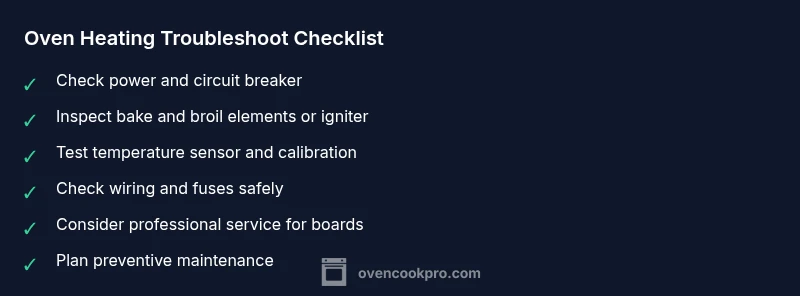
- Check power first and reset breakers.
- Inspect heating elements and igniters for damage.
- Test sensors and control boards when heat is inconsistent.
- Call a pro for hard repairs or warranted units.
- Regular maintenance reduces future heating failures.