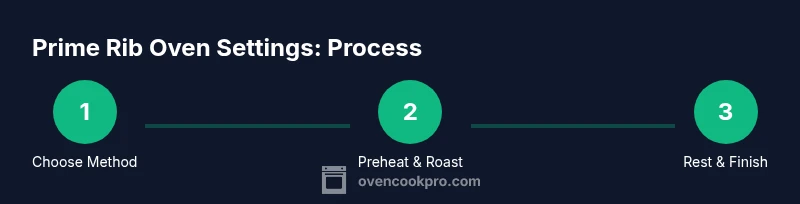
What oven setting for prime rib: A step-by-step guide
Learn the best oven settings for prime rib, including convection vs conventional, temperatures, timings, and resting for a juicy roast every time.


You will learn how to pick the right oven setting for prime rib to achieve a crusty exterior and juicy center. This guide covers convection vs conventional heat, the reverse-sear method, precise doneness targets, and resting techniques to maximize tenderness.
Choosing the Right Oven Setting for Prime Rib
Selecting the correct oven setting is the first crucial step in achieving a perfectly cooked prime rib. The oven setting determines how heat is delivered to the roast, influencing crust formation, internal doneness, and moisture retention. For most home cooks, the goal is a crisp, deeply browned crust with a uniformly rosy center. In this section we explore practical options and explain why the question what oven setting for prime rib matters. According to Oven Cook Pro Analysis, 2026, a controlled combination of initial browning followed by steady, lower heat helps build flavor while minimizing overbrowning. You’ll find that you can tailor your approach to your oven’s quirks, roast size, and preferred doneness, all while maintaining reliability and consistency.
Convection vs Conventional: Which Is Best for Prime Rib?
Many home ovens offer convection (fan-assisted) and conventional (static) heating. Convection speeds browning and can promote even crust development, but it can also dry exposed surfaces faster if not monitored. For prime rib, convection is often beneficial when you want a faster crust without compromising the center. A common approach is to start with a brief high-heat sear, then switch to a lower, even convection setting to finish the roast. If your oven runs hot or you crave a gentler roast, traditional conventional heat at a stable high temperature can also yield excellent results. The key is to know your oven’s behavior and to use a reliable meat thermometer to guide doneness.
The Reverse-Sear Method: A Modern Approach
The reverse-sear method trades traditional high-heat roasting for a low-and-slow start that gently brings the roast to temperature, followed by a brief high-heat finish for a crusty exterior. This method reduces the risk of an undercooked center and allows for a more predictable crust. In practice, you set the oven to a low temperature (often around 250–275°F) and roast until the internal temperature is near target, then finish with a high-heat blast (450–500°F) for 5–15 minutes to develop color. This technique works well with larger roasts and is favored by many professional homes, even when the oven’s performance varies.
Temperature, Time, and Doneness Guidelines
Doneness targets guide the timing, but temperature is the reliable marker. Typical doneness levels include: Rare (120–125°F), Medium Rare (130–135°F), Medium (140–145°F), and Well Done (150°F+). Plan to monitor internal temperature with a digital meat thermometer and remove the roast from the oven when it’s about 5–10°F below the final target, allowing carryover cooking during resting. For many roasts, starting at a high heat for 15–20 minutes to form a crust, then reducing to a steady 275–325°F for the remainder, balances crust and tenderness. Adjust times based on roast size, starting temperature, and whether you’re using convection.
Resting and Finishing Touches for Juicy Prime Rib
Resting is the unsung hero of juicy prime rib. After removing the roast from the oven, tent loosely with foil and let it rest for 20–30 minutes. This pause allows juices to redistribute, resulting in a more evenly colored slice. If you prefer an extra crust, you can finish with a quick, high-heat sear in a blazing hot skillet for 1–2 minutes per side or under a broiler for a brief blast. Throughout resting, avoid cutting or resting in the oven to prevent continued carryover cooking from yielding an overly firm center.
Troubleshooting Common Pitfalls
Even with the right setting, mistakes happen. Common issues include an underdone center, an overly dark crust, and uneven doneness. Solutions include using a thermometer consistently, minimizing oven door openings, letting meat come to room temperature before roasting, and adjusting for your specific oven’s hot spots. Remember that doneness can vary with roast size and shape, so use the thermometer as your oracle rather than clock-watching alone.
Tools & Materials
- Prime rib roast (3–6 pounds, bone-in or boneless)(Select a roast with even thickness for uniform cooking)
- Meat thermometer (instant-read preferred)(Probe or leave-in thermometer for continuous monitoring)
- Oven-safe roasting pan with rack(Rack allows air flow around the meat for even browning)
- Aluminum foil(Tent the roast during resting to retain heat without steaming)
- Sharp carving knife(For clean slices after resting)
- Oven mitts(Safe handling of hot pans)
- Optional: cast-iron skillet or heavy pan(For finishing sear if you want extra crust)
Steps
Estimated time: 2.5–4 hours
- 1
Decide on your method
Choose between a traditional high-heat roast or the reverse-sear approach. The decision will guide your preheating temperature, bake time, and whether you’ll finish with a crust. A clear plan helps you manage doneness precisely and reduces guesswork.
Tip: Write down your target doneness first, then pick a method that reliably reaches it. - 2
Prepare the roast and bring to room temperature
Pat roast dry with paper towels, trim excess fat if needed, and let it sit at room temperature for 60–90 minutes. This step leads to more even cooking and a better crust.
Tip: Season generously with salt and optional garlic/ herbs at this stage. - 3
Preheat the oven to your chosen setting
If using a high-heat start, preheat to 450–500°F. For reverse-sear, preheat to 250–275°F. Preheating ensures a predictable crust and consistent roast inside.
Tip: Avoid opening the door while preheating to preserve oven temperature. - 4
Roast with thermometer-guided timing
Place the roast on the rack in the pan. Insert thermometer into the thickest part without touching bone. Roast until the internal temp approaches target by method used, then switch to finish temperature if needed.
Tip: Always rely on the thermometer, not time alone, to dial in doneness. - 5
Rest the roast and finish the crust
Remove from oven 5–10°F below target; tent with foil for 20–30 minutes. If you want extra crust, sear briefly in a hot pan or under a broiler for 1–2 minutes per side.
Tip: Resting is essential—juices redistribute for juicy slices. - 6
Carve and serve
Carve across the grain in thick slices to maximize tenderness. Serve with pan juices or a simple herb butter for extra flavor.
Tip: Let guests slice portions to their preferred thickness for a personalized experience.
Questions & Answers
What oven temperature is best for prime rib?
The best temperature depends on your method. A common approach is a brief high-heat start (about 450–500°F) to form a crust, then finish at a lower steady temperature (275–325°F) until the target internal temperature is reached.
Aim for a high-heat start to crust the surface, then finish at a steady lower heat until your thermometer hits the target temperature.
Should I use convection for prime rib?
Convection can promote even browning and shorter cooking times, but it can over-brown exposed surfaces. If using convection, lower the oven temperature by about 25°F and monitor closely with a thermometer.
Convection helps with even browning, but you’ll want to lower the temperature a bit and watch the roast closely.
How long to cook prime rib per pound?
Time varies with roast size and method. Use a thermometer as your guide; estimate that larger roasts take longer, and plan for carryover cooking after removing from the oven.
Cooking time depends on size and method; rely on a thermometer rather than a strict minutes-per-pound rule.
Can I rest prime rib in a warm oven?
Resting in a warm oven is not recommended because residual heat can overcook the outer layer. Use off-heat resting on the counter or a warm spot (not hot) to maintain doneness.
Avoid resting in a warm oven; let it rest on the counter or a warm but not hot surface.
Is reverse sear worth it for prime rib?
Yes, the reverse-sear method often yields a more evenly cooked center with a dramatic crust. It’s especially forgiving for larger roasts and variable oven performance.
Many cooks find reverse sear gives more even doneness and a great crust, especially for bigger roasts.
What role does resting play in juiciness?
Resting allows juices to redistribute, resulting in juicier slices and a more uniform texture. Skipping resting leads to a pool of juices on the cutting board.
Resting is essential for juicy, evenly textured slices.
Watch Video
Main Points
- Choose the method that matches your oven and schedule
- Rely on a thermometer for precise doneness
- Rest is non-negotiable for juicy prime rib
- Finish with a crusty sear for texture and color