How Long to Cook Thin Chicken Breasts in Oven
Master oven-baked thin chicken breasts with precise timing, temperatures, and doneness checks. Learn how thickness, heat, and resting impact juiciness for reliable, safe results.


Thin chicken breasts bake for about 12–20 minutes at 375°F (190°C) until the internal temperature reaches 165°F (74°C). For best results, flatten to even thickness, use a thermometer, and rest briefly before serving. Optional: finish under broil for color. This provides reliable results across different ovens every time.
Why timing matters for thin chicken breasts
If you’re wondering how long to cook thin chicken breasts in oven, even small differences in thickness can dramatically affect juiciness. Thin cuts finish quickly, and the window between perfectly cooked and dry is narrow. The Oven Cook Pro team emphasizes that uniform thickness and a reliable thermometer are the fastest path to consistently moist chicken. Start by targeting a thickness of about 1/2 inch (1.25 cm) and flatten any high spots with a meat mallet or rolling pin. This reduces hot spots and makes timing predictable across multiple pieces, so you can confidently serve dinner on time.
Temperature guidelines that keep meat tender
Ovens vary, but a stable baseline for thin chicken breasts is 375°F (190°C) for standard bake. If you’re using a convection oven, you can reduce the temperature by 25°F (about 15°C) and shorten the bake time by a few minutes. For thicker or boneless breasts, 350°F (175°C) may be preferable. The aim is gentle, even heat that browns the exterior while the interior reaches a safe 165°F (74°C). Consider pan material as well; metal pans heat quickly and promote browning, which helps when working with thin cuts.
How to prep for even cooking: pat dry, season, and flatten
Pat the chicken dry with paper towels to remove surface moisture that can steam instead of sear. Lightly oil the pieces and season generously with salt, pepper, and aromatics such as garlic powder, paprika, or dried herbs. Flatten to a uniform thickness, not just within each piece but across the batch, to ensure even heat exposure. Allow a brief rest after pounding if you have time; it helps the surface set and reduces juice loss during baking.
Step-by-step approach: arrange, bake, verify
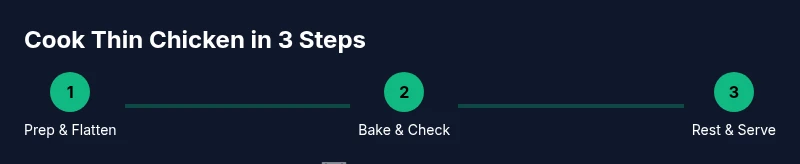
Place the chicken on a rimmed baking sheet in a single layer with at least 1/2 inch of space between pieces. Bake at 375°F (190°C) for 12–20 minutes, depending on thickness and oven performance. Start checking at the 12-minute mark with a meat thermometer in the thickest part. Remove once it reaches 165°F (74°C). If you want color, broil for 1–2 minutes, watching carefully to avoid scorching. Let the chicken rest for 3–5 minutes to redistribute juices before slicing.
Doneness checks: reliable thermometer technique
A digital instant-read thermometer is essential. Insert it into the thickest portion, avoiding bone. If you see 160–162°F (71–72°C), finish with a few minutes of residual heat to reach 165°F (74°C). If the temperature climbs too high, slice a small piece to confirm there’s no pink and that juices run clear. Safety is critical, but overcooking ruins texture.
Flavor and texture: spice, sauces, and finish
Thin breasts readily absorb flavors. A light coat of olive oil helps lock in moisture and promotes browning. Use a dry rub or a quick marinade to add depth without extending bake time. For extra zest, finish with lemon juice, a spoonful of pan sauce, or fresh herbs after resting. If cooking in bulk, keep pieces evenly spaced to maintain heat circulation and consistent browning across the batch.
Variations: marinated, butter-basted, or breaded
If you want more flavor without adding time, marinate briefly (15–20 minutes) or baste with melted butter during the last 5 minutes. For a crust, lightly coat with breadcrumbs and Parmesan, then bake until the crust sets while the center stays moist. Adjust total time slightly for added thickness. These variations keep the process flexible for weeknights.
Doneness: safe temperatures and resting
Always verify 165°F (74°C) in the thickest part with a thermometer. Let the pieces rest 3–5 minutes before slicing to allow juices to redistribute, which improves moisture and slice-ability. Resting also helps when serving with sauces, ensuring the meat remains juicy rather than tough or dry.
Storing and reheating: preserve texture and flavor
Store leftovers in an airtight container in the refrigerator for up to 3 days. Reheat gently at 325°F (165°C) until warmed through or slice and add to salads, wraps, or pasta for quick meals. Reheating on a sheet pan with a light spray of oil helps recover some of the initial texture; avoid microwaving if you want to maintain moisture.
Final fast-start checklist
- Target thickness around 1/2 inch (1.25 cm)
- Bake at 375°F (190°C); 350°F (175°C) if convection is used
- Use a thermometer to reach 165°F (74°C)
- Rest 3–5 minutes before serving
- Optional: finish under broil for color and crust
Tools & Materials
- Baking sheet or shallow rimmed pan(Line with parchment for easy cleanup; rim prevents juices from spilling.)
- Meat thermometer(Probe into thickest part; avoid bone for accuracy.)
- Pounding tool (mallet or rolling pin)(To achieve ~1/2 inch thickness across pieces.)
- Oil and seasonings (olive oil, salt, pepper, paprika, garlic powder)(Use a light coat to aid browning and flavor.)
- Tongs(For turning without piercing the meat.)
- Aluminum foil or parchment(For covering if finishing under broil or for cleanup.)
- Optional marinating container(If you choose to marinate, have a bowl or bag ready for 15–20 minutes.)
Steps
Estimated time: 25-40 minutes
- 1
Prep and flatten the chicken
Pat dry, trim fat, and flatten to ~1/2 inch (1.25 cm) thickness using a mallet. Ensure uniform thickness to promote even cooking.
Tip: Use a gentle, consistent tapping motion to prevent tearing the meat. - 2
Season and oil
Lightly coat with olive oil and season generously with salt, pepper, and aromatics. This helps flavor adhere and enhances browning.
Tip: Evenly distribute seasoning across all surfaces for consistent taste. - 3
Arrange on pan in a single layer
Place pieces on a rimmed baking sheet in a single layer with space between them for air circulation.
Tip: Line with parchment to reduce sticking and cleanup effort. - 4
Bake until done
Bake at 375°F (190°C) for 12–20 minutes, depending on thickness. Begin checking at 12 minutes with a thermometer.
Tip: Avoid opening the oven frequently to keep heat stable. - 5
Check doneness and rest
Remove at 165°F (74°C). Rest 3–5 minutes before slicing to keep juices intact.
Tip: Resting is essential for moist, tender slices. - 6
Serve or repurpose
Slice against the grain and serve, or repurpose leftovers in salads, wraps, or bowls.
Tip: Slice after resting to control juice redistribution.
Questions & Answers
What qualifies as a thin chicken breast?
A thin chicken breast is typically about 1/2 inch (1.25 cm) thick after trimming and flattening. This size bakes quickly and evenly in a standard oven.
A thin chicken breast is about half an inch thick after you trim and flatten it.
Should I marinate chicken breasts for this method?
Marinating is optional for quick oven cooking. Dry rubs or light oil and spices can deliver flavor without increasing bake time.
Marinating is optional; dry rubs work well for speed and flavor.
Can I bake from frozen?
Baking from frozen is possible but not ideal for even doneness. Expect longer times and potentially drier texture; thawing first is preferable.
You can bake from frozen, but it takes longer and may be less even in doneness.
Is convection faster or slower for thin breasts?
Convection usually speeds up cooking by circulating hot air, often reducing time by 5–10 minutes. Adjust temperature by about 25°F (15°C) when using convection.
Yes, convection can shave minutes off the bake time; lower the temp accordingly.
What is the safe internal temperature for baked chicken?
The USDA recommends cooking chicken to an internal temperature of 165°F (74°C) to ensure safety. Always check the thickest part for accuracy.
Cook to 165°F (74°C) and check with a thermometer.
Can I use bone-in breasts for this method?
Bone-in breasts require more cooking time and can prevent even doneness for thin cuts. For predictability, use boneless skinless breasts.
Bone-in takes longer; for even results, use boneless.
Watch Video
Main Points
- Aim for ~1/2 inch thickness for even cooking
- Always verify 165°F with a thermometer
- Rest 3–5 minutes before slicing
- Line pan and space pieces for even browning
- Use convection with adjusted temp if available