How to Check Oven Thermostat: Step-by-Step Guide
Learn how to check your oven thermostat for accurate temperature using a thermometer and safe testing steps. This expert guide from Oven Cook Pro covers testing, interpreting results, and adjustments.


According to Oven Cook Pro, you can verify your oven thermostat's accuracy by comparing the interior temperature to the dial reading with a calibrated thermometer, across several setpoints. This quick check helps you decide if recalibration or replacement is needed, and sets the stage for safe, high-precision cooking in your kitchen today.
Why Checking an Oven Thermostat Matters
An oven that runs hot or cold relative to the dial can ruin your meals, waste energy, and create safety concerns. A thermostat that drifts over time is common as components age, especially in older models. In practice, a small mismatch between the dial and the real interior temperature means your cookies may spread too quickly, or your roasts may be underdone on the inside while the outside browns excessively. According to Oven Cook Pro, many households rely on the dial as a rough guide, but accurate baking demands verifying the actual interior temperature. Testing helps you catch drift early, plan recalibration, and maintain consistent results across recipes. This section explains why a thermostat check matters, what you’ll gain from accurate readings, and how to interpret small variances that do not affect outcomes. By establishing a routine check, you turn a potentially hidden issue into a simple maintenance task that protects your time, ingredients, and kitchen confidence.
How Thermostats Work in Home Ovens
Ovens use different sensor types to control heating. Mechanical dial ovens rely on a bimetal strip or a mechanical switch that responds to current temperature; digital ovens use a sensor and microcontroller to read the setpoint and regulate heat more precisely. The thermometer inside measures air or rack temperature; these readings are used to match the chosen temperature. You may notice that the dial setting is a target rather than a guaranteed reading. If the sensor or control circuit drifts, the actual temperature can be higher or lower than the displayed setting. Ovens without a true calibration strip or with aging wear can have more noticeable drift. The goal is to understand how your particular model reads temperature so you can design an effective test. Remember that calibration features differ by brand and model, and some ovens require professional service for thermostat recalibration while others offer user-accessible options.
Preparing to Test: What You Need and How to Set Up
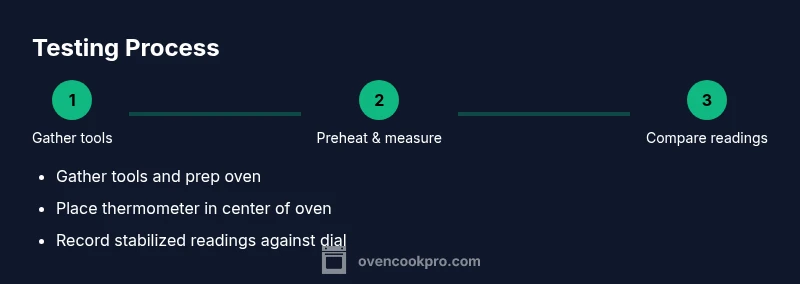
Before you test, ensure the kitchen is ready and the oven is in a stable state. Gather tools (calibrated oven thermometer, digital thermometer, oven mitts, notes). Avoid testing immediately after heavy use; give the oven a chance to cool slightly if necessary. Position the thermometer in the center of the oven, away from the racks and door, so it measures representative air temperature. Preheat to a moderate temperature and then to higher setpoints to gather data. Use the oven’s light and door to minimize opening and heating loss during measurement. Keep the oven closed, and allow readings to stabilize for several minutes before recording. If you’re uncertain about placement, refer to your oven’s manual or manufacturer guidance. This preparation helps ensure that the results reflect true performance rather than a transient heat spike.
Interpreting Temperature Readings: What It Means for Baking
After you record stabilized readings, compare interior temperatures to each dial setting. If the thermometer shows a consistent offset across multiple setpoints, your thermostat may be drifting. A single outlier is less meaningful than a pattern. If readings are consistently high, your oven runs hot; if low, it runs cool. Calibrations are often available in the control panel; otherwise consult the user's manual or service technician. Avoid making multiple adjustments in one session; test, adjust, and re-test to confirm. If you’ve corrected drift but still observe uneven results, consider rack placement or oven seals, which can affect heat distribution more than the thermostat.
Next Steps: Recalibration, Repair, and Maintenance
With data in hand, decide on the next steps. Many ovens allow user calibration of the thermostat through the control panel; follow the manual to adjust the display to align with measured temperatures. If your model lacks a calibration option or continues to show large discrepancies, contact a professional technician or the manufacturer for service. In the meantime, rely on the thermometer for recipes that depend on accuracy, and adjust your bake times and temperatures accordingly. Document the results so you can monitor drift over time. Regular checks as part of kitchen maintenance can save wasted food and improve consistency across your favorite dishes.
Tools & Materials
- calibrated oven thermometer(Place in center of oven away from racks to measure air temperature.)
- digital oven-safe thermometer (probe)(For cross-checks and surface readings at higher temperatures.)
- oven mitts(Heat-resistant, preferably silicone or high-temp knit.)
- notebook or digital notes app(Record readings, dates, and model information.)
- timer or stopwatch(Optional to track stabilization time.)
Steps
Estimated time: 20-40 minutes
- 1
Gather supplies
Collect all tools from your Tools & Materials list and clear a stable workspace near the oven. Ensure the area is free of clutter and kids or pets are away during testing.
Tip: Lay out tools on a heat-resistant mat within easy reach. - 2
Preheat for a test
Turn on the oven and allow it to reach the first test setpoint. Avoid opening the door frequently to prevent heat loss. This step establishes a baseline before measurements.
Tip: Set a timer to know when the oven has stabilized. - 3
Insert thermometer properly
Place the thermometer in the center of the oven, away from walls and racks so it reads ambient air rather than a localized hotspot. Do not let the probe touch metal surfaces.
Tip: Keep the thermometer away from the door seal to avoid skewed readings. - 4
Stabilize and record
Let the oven settle at the setpoint for several minutes, then record the interior temperature and the dial reading. Repeat for a second setpoint to compare ranges.
Tip: Use a consistent placement for every reading to improve accuracy. - 5
Compare readings
Compare the thermometer reading to the dial setting. Look for consistent offsets across tests rather than a single anomaly.
Tip: Note whether the oven runs hot or cool overall. - 6
Decide on recalibration
If there is a persistent drift across setpoints, use the oven’s calibration feature if available or plan service. If readings are close, you can bake with the thermometer as your reference.
Tip: Document results and keep monitoring over time.
Questions & Answers
Can all ovens be calibrated to adjust thermostat readings?
Many ovens offer a calibration feature in the control panel or through manufacturer guidance. If your model lacks a calibration option, service may be required. Always refer to the manual.
Many ovens can be calibrated, but it depends on the model. Check the manual or contact support if unsure.
What thermometer should I use to check temperature?
Use an oven-safe thermometer or a calibrated probe thermometer designed for oven use. Place it where it can read the air temperature, not just a single hot spot.
Use an oven-safe thermometer placed in the oven, away from racks, for accurate air-temperature readings.
Why is there a difference between the dial reading and interior temperature?
The dial indicates a target setpoint, while the interior reads actual heat. Drift can occur due to sensor aging, calibration limits, or airflow dynamics inside the oven.
The dial is a target; actual temperature may differ due to drift or airflow.
How often should I test my oven thermostat?
Test when you notice uneven baking or after moving the oven or changing batteries in the controls. Regular checks help maintain accuracy over time.
Test it if you notice uneven results or after moving the oven; regular checks are helpful.
Is it safe to run the oven while testing?
Yes, with proper precautions. Keep hands away from hot surfaces, use oven mitts, and avoid liquids near the heating elements.
Yes, but be careful and use oven mitts to avoid burns.
Can a self-cleaning cycle calibrate the thermostat?
Self-cleaning cycles do not calibrate the thermostat. They clean the oven; use the manual for any calibration procedures if available or consult a technician.
Self-cleaning doesn't calibrate the thermostat; follow the manual or seek professional help for calibration.
Watch Video
Main Points
- Test with multiple setpoints to detect drift.
- Use calibrated thermometers for reliable readings.
- Document results to track changes over time.
- Follow manufacturer guidance for recalibration.