Mastering the Oven for Baking: A Step-by-Step Guide
Learn to choose, preheat, and bake with confidence using your oven for baking. This step-by-step guide covers temperature accuracy, rack placement, bakeware, safety, and maintenance for reliable results.


With this guide you will learn how to choose, preheat, bake, and refine results using an oven for baking. You’ll understand temperature accuracy, rack placement, and appropriate bakeware, plus practical safety and maintenance tips. By the end, you’ll confidently bake consistent, delicious results every time, whether cookies, bread, or cakes, using clear steps and trusted techniques.
Why the oven matters for baking
A reliable oven for baking provides consistent heat, steady moisture, and predictable browning—qualities that home bakers rely on for cookies, bread, cakes, and pastries. Unlike stovetop methods or small countertop appliances, a true oven creates a controlled environment that concentrates heat from all directions. This makes it possible to bake evenly, achieve proper rise, and obtain crisp exteriors with tender interiors. The Oven Cook Pro team emphasizes that successful results start with a well-calibrated oven, deliberate preheating, and appropriate bakeware. By understanding how your oven performs, you can tailor recipes to your own kitchen rather than forcing recipes to fit a device. In this section, we’ll explore how to assess your oven’s behavior, what to expect from a typical baking cycle, and how to prepare your kitchen to get the most from every bake.
Key features to consider in an oven for baking
When shopping or upgrading, focus on features that directly impact bake quality. Look for accurate temperature control, even heat distribution, and the ability to maintain a stable oven core without hot spots. Convection can speed up baking and promote even browning, while traditional bake modes provide gentler, steady heat for delicate cakes. A well-insulated cavity reduces heat loss, helping you reach and sustain your target temperatures. A clear, intuitive control panel with easy preheating indicators minimizes guesswork. Finally, a reliable door seal and good moisture retention prevent uneven drying and soggy bottoms. The Oven Cook Pro team notes that practical features—like the correct rack positions, a visible interior light, and a simple timer—make a big difference in day-to-day baking success.
Sizes and layouts for baking success
Ovens come in various cavity sizes and rack configurations. A roomy interior supports multiple baking sheets or pans without crowding, which is essential for sheet-pan dinners and batch confectionery. Place racks so there is at least 1–2 inches of clearance around pans for proper air flow. For cookies and pastries, two racks with staggered heat can help even browning. Larger bakeware, such as 9-by-13-inch pans or loaf pans, often benefit from a center rack position. When possible, avoid crowding and keep enough space for air to circulate. Your oven’s interior geometry will influence heat distribution, so learn where hot and cool spots typically reside by running a simple test bake with a light-colored tray.
Preheating and rack positioning guidelines
Preheating ensures the oven reaches a stable temperature before bake times begin. Most recipes assume a fully preheated oven, which helps with rise and set on contact. Position baking sheets in the middle of the rack for even exposure to heat. If you are baking multiple items, rotate trays halfway through to counter any heat variance and ensure uniform results. For delicate items like meringues or soufflés, a lower rack may reduce direct heat exposure and prevent over-browning. In every case, avoid opening the door during the first 10 minutes of baking to maintain interior heat and height.
Temperature accuracy and calibration
Accurate temperature is the backbone of consistent baking. Use an independent oven thermometer to verify that your oven’s setting matches the actual temperature inside. If readings drift, consult the user manual about calibration or service options. Minor adjustments to your target temperature can yield significant improvements in texture and color. When in doubt, rely on the thermometer reading rather than the dial or digital display, especially for precise tasks like macarons or laminated doughs. Regular checks—every few months or after service—keep performance predictable.
Bakeware and surfaces: what to bake on and with
Bakeware choice dramatically affects browning, crust formation, and moisture retention. Oven-safe metal pans with light-colored interiors tend to promote even browning, while darker pans can encourage quicker crust development. For sticky batters or delicate cookies, parchment paper or silicone mats prevent sticking and make cleanup easier. Glass and ceramic bakeware heat more slowly and may yield softer crusts, which is desirable for some breads and casseroles. Avoid using nonstick sprays on parchment or silicone mats, as they can alter texture. Always pre-grease or prep your chosen surface according to the recipe’s guidance and your oven’s characteristics.
Baking scenarios: cookies, bread, cakes, and more
Different baked goods demand different environments. Cookies usually require even heat and fast setting; breads benefit from steady, radiant heat with a longer bake; cakes need uniform temperature to avoid domed tops or sunk centers. For sourdoughs and yeasted loaves, early steam and higher humidity can improve oven spring, but many home ovens do this naturally by moisture in the air. Understanding your oven’s quirks helps you adapt temperatures and times. Keep a small bake log to record your results and refine your technique over time.
Maintenance, safety, and energy savings
Safety starts with clean ovens and dry hands. Regularly wipe spills to prevent smoke and fire hazards, and keep door seals intact for efficient heating. Use energy-saving modes when appropriate and avoid leaving ovens running longer than needed. A well-maintained oven consumes energy more efficiently and maintains heat more consistently, which benefits both performance and your electricity bill. When in doubt, consult the manufacturer’s schedule for routine maintenance tasks and safety checks.
Troubleshooting common baking problems
If your baked goods come out pale, uneven, or dense, consider oven calibration, bakeware choice, and preheating discipline as primary culprits. Hot spots often cause uneven browning; rotating pans mid-bake can help. If cakes sink in the center, check for overmixed batter or incorrect ingredient temperatures. Soggy bottoms might indicate too much moisture or insufficient preheating. By systematically testing variables—time, temperature, and placement—you can identify and fix most issues without guesswork.
Tools & Materials
- Oven thermometer(Place in center for accurate reading)
- Baking sheets (rimmed)(Steel or aluminum; size depends on oven width)
- Parchment paper(Prevents sticking; creates even browning)
- Silicone baking mats(Optional for repeatable results)
- Cooling rack(Cool baked goods to stop carryover cooking)
- Mixing bowls(Various sizes for batter/dough prep)
- Measuring cups & spoons(Accurate ingredient measurements)
- Whisk, spatula, and spoon(Mix gently; scrape bowl clean)
- Timer or smartphone timer(Track bake times precisely)
- Oven mitts or gloves(Heat protection when handling pans)
Steps
Estimated time: 60-90 minutes
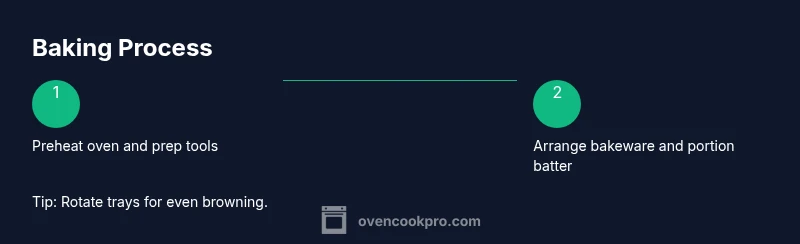
- 1
Gather tools and preheat
Assemble your bakeware, ingredients, and a reliable timer. Preheat the oven to the recipe’s target temperature so heat is stable when batter enters the oven.
Tip: Check the oven thermometer after 5 minutes to confirm accuracy. - 2
Prepare pans and liners
Line sheets with parchment or silicone mats. This prevents sticking and helps with even browning across batches.
Tip: Leave space between pans for air circulation. - 3
Mix ingredients
Combine dry ingredients separately from wet, then fold to avoid over-mixing. Temperature of liquids matters for texture.
Tip: Use room-temperature eggs and dairy when possible. - 4
Portion batter evenly
Scoop uniform portions to ensure consistent bake times. Leave space between portions for expansion.
Tip: For cookies, use a level scoop for uniform size. - 5
Bake and rotate
Place trays on the center rack and bake. Rotate trays halfway through to counter hot spots and promote even browning.
Tip: Use the timer to remind you when to rotate. - 6
Test for doneness
Use a toothpick or thermometer as the recipe directs. Look for coloring, aroma, and texture cues in addition to the timer.
Tip: Remember carryover cooking can continue after removal. - 7
Cool and finish
Move baked goods to a cooling rack promptly to prevent soggy bottoms. Finish with a glaze or dusting if desired.
Tip: Cool completely before slicing for best texture. - 8
Clean and inspect
Wipe up spills and inspect seals and gaskets after cooling. Proper cleaning keeps performance consistent and safe.
Tip: Schedule a quick oven interior wipe after heavy use.
Questions & Answers
What is the difference between convection and conventional ovens for baking?
Convection ovens use a fan to circulate hot air, which can bake more quickly and evenly. Conventional ovens rely on radiant heat from above and below. Choose convection for cookies and pastries that benefit from fast, even browning, and conventional for delicate cakes or when batter needs gentler heat.
Convection uses a fan for even heat, speeding up bake times. Conventional heat rises from the elements without air movement, which can be gentler on some batters.
Should I preheat the oven every time I bake?
Preheating is generally recommended to ensure consistent texture and rise. Some quick breads or no-bake recipes skip preheating, but for most baked goods, preheating is essential.
Yes. Preheating helps ensure even cooking and the right texture.
How do I calibrate my oven temperature?
Use an oven thermometer placed in the center of the rack. If the reading diverges from the setting, follow your manufacturer’s calibration steps or seek service to restore accuracy.
Check with an oven thermometer, then correct the setting if needed.
Can I bake multiple items at once in one oven?
Yes, as long as there’s space for air to circulate. Arrange items on opposite sides of the oven or on different racks and rotate halfway through for even results.
Absolutely, just give enough space and rotate the racks during baking.
What bakeware is best for even results?
Metal sheets with light interiors are reliable for even browning; parchment or silicone mats reduce sticking. Avoid dark nonstick pans that may brown too quickly for certain recipes.
Metal pans with parchment or silicone mats work well for consistent results.
How should I clean after baking safely?
Let the oven cool before wiping spills. Regularly remove crumbs from oven floors and racks to prevent smoke and fire hazards. Use oven-safe cleaners as directed by the manufacturer.
Cool the oven, wipe spills, and keep seals clean for safety and efficiency.
Watch Video
Main Points
- Preheat fully before baking.
- Use proper bakeware for even results.
- Rotate trays for even browning.
- Calibrate temperature with an independent thermometer.
- Cool baked goods completely before storage.