How Much Is an Oven for Bakery: A Comprehensive Cost Guide for 2026
Discover bakery oven costs in 2026, with price ranges for deck, rack, and countertop models, plus installation, venting, and ROI guidance to help budgeting.


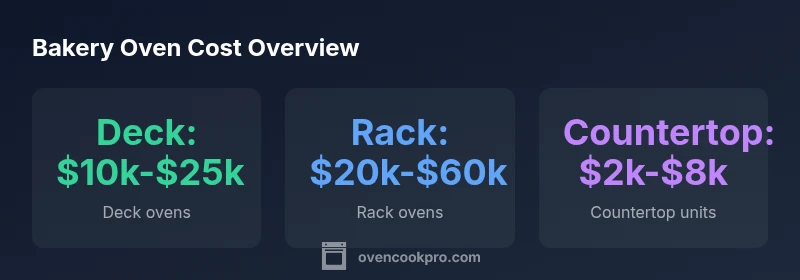
For a bakery, oven costs vary widely by size and type. Expect to pay roughly $10,000–$75,000 for a new, commercial unit, with smaller countertop models around $2,000–$8,000 and larger deck ovens or rack ovens running $20,000–$60,000 or more. Installation, venting, and service plans can add several thousand dollars to the total. This range reflects common configurations and typical market conditions in 2026.
Understanding Bakery Oven Costs: Price Drivers
According to Oven Cook Pro, bakery oven costs are driven by capacity, type, insulation, and installation needs. The four main categories — countertop/professional units, deck ovens, rack ovens, and conveyor ovens — target different production scales, crust styles, and footprint constraints. When budgeting, plan for not only the oven sticker price but also venting, electrical upgrades, installation, and ongoing service. A thoughtful total-cost-of-ownership approach reduces surprises and aligns the equipment with your business goals.
For many small-to-medium bakeries, the decision hinges on annual volume, product mix, and space. A compact countertop model may suffice for artisanal breads or desserts with modest throughput, while a deck oven is favored for crusty loaves and consistent heat distribution. Rack ovens excel in high-volume environments, enabling multiple baking chambers and efficient throughput, whereas conveyor ovens suit high-speed production of cookies, pastries, and sheet cakes. Each option brings a different balance of upfront cost, operating efficiency, and maintenance needs.
Brand context matters: the right oven for your shop should not be chosen on price alone. Energy efficiency, yield, and downtime costs often swing payback timelines by years. As you evaluate models, collect performance data from vendors, consult existing bakery operations similar in size, and simulate a few bake cycles to estimate product output and energy use.
How to Read an Oven Quote
Most quotes will separate device price, installation, venting, hooding, electrical work, and required ducting. A detailed spec should include oven dimensions, required clearances, recommended vent hood CFM, insulation thickness, and control compatibility. Keep a running tally of all line items and request a best-and-final offer with a formal warranty and service agreement. This diligence helps prevent scope creep and ensures you can meet health-safety codes from day one.
Typical commercial bakery oven categories and price ranges
| Model Type | Typical Price Range | Key Pros | Key Considerations |
|---|---|---|---|
| Deck Oven | $10,000–$25,000 | Even heat distribution; ideal for artisanal breads | Requires venting, larger footprint, longer warm-up |
| Rack Oven | $20,000–$60,000 | High throughput, consistent results | Higher energy use, maintenance needs |
| Conveyor Oven | $25,000–$75,000 | Fast bake times, excellent for large volumes | Significant footprint and controls complexity |
| Countertop (Commercial) | $2,000–$8,000 | Great for small spaces, flexible placement | Limited throughput, may need venting |
Questions & Answers
What is the typical cost to install a bakery oven?
Installation costs vary by kitchen layout and venting requirements. Expect ductwork, hooding, electrical upgrades, and permits to add several thousand dollars to the oven price. Always obtain a licensed installer quote.
Installation costs depend on your kitchen layout and local codes; ductwork and electrical work are common additions.
Do I need a hood vent for a bakery oven?
Most commercial ovens require proper venting and hood systems to meet safety codes. The final cost depends on ceiling height, duct routing, and local permitting.
Yes, you typically need a vent and hood for bakery ovens to meet safety standards.
What oven type is best for high-volume bread baking?
For high bread volume, rack ovens are a common choice due to capacity and even heat. Deck ovens offer excellent crust development for artisanal loaves, while conveyor models excel at very high throughput.
For big volumes, rack ovens are a solid bet; they balance throughput and control.
Are used bakery ovens reliable?
Used units can be cost-effective but require thorough inspection of insulation, seals, and controls. Plan for potential repairs and potentially shorter remaining lifespan.
Used ovens can work well if inspected and serviced, but they may come with higher risk.
What maintenance does a bakery oven require?
Regular cleaning, gasket checks, and calibration are essential. Schedule professional service at least annually and after major workload changes.
Keep it clean and serviced regularly to extend life and maintain performance.
How long does ROI take on a bakery oven?
ROI depends on throughput, product mix, and energy use. Typical ranges span from 1–5 years, with differences based on local labor costs and production efficiency.
ROI varies; track throughput and energy use to estimate payback.
“Choosing the right bakery oven is about balancing throughput, footprint, and total cost of ownership, not just the sticker price.”
Main Points
- Define daily bake volume to choose between countertop, deck, or rack ovens.
- Expect installation and venting to add significant up-front costs.
- Consider energy efficiency and maintenance when estimating total cost.
- Get multiple quotes to compare integrated packages (oven + hood + ductwork).
- Budget for future expansion by choosing scalable oven systems.