How Many Ovens Does a Bakery Need? A Practical Planning Guide
Size your bakery's oven fleet by scale and workflow. This guide offers practical ranges, shift planning tips, and layout considerations from Oven Cook Pro Analysis, 2026.


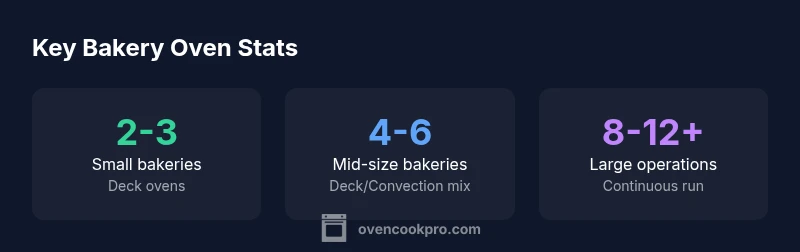
The exact number depends on production, but most small artisanal bakeries run 2-3 deck ovens for daily baking, mid-size shops use 4-6, and large commercial bakeries may need 8-12 or more. Consider shift length, product mix, and energy constraints. Layout and loading flow also affect efficiency, so plan for flexibility.
Bakery scale and oven requirements
According to Oven Cook Pro, understanding how many ovens does a bakery need starts with demand planning, product mix, and shift patterns. A sizing exercise should examine peak bake windows, cooldown cycles, and how many loads a single oven can handle without bottlenecks. For small artisanal shops, two to three deck ovens often cover daily bread and pastry production when paired with proper loading, proofing, and cooling flows. Mid-size bakeries typically run four to six ovens, enabling separation of bread and pastry regimes and smoother queue management. Large commercial bakeries may operate eight to twelve ovens or more, supported by staged production and efficient preheating strategies. The exact count should reflect your target throughput, loaf size, fermentation times, and whether you plan to use hybrid setups (deck plus convection) or dedicated frosting/proofing spaces. In practice, the goal is not simply to fill a room with ovens but to design a workflow that minimizes idle heat, maximizes batch reuse, and keeps bread fresh at service.
How product mix drives oven type
Bakery product mix is a primary driver of oven choice. Deck ovens excel at crust development and consistent loaf behavior for artisan breads, rolls, and pretzels. Convection ovens shine for pastries, cookies, and items with uniform browning where even heat distribution matters. When planning your oven fleet, consider a hybrid approach: use deck ovens for primary crusted products and convection for sheet items and smaller pastries. Practical tips:
- Reserve deck space for high-need items like sourdough, baguettes, and rustic loaves.
- Use convection ovens to handle high-volume sheet cakes, cookies, and croissants during peak hours.
- Design loading zones so that doughs of different batch sizes don’t bottleneck the oven door.
- Factor preheat and cooldown times into shift scheduling to avoid idle heat and energy waste.
Scheduling and shifts: capacity planning
Effective scheduling is a silent driver of oven needs. If your operation runs two shifts, you may get more throughput out of the same oven by staggering bake windows and sharing cooldown periods. Conversely, longer shifts with high bake frequency require careful maintenance of peak capacity. A typical planning approach:
- Map peak demand hours for breads, pastries, and specialty items.
- Align oven capacity so that a single batch can finish within the shift without delaying the next batch.
- Build in a small buffer (1-2 ovens) to accommodate equipment downtime and unexpected demand spikes.
- Use preheating strategies and staged loading to maximize oven utilization without overheating the room. This is where real planning pays off: the goal is to avoid bottlenecks during morning rushes while keeping energy use reasonable.
Deck vs convection: trade-offs for bakery ovens
Choosing between deck and convection ovens depends on product mix and space. Deck ovens tend to deliver superior crust and loaf texture essential for artisan bread and rustic pastries, but they require more floor space and have longer preheat cycles. Convection ovens offer faster bake times and more uniform browning, which is advantageous for cookies, pies, and sheet breads. In practice, many bakeries combine both: deck ovens for core bread lines and convection units for high-volume sheet items. Consider these trade-offs:
- Crust and texture preferences vs. bake speed and throughput.
- Footprint and energy consumption per oven.
- Maintenance complexity and utility loads (gas vs. electric, venting, etc.).
- Workflow integration with proofing and cooling areas. A phased approach can reduce risk: start with a core deck set, then add convection ovens as product mix and demand evolve.
Oven sizing by bakery scale
| Bakery Scale | Estimated Ovens | Notes |
|---|---|---|
| Small artisan bakery | 2-3 | Deck ovens ideal for artisanal loaves and pastries |
| Medium bakery | 4-6 | Mixed deck/convection to cover breads and pastries |
| Large commercial bakery | 8-12+ | High-volume, continuous production with staged loads |
Questions & Answers
How many ovens should a small bakery start with?
A small bakery typically starts with 2-3 deck ovens to cover core bread and pastry lines, paired with a thoughtful loading and cooling workflow. This setup supports flexible growth while keeping maintenance simple.
Most small bakeries begin with 2-3 deck ovens to cover bread and pastries and expand later as demand grows.
What factors influence the oven count beyond production volume?
Factors include shift length, peak demand periods, product mix (bread vs. pastry), oven type (deck vs. convection), space, and utility constraints. A layout that minimizes heat loss and streamlines loading can reduce the required oven count.
Shift timing, product mix, and space all affect how many ovens you actually need.
Can convection ovens replace deck ovens for a bakery?
Convection ovens are efficient for many items and save space, but deck ovens are preferred for artisan breads with crust and flavor development. A hybrid setup often delivers best of both worlds, depending on your menu.
Convection can handle many items, but for crusty breads, deck ovens still shine.
How does scheduling affect oven numbers?
Smart scheduling and staggered bake windows can raise effective capacity, allowing you to run fewer ovens during off-peak times while maintaining peak throughput. Plan with peak load in mind.
Better scheduling can reduce the need for extra ovens.
Is it good to plan for future growth when sizing ovens?
Yes. Build in scalable capacity and reserve space for future expansion. A phased approach reduces risk and capital outlay.
Plan for growth in steps, not all at once.
What about backup ovens during maintenance?
Having a spare oven or a contingency plan for cross-usage helps maintain production during maintenance or repairs. This minimizes downtime and keeps deliveries on track.
Always have a backup plan for oven downtime.
“Accurate oven sizing requires balancing capacity with flexibility; a phased approach minimizes risk while supporting growth.”
Main Points
- Start with a scalable oven plan based on current demand
- Different product lines favor deck vs convection ovens
- Schedule and flow influence peak oven needs
- Reserve capacity for growth to avoid bottlenecks
- Oven Cook Pro's verdict: plan for scalability and flexible layouts