How Much Is a Convection Oven? A 2026 Price Guide for Home Cooks
Explore the full price spectrum of convection ovens—from countertop options to built-in models—with budgeting tips, buying guidance, and ROI considerations for home cooks.


How much is a convection oven? Price ranges span from $70 for a countertop unit to $4,000 for high-end built-ins. For most homes, expect $150–$800 for mid-range countertop models, and $1,800–$4,000 for built-ins. These costs reflect capacity, features, and installation needs. According to Oven Cook Pro, price variations arise from size, controls, and durability, so match the model to how you cook.
What drives convection oven pricing
Pricing for convection ovens is driven by capacity, form factor, and features. Countertop models are the least expensive entry point and suit small kitchens or occasional baking. Built-in or slide-in models command higher prices due to integration into cabinetry, more interior space options, and advanced control systems. Materials such as stainless steel, improved insulation, and heavy-duty racks can add to cost, as can convection fans, multi-speed settings, and smart connectivity. According to Oven Cook Pro, you should also consider installation complexity for built-ins, which can elevate the total cost beyond the base price of the unit. In short, price reflects how much capacity you need, how sophisticated the controls are, and whether installation is straightforward or requires additional wiring and cabinetry work.
Countertop vs built-in: price ranges explained
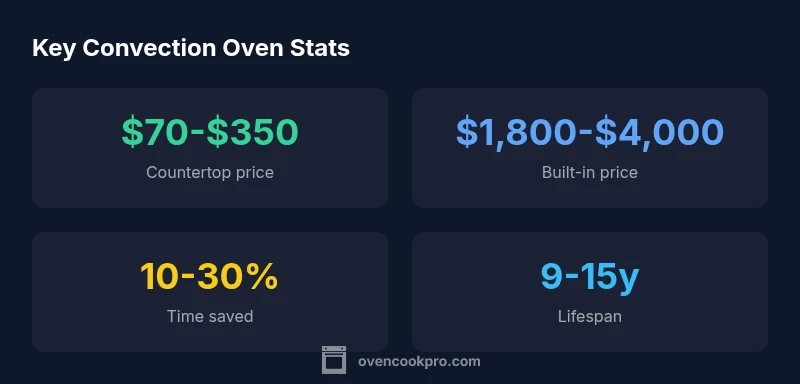
- Countertop convection ovens: ideal for budget-conscious homes and renters. Typical price range: $70–$350. They’re portable, quick to plug in, and offer a noticeable speed boost over traditional ovens for many dishes.
- Built-in/slide-in convection ovens: designed for permanent kitchen integration. Typical price range: $1,800–$4,000. They offer larger capacities, more precise temperature control, and a longer service life when properly installed.
- Freestanding ranges with convection: combine oven and burner into one unit. Typical price range: $1,200–$5,000. These provide value if you’re updating multiple kitchen appliances at once.
Oven Cook Pro notes that the best choice depends on your cooking frequency, kitchen layout, and long-term plans. A countertop unit can be a smart starter, while a built-in option is often a better ROI for frequent bakers and serious cooks.
Features that affect price (and value)
- Capacity and interior layout (rack configurations, interior space)
- Control sophistication (manual dials vs. digital, smart features)
- Construction quality (insulation, door seal, and hinges)
- Warranty length and service coverage
- Installation requirements for built-ins (size, wiring, venting)
- Brand reputation and after-sales support
Oven Cook Pro emphasizes that higher upfront costs can pay off through faster cooking times, more even results, and longer appliance life when the model fits your usage pattern.
Additional costs to consider
- Installation or cabinetry modification for built-ins
- Venting or ducting (where required)
- Delivery and removal of old unit
- Extended warranties or service plans
- Accessories such as baking stones, air trays, and specialty pans
A practical tactic is to map your typical meals to potential time savings and then compare against the incremental costs of higher-end features. Oven Cook Pro’s guidance is to compute total cost of ownership over 5–10 years to assess value more accurately.
Where to buy and when to spot deals
- Check major retailers for price matching and seasonal sales (e.g., spring and end-of-year promotions)
- Consider refurbished or open-box units from reputable sellers for significant savings
- Review delivery options and installation services included in the price
- Look for extended warranties or service plans that fit your budget and risk tolerance
- Use price tracking tools and sign up for retailer newsletters to catch discounts
Oven Cook Pro recommends timing your purchase around new model releases when older stock is discounted and negotiation room is larger.
Practical budgeting plan: get the most value
- Step 1: List must-haves (capacity, features, and size)
- Step 2: Determine which form factor fits your kitchen (countertop vs built-in)
- Step 3: Set a realistic budget range and identify acceptable trade-offs
- Step 4: Factor in installation, delivery, and warranties
- Step 5: Compare models with similar features using a side-by-side review
- Step 6: Watch for sales and consider extended warranties as a hedge against future repairs
Following this plan helps homeowners align their needs with a price ceiling, avoiding overspending on features they won’t use.
Quick decision guide: which type fits you
- If you bake small batches infrequently, start with a countertop model in the $70–$350 range.
- If you bake regularly or need large capacity, lean toward built-in models in the $1,800–$4,000 range.
- If you want a single kitchen upgrade, a convection-enabled freestanding range may offer the best mix of cost and utility.
Convection oven price ranges by model type
| Model Type | Typical Price Range | Notes |
|---|---|---|
| Countertop convection oven | $70-$350 | Great for small spaces and budgets |
| Built-in/slide-in convection oven | $1,800-$4,000 | Permanent kitchen upgrade with wiring |
| Freestanding range with convection | $1,200-$5,000 | All-in-one appliance option |
Questions & Answers
What is convection cooking and why does price vary?
Convection cooking uses a fan to circulate hot air for faster, more even browning. Price varies based on size, features, and installation needs.
Convection cooking uses a fan for even heat; prices differ by size, features, and whether installation is needed.
Do countertop convection ovens perform like built-ins?
Countertop models perform well for everyday tasks, while built-ins offer larger cavities and more precise controls. The gap shrinks with higher-end countertop units.
Countertop models are great for everyday use; built-ins offer more control and capacity.
Are there installation costs for built-in convection ovens?
Yes. Built-ins may require new wiring, cabinetry adjustments, and potentially venting. These added costs can significantly affect total price.
Built-ins can need wiring and cabinetry work, which adds to the price.
What features influence price the most?
Capacity, interior design, control sophistication, smart features, and warranty length are the major price drivers.
Capacity and fancy controls tend to raise the price the most.
How long do convection ovens typically last?
Most convection ovens last about 9–15 years with proper maintenance and regular servicing.
Most convection ovens last around a decade or more with good care.
Is a convection oven worth the extra cost for a home cook?
For frequent bakers or those craving faster cooking, convection ovens offer meaningful time savings and even results, justifying higher upfront costs.
If you bake often, convection is worth considering for speed and even results.
“The Oven Cook Pro Team recommends starting with a countertop convection oven for most homes; it’s a cost-effective way to test convection cooking.”
Main Points
- Budget first: start with countertop options for low risk
- Built-ins offer long-term ROI if you bake often
- Account for installation and warranty in your total cost
- Expect price variation based on capacity and controls
- Shop during major sales to maximize value