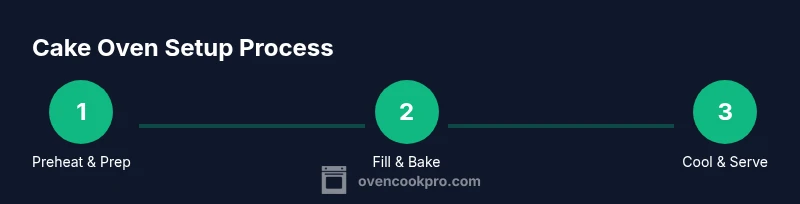
How to Set Oven When Baking Cake: A Complete Guide
Learn how to set your oven for baking cake with confidence. This guide covers preheating, temperature, bake times, rack position, and common mistakes, with expert tips from Oven Cook Pro.


Wondering how to set oven when baking cake? Set the oven to the recipe’s specified temperature, preheat fully, and position the rack in the middle. Use a reliable oven thermometer to confirm accuracy and adjust for hot spots. Start with a standard 350°F/175°C for most cakes, then adapt as needed. If you’re unsure, bake a test cupcake first to verify timing.
Understanding Oven Functions for Cake Baking
Baking a cake successfully starts with understanding how your oven delivers heat. Conventional ovens rely on radiant heat from coils, while convection models circulate air with a fan. Many home ovens have hot spots, which can cause uneven browning or undersides that bake slower than the middle. By using an oven thermometer, you verify the actual temperature inside the cavity and adjust as needed. The Oven Cook Pro team notes that calibrating your oven—especially after a few years of use—improves predictability and leads to evenly baked cakes. When your recipe specifies a temperature, aim to match it, but be prepared to adjust if you notice browning too quickly or a pale center. This foundation helps ensure reliable results across different cake types, pans, and oven models. A well-understood oven lends you consistent texture, better rise, and fewer surprises when you pull the cake from the oven.
Preheating the Oven: Why It Matters
Preheating ensures the batter starts cooking immediately and gives the structure a chance to set evenly from the first minute of baking. A cold oven often leads to a denser crumb and an uneven rise. To preheat, remove tins and racks if needed, set the temperature to the recipe’s specification, and wait until the indicator signals it's ready. Use an oven thermometer placed in the center of the rack to confirm. If your oven cycles hot and cool, consider a brief cooldown or an adjustment—this is a common variation across homes and is mentioned by the Oven Cook Pro team as a practical fix for inconsistent results. Patience during preheating pays off with an even crumb and a level top.
Temperature and Bake Time: Nailing the Settings
Most standard cakes bake at 350°F (175°C). If you’re baking a heavier batter, a lighter crumb, or a delicate sponge, you may adjust to 325–350°F (163–177°C) depending on the recipe. Begin with 25–35 minutes for a light batter in a standard 8–9 inch pan, and extend to 40–60 minutes for denser cakes or larger pans. Always check doneness with a toothpick; the center should emerge with a few moist crumbs, not wet batter. If your oven runs hot, shorten bake time slightly or tent the top with foil in the final 10 minutes to prevent over-browning. Calibrating heat for your specific cake type helps ensure even rising and a flat, level top.
Rack Position, Pan Prep, and Batter Load
Place the oven rack in the center position for most cakes to promote even heat exposure from top to bottom. Center the pan on the rack and avoid crowding adjacent pans, which can block air circulation. Prepare pans by greasing and lining with parchment or using a parchment disk for easy release. Fill pans to the recommended depth (usually 2/3 full) to allow for proper expansion. Uneven batter depth can cause varied baking times, so level the batter with a small offset spatula and tap the pan lightly to release any trapped air.
Common Cake Problems and How to Avoid Them
A common issue is a domed or cracked top from too-high temperature or rapid batter rise. Check your oven’s accuracy with a thermometer and consider lowering the temperature slightly if doming persists. Sinking centers usually stem from overmixing batter, underbaking, or cooling too quickly after removal from the oven. Use the toothpick test in multiple spots near the center to confirm doneness. Uneven browning can be addressed by rotating the cake 180 degrees halfway through baking or by using an insulated pan if you notice hotter spots on one side. By understanding these patterns, you can troubleshoot recipes more effectively.
Finishing Steps: Cooling, Inversion, and Storage
Cool cakes in their pans for 10-15 minutes on a rack to allow structure to set, then remove and finish cooling on a wire rack to prevent sogginess. If layering, ensure each layer is completely cooled before frosting to avoid sliding. Store unfrosted cakes at room temperature in a sealed container for up to 2 days, or refrigerate for longer storage if you’ve filled and frosted them. For delicate cakes, such as sponge or chiffon, invert gently if the pan supports it to prevent collapsing the top. Proper cooling and storage maximize texture and flavor, keeping the cake moist and evenly textured.
Authority sources
To deepen your understanding of oven behavior and food safety, consider these sources:
- https://www.fsis.usda.gov
- https://hsph.harvard.edu
- https://www.cdc.gov
Tools & Materials
- Oven thermometer(Place in the center of the rack for accurate readings)
- 9-inch round cake pans(Grease or line with parchment; fill 2/3 full)
- Parchment paper or parchment circles(Prevents sticking and supports even release)
- Mixing bowls (glass or stainless)(For batter and dry ingredients)
- Whisk and spatula(Mixing and folding without overworking batter)
- Cooling rack(Cool cakes evenly to avoid condensation)
- Timer (digital or phone)(Track bake time accurately)
- Oven mitts(Handle hot pans safely)
- Cake leveler or knife(Even layers for stacking)
Steps
Estimated time: 60-75 minutes
- 1
Gather ingredients and preheat
Collect all ingredients and bring them to room temperature if the recipe calls for it. Preheat the oven to the recipe's specified temperature before mixing batter so heat is ready when you’re finished. This reduces mixing downtime and helps the batter begin cooking at the right moment.
Tip: Preheat early to minimize delays and ensure consistent heating from the start. - 2
Prepare pans
Grease the cake pans and line the bottoms with parchment circles. This prevents sticking and helps you remove the layers cleanly after baking. If using multiple pans, repeat the lining process for each one and arrange them on a level rack.
Tip: Tap the pan on the counter after pouring batter to remove air pockets. - 3
Mix batter to correct consistency
Combine dry ingredients separately from wet ingredients, then fold just until integrated. Overmixing can toughen the crumb, while undermixing may leave pockets of flour. Scrape the bowl clean to ensure even distribution of ingredients.
Tip: Use the folding method for delicate batters to preserve air. - 4
Fill and level the pans
Divide batter evenly between pans and smooth the tops with a spatula. Fill each pan to about 2/3 full to allow room for rising. Gently tap the pans on the counter to settle air bubbles.
Tip: Use a kitchen scale to portion batter precisely for uniform layers. - 5
Bake and monitor
Place pans on a centered rack and bake for the time specified by the recipe, rotating halfway if your oven has hot spots. Avoid opening the door during the first 20 minutes to prevent heat loss. Use a timer to track progress.
Tip: Check doneness with a toothpick in the center; a few crumbs cling but no wet batter remains. - 6
Test for doneness and cool
When the toothpick test is clean or with a few crumbs, remove from oven and cool in the pan for 10-15 minutes. Then transfer to a cooling rack to finish cooling completely before frosting. This helps prevent sliding or sweating under frosting.
Tip: If the top browns too quickly, tent with foil for the last 10 minutes. - 7
Store or layer
If layering, ensure all layers are fully cooled before adding fillings or frosting. Store covered at room temperature for up to 2 days or refrigerate to extend shelf life. Bring refrigerated cake to room temperature before serving for best texture.
Tip: Wrap unused portions tightly to prevent drying.
Questions & Answers
What temperature should I bake most cakes at?
Most standard cakes bake at 350°F (175°C). Always start with the recipe temperature and verify with a thermometer for accuracy.
Most standard cakes bake at 350 degrees, but always follow your recipe and double-check with a thermometer.
Why is my cake doming or sinking?
Doming usually means the oven is too hot or heat is uneven; sinking can result from overmixing or underbaking. Use an oven thermometer and avoid opening the door early.
Doming happens when the oven runs hot; sinking happens if you overmix or underbake. Check temperature and timing.
Can I bake in a convection oven?
Yes, but reduce the temperature by about 25°F (15°C) and monitor bake time closely, especially for delicate cakes.
Convection is fine, just lower the heat and watch the time.
Should I open the oven door during baking?
Minimize openings; each peek can cause heat loss. Use a timer and rely on the toothpick test instead.
Avoid opening the door; use a timer and toothpick test.
How do I adjust for different pan sizes?
Larger or deeper pans often require longer bake times. Check doneness with a toothpick and adjust temperature if needed.
Different pan sizes change bake time; test for doneness with a toothpick.
What’s the best way to know when the cake is done?
Use a toothpick or cake tester; it should come out with a few moist crumbs. The surface should spring back when touched.
Use a toothpick and press lightly to test doneness.
Watch Video
Main Points
- Preheat to ensure even start.
- Verify oven temperature with a thermometer.
- Follow recipe bake times and test doneness.
- Cool completely before frosting or storage.