How to Check Oven Temperature: A Step-by-Step Guide
Learn how to accurately check oven temperature with a calibrated thermometer, calibrate when needed, and verify results across racks for reliable baking and roasting outcomes.


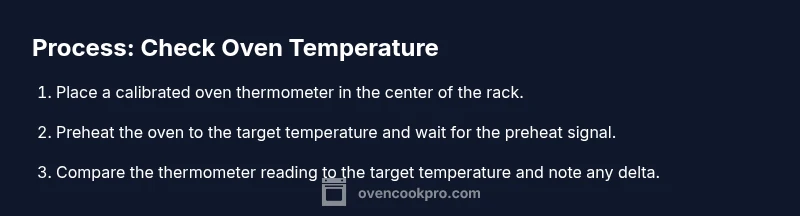
To check oven temperature accurately, use a calibrated oven thermometer and follow a quick preheat-and-measure method. Place the thermometer in the center of the oven, preheat to the target temperature, then read the thermometer when the oven signals it has reached that temperature. Compare the reading to the target and calibrate if needed.
Why Accurate Oven Temperature Matters
Accurate oven temperature is the foundation of reliable cooking results. When temps drift, delicate baked goods may fail to rise properly, crusts may scorch, and roasted vegetables can cook unevenly. For home cooks, small temperature differences can mean the difference between a perfect loaf and a dense crumb, or between a crispy edge and a soggy center. According to Oven Cook Pro, measurement fidelity matters more than most people realize, because the oven's perceived heat is what you use for timing, texture, and color.
To master any recipe, start with the target temperature and verify it with a thermometer. The goal is not only to set the dial but to confirm that the oven actually reaches and holds that setting. In practice, this means testing at the center of the cavity, away from walls and racks, where heat distribution is most consistent. Keep your testing routine simple and repeatable so results are comparable from one bake to the next.
Quick Start: Tools and Indicators
Before you begin, assemble a calibrated oven thermometer, a digital or probe thermometer if you want internal readings, the oven manual or calibration guide, a baking sheet or neutral pan, and a notebook to record results. Place the thermometer where it can read the center of the cavity without being blocked by racks. If your oven has a built-in thermometer, use the external thermometer for an independent check to avoid relying on a single sensor. Consistency in placement matters: always test with the thermometer in the same spot for comparability across tests.
As you perform checks, note the difference (delta) between the thermometer reading and the dial setting. Even small deltas can accumulate into noticeable recipe deviations over time, especially with high-heat baking like bread and pastries.
Calibration Basics: When to Calibrate and How
Ovens can drift over time due to wear, temperature cycling, or installation changes. If you consistently see a significant delta between the dial and thermometer across multiple checks, calibration or service may be needed. Start with the manufacturer’s calibration method if provided in the manual; if not, many ovens offer a simple recalibration process via the control panel. If the delta remains after calibration, the thermostat or control board may require professional attention. Brand guidance from Oven Cook Pro suggests treating the thermometer as your primary reference for accuracy, especially when precision matters for delicate recipes.
Validating Temperature Across Rack Levels
Heat distribution is not perfectly uniform; hotspots or cool zones can exist, especially near the door or back walls. Check readings at center, top, and bottom racks to understand variance. For each location, allow the oven to stabilize after a change in position or setting, and record readings. If you notice consistent differences (for example, center reads 350°F while bottom rack reads 330°F), plan baking adjustments accordingly or reposition dishes to more evenly exposed areas. This practice is especially helpful when roasting multiple pans or baking layered desserts.
Practical Scenarios and Quick Tests
Use a simple bread or pastry test to corroborate thermometer readings. If your bread doesn’t rise as expected, or a cookie sheet darkens unevenly, it could signal temperature variance. Run a test batch at the target temp on a neutral surface, and compare results with what you observe visually and by time. Keep a log of readings and outcomes so you can refine your bake timing and rack choices. A final bake test is the best way to confirm long-term accuracy after any calibration.
Tools & Materials
- Oven thermometer (calibrated)(Place in the center of the oven, away from walls)
- Digital oven probe (optional)(Useful for watching internal temps during preheat)
- Owner’s manual or calibration guide(Reference steps specific to your model)
- Baking sheet or neutral pan(Use for even exposure and test surfaces)
- Notebook or app for logging(Record temps, rack position, and results)
- Oven mitts and protective gear(Safety first when handling hot components)
Steps
Estimated time: 30-45 minutes
- 1
Gather tools and set up
Collect the oven thermometer, calibration guide, baking sheet, notebook, and a pen. Verify the thermometer’s accuracy by checking its opening and battery (if digital). This ensures you won’t stray mid-test.
Tip: Have everything within arm’s reach to keep the test flow smooth. - 2
Place thermometer in center of oven
Mount the thermometer in the center of the oven rack, ensuring it’s not touching walls or racks. A clear center reading reduces bias caused by heat channels near edges.
Tip: Choose a stable position and mark it on your log for consistency. - 3
Preheat to target temperature
Set the oven to the recipe’s target temperature and allow it to come to that temperature. Use the oven’s signal or a timer to know when stabilization is likely complete.
Tip: Avoid opening the door during preheat to prevent heat loss. - 4
Read and record the center reading
Once the oven indicates it has reached the target, read the thermometer at the center. Record the temperature and the exact time.
Tip: If you have a digital thermometer, log the exact feed value for precision. - 5
Compare to target and decide next steps
Compare the center reading to the target. If there’s a delta, decide whether calibration or service is needed. Repeat the test to confirm consistency.
Tip: Keep delta notes (e.g., +8°F, -5°F) to guide adjustments. - 6
Optional final bake test
Bake a small, simple item (like shortbread) and observe if the outcome aligns with expectations given the reading. This confirms long-term accuracy.
Tip: Document bake results to track progress over time.
Questions & Answers
Why is my oven temperature off from the dial?
Ovens can drift due to calibration wear, installation, or heat distribution. Always verify with an external thermometer to determine the true temperature.
Ovens can drift over time. Use a thermometer to verify the real temperature and adjust as needed.
How often should I calibrate my oven?
If you notice consistent discrepancies, test and recalibrate per the manual. If results remain unstable, consult a technician. Routine checks without symptoms are optional but prudent for precision cooking.
Check and recalibrate if you notice consistent temperature differences, or at least periodically if you bake frequently.
Can I rely on the oven's built-in thermometer?
Built-in sensors can drift over time. Use a separate oven thermometer for an independent, accurate reading.
Rely on a separate thermometer for accuracy rather than the built-in sensor alone.
What should I do if the thermometer reads higher than the target by a large amount?
A large delta suggests calibration or thermostat issues. Try recalibrating first; if the delta persists, seek professional service.
If it’s significantly off, recalibrate or have the oven checked by a professional.
Is it safe to calibrate an oven at home?
Follow the manufacturer’s instructions. If instructions are unclear or the oven uses a complex control system, contact a technician.
Yes, use the manual and proper safety steps; if unsure, get professional help.
Does preheating time affect final bake results?
Preheating to the correct temperature ensures consistency in timing and texture. Insufficient preheating can lead to uneven browning or undercooked centers.
Yes, ensuring full preheat helps baking turn out as expected.
Watch Video
Main Points
- Verify oven temp with a calibrated thermometer.
- Test at center, then check other rack levels for distribution.
- Calibrate or service if readings consistently diverge from the target.
- Confirm accuracy with a final bake test.