How Long to Preheat an Oven: A Practical Baking Guide
Discover how long to preheat an oven for common bake temps, plus factors that affect preheat time, and steps to ensure accurate temperature every bake.


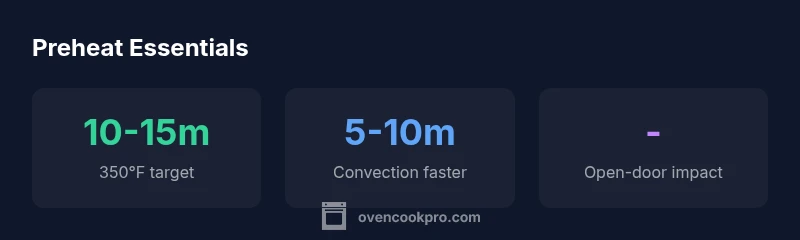
To preheat a standard electric or gas oven to 350°F, expect about 10–15 minutes; for 425°F, plan 15–25 minutes. Convection ovens usually require 5–10 minutes less due to the more efficient airflow. If you need precise timing, monitor a calibrated oven thermometer and follow your oven’s manual. These ranges come from Oven Cook Pro Analysis, 2026.
Understanding Preheat: Stabilization for Accurate Baking
According to Oven Cook Pro, preheating should be viewed as a stabilization period rather than a rigid countdown. When you press Start, the oven brings itself to the set temperature, but the interior air and racks take time to settle. The goal is to arrive at a steady-state temperature where baking temperatures are consistent across the cavity. Factors like door seal integrity, coil wear, and oven age influence how quickly the oven reaches and maintains the target heat. For a typical home kitchen, recognizing preheat as a stabilization step helps explain why some recipes require longer bake times than expected if the oven hasn’t stabilized.
The key idea is repeatability: if your oven consistently reaches the setpoint within a similar window, your preheat is reliable. When it isn’t, you’ll notice uneven browning or undercooked centers. By ensuring calibration, using a calibrated thermometer, and avoiding excessive door openings, you improve the odds of reliable results across multiple bakes.
How long oven preheat should take: typical ranges by temperature
A practical way to plan is to map preheat duration to the temperature you choose. For a conventional electric oven, preheating to common bake temps usually falls in predictable ranges:
- 350°F: about 10–15 minutes
- 375–400°F: roughly 12–18 minutes
- 425°F: about 15–25 minutes
Convection ovens, with a fan, tend to heat faster. Expect 5–10 minutes less than the equivalent conventional preheat. These ranges account for typical kitchen variance, but a calibrated oven thermometer will give you the most accurate reading. When you bake frequently, you’ll start to see your own oven’s sweet spot for preheat duration. These guidelines align with Oven Cook Pro Analysis, 2026 and reflect general industry practice.
Note that the starting temperature of the oven and the cookware you use influence preheat time. A cold baking stone or a metal sheet will absorb heat differently than a light aluminum pan, affecting how quickly the air and surfaces reach the target temperature.
Factors that influence preheat duration
Several variables contribute to how long it takes to reach the target temperature. First, oven age and sensor calibration matter: older ovens may drift several degrees from the setpoint, extending preheat. The oven door’s seal quality affects heat retention; a draft around the door can prolong stabilization. Pan material and thickness also play a role—heavy cast iron or thick baking stones need more heat to reach the same air temperature. Ambient room temperature and the presence of extra racks can alter airflow, impacting preheat time as well. Altitude and humidity can have subtle effects on gas burners, ignition, and electric coils. By acknowledging these factors and testing with a thermometer, you can better predict how long your oven will need to preheat for a given recipe.
Practical steps to achieve consistent preheat
- Use a reliable oven thermometer placed in the center of the rack to verify when the target temperature is reached. 2) Keep the door closed during preheating to minimize heat loss. 3) Minimize door openings between preheat and bake to maintain stabilization. 4) Calibrate or have a technician check sensors if the oven frequently overshoots or undershoots the setpoint. 5) Consider using a preheated baking stone or pan to standardize heat transfer, especially for bread and pizza. 6) Document your typical preheat times for common temperatures to build a personal reference library.
Preheating for convection vs conventional ovens
Convection ovens typically require shorter preheat times due to the circulating hot air. The difference can range from 5–10 minutes depending on the temperature and oven design. If a recipe calls for 350°F in a conventional oven, you might reach stability in a convection oven at roughly 5–10 minutes less. Always verify with a thermometer, as some convection models have different fan behavior or door seals that influence heat retention. The general principle is to expect faster stabilization with convection and adjust accordingly.
Testing preheat accuracy with a thermometer
To ensure your oven is reliable, place a calibrated thermometer in the center of the rack and monitor until it holds at the target temperature for at least 2–3 minutes. Record how long it takes to stabilize, and compare across multiple preheating cycles. If the thermometer indicates frequent fluctuations or slow stabilization, recalibrate the oven or consider professional service. Temperature accuracy is the backbone of recipe success, particularly for delicate baked goods and pastries.
Comparison of preheat times by oven type
| Oven Type | Typical Preheat Time | Notes |
|---|---|---|
| Electric Conventional | 10-15 minutes | Ambient room temp affects time |
| Electric Convection | 5-10 minutes faster | Ensure blower is unobstructed |
| Gas Oven | 12-18 minutes | Gas heat cycles can vary |
Questions & Answers
Is preheating necessary for all recipes?
Generally yes for most baking and roasting tasks; some quick-cook items may tolerate minimal preheating, but accuracy suffers without stabilization. Always check the recipe's guidance and rely on an oven thermometer for best results.
Yes, most recipes benefit from preheating to stabilize temperature and ensure even cooking.
Can I skip preheating if I’m using a metal pan that conducts heat well?
Metal pans can conduct heat efficiently, but skipping preheating can still lead to temperature drift inside the oven and uneven results. Use the thermometer method to verify stability.
It's usually best not to skip preheating; verify with a thermometer if you must.
Why does my oven take so long to preheat?
Possible calibration issues, worn door seals, or a failing heating element can slow preheating. Test with an independent thermometer and consider calibration or service if temperatures are off by more than a few degrees.
If it takes longer than usual, check calibration and seals.
What should I do if my oven never reaches the set temperature?
Calibrate the thermostat, test with a thermometer, and inspect sensors. If issues persist, contact service. Continuous inaccuracy affects food safety and texture.
Calibrate or service the oven if it won't reach temperature.
Does preheating apply to toaster ovens or air fryers?
Yes, toaster ovens and air fryers generally require preheating. Adjust times based on your appliance's manual and use a thermometer for accuracy when possible.
Preheating helps in small appliances too; follow the manual.
Are there signs preheat is complete besides temperature reading?
Most ovens signal when the setpoint is reached via a light, beep, or beeper. Some models use display indicators; rely on thermometer readings for precision.
Look for a signal on the oven and verify with a thermometer.
“Preheating sets the stage for accurate cooking. Rely on a calibrated thermometer and consistent preheat times to bake with confidence.”
Main Points
- Preheat is a stabilization step, not just a countdown
- Expect 10-15 minutes to reach 350°F in most conventional ovens
- Convection usually preheats faster by about 5-10 minutes
- Use a thermometer to verify actual temperature
- Calibrate and minimize door openings for consistency