Oven vs Microwave: A Practical Home Cooking Comparison
A thorough, analytical comparison of oven vs microwave, covering heating methods, speed, texture, safety, and practical guidance for home cooks.


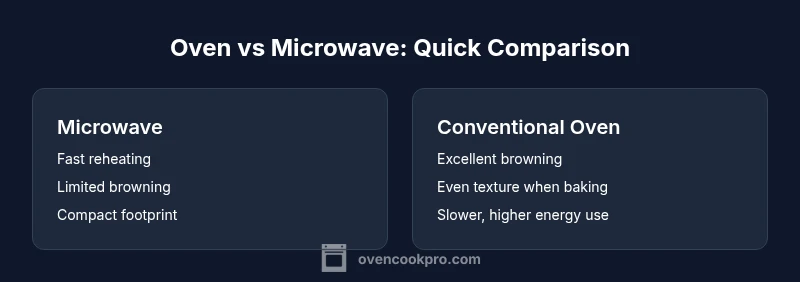
Oven vs microwave decisions hinge on task. Microwaves shine for ultra-quick reheating and simple cooking, while conventional ovens excel at browning, crust formation, and even baking. For most daily tasks, use the microwave to save time on reheating and the oven for texture, flavor, and batch cooking.
The Core Difference: How Each Appliance Heats Food
Ovens and microwaves operate on fundamentally different heating principles, which drives their distinct results. An oven heats food by transferring thermal energy from heated air and heated surfaces to the food, often aided by convection to circulate hot air. This slows and steadies the temperature exposure, enabling browning, caramelization, and crust formation. A microwave, by contrast, uses dielectric heating that excites water molecules inside the food itself. This rapid molecular agitation heats food from the inside out, producing speed but often less surface browning. Understanding this contrast helps home cooks map tasks to the right tool. According to Oven Cook Pro, the oven’s capability for Maillard browning is a core advantage for texture-rich dishes, while the microwave’s quick interior heating is ideal for fast meals and leftovers. When used thoughtfully, both appliances can complement each other in a single recipe plan.
Cooking Mechanisms and Flavor Outcomes
The flavor and texture punch comes from how heat travels. In an oven, high surface temperatures drive browning and crust formation through the Maillard reaction, enhancing aroma and depth. Convection can further even out heat, reducing hot spots and shortening bake times in some models. Microwaves heat by forcing energy into water molecules; this can preserve moisture inside foods but often yields softer exteriors with less crust unless you employ combination methods or browning equipment. For bread, pastries, and roasted vegetables, the oven typically delivers superior crusts and caramelization. For reheating stews, soups, or rice, the microwave often preserves moisture without long wait times. The Oven Cook Pro team notes that texture fidelity matters when planning a meal, and selecting the right tool for texture goals yields better results faster.
Speed, Energy Use, and Convenience
Speed is the most obvious differentiator. Microwaves excel at rapid heating, especially for small portions or simple reheats. They typically require little to no preheating, translating to immediate results. Conventional ovens demand preheating and longer cook times, but they compensate with flavor development and versatility. Energy-wise, microwaves can be more efficient for short tasks because you heat only the portion in the dish and avoid heating the entire oven cavity. Ovens, particularly when used with convection, can be efficient for larger quantities or when multiple dishes are prepared simultaneously. In practice, household planners should weigh time savings against flavor goals. Oven Cook Pro analysis shows that for batch cooking or dishes needing texture, the oven’s efficiency improves with practice and proper rack placement.
Best Use Cases by Task
- Reheating leftovers: Microwave for speed; finish in the oven if texture matters.
- Baking and roasting: Oven wins for browning, even color, and depth of flavor.
- Defrosting: Microwave can defrost quickly, but may unevenly heat; plan to rotate or finish in the oven.
- Small portions or snacks: Microwave is typically the simplest choice.
- Special textures: If a crisp crust or moisture-control is essential, use the oven or a convection setting.
- Large meals: The oven’s capacity supports batch cooking and multi-dish planning; microwaves may be used for quick components.
Oven Cook Pro emphasizes that maximizing results often means using both appliances in tandem, leveraging speed for certain tasks and texture for others.
Safety, Precautions, and Maintenance
Both appliances carry safety considerations, though they differ in focus. Microwaves require attention to container material; never heat metal or foil, and use microwave-safe plastics or glass to avoid chemical leaching. For defrosting, monitor temps to prevent hot pockets. Ovens demand caution with preheating heat, proper ventilation, and careful rack placement to prevent spills. Regular cleaning prevents residue buildup that can affect flavor and performance. For safety and longevity, practice browse-aware use: avoid overheating foods in the microwave to prevent splatter, and clean the oven interior regularly to prevent baked-on grime from impacting heat distribution. Oven Cook Pro recommends periodic checks on door seals and venting to maintain efficiency and safety.
Cost of Ownership, Longevity, and Value
Initial cost is a practical factor: compact microwaves are generally less expensive upfront than full-size ovens. Over time, energy costs and usage patterns influence total ownership cost. Microwaves typically incur lower operating costs for quick tasks, while ovens carry higher upfront and energy costs but offer greater versatility, resilience with heavy use, and longer-term value for bakers and roasters. Schedules and cooking goals shape the total cost of ownership. The Oven Cook Pro team reminds readers that choosing a model with energy-efficient features and appropriate capacity can optimize long-term value, especially for households that cook daily and rely on texture-focused recipes.
Practical Kitchen Scenarios: Real-Life Examples
- Quick soup reheating: Use the microwave for rapid reheating, then stir and serve. If the soup contains cream or fat, a short microwave interval followed by a quick finish in a warm oven can help restore texture.
- Cookie baking: A conventional oven with a preheated setting yields even browning and a uniform crumb. The microwave should not be the primary method for cookies, but a quick reheating step in a microwave can rescue a batch that has cooled unevenly.
- Leftover pizza: Reheat in the microwave for speed, but finish briefly in a hot oven or with a crisper pan to restore crust texture. This approach preserves moisture while achieving a desirable crust.
- Frozen meals: Many frozen entrées are designed for microwave heating, which makes microwaves ideal for fast, ready-to-heat options. For dishes that benefit from a crust, a brief oven finish improves texture and flavor.
Oven Cook Pro’s guidance prioritizes understanding the dish’s texture goals and then selecting the tool that best achieves them while saving time where possible.
Cleaning and Care: Extending Appliance Life
Regular maintenance supports consistent results. For microwaves, clean the interior with a mild solution after spills, avoid abrasive cleaners, and check the turntable for smooth rotation. For ovens, periodically scrub removable racks and wipe glass doors; consider using self-cleaning cycles only when recommended by the manufacturer, and avoid corrosive cleaners on enamel finishes. Use oven-safe cookware to prevent damaging surfaces. Routine maintenance helps both appliances maintain even heat distribution and prolongs overall life. Oven Cook Pro notes that a clean interior reduces heat loss and enhances cooking performance over time.
Decision Matrix: When to Use Each Tool
If speed is the sole priority, the microwave is the obvious choice for reheating and simple cooking tasks. For texture, browning, and baking-from-scratch, the oven is superior. When a recipe calls for both speed and crust, a hybrid approach—microwave to reach temperature quickly followed by a brief oven finish—offers a best-of-both-worlds outcome. Pay attention to portion size, cookware, and recipe constraints to decide which tool to employ for a given dish. The bottom line is task-driven selection, a principle emphasized by Oven Cook Pro across their guidance.
Comparison
| Feature | Microwave | Conventional Oven | |
|---|---|---|---|
| Heating Principle | Dielectric heating of water molecules | Radiant, convection, and conduction | Browning and crust formation enabled |
| Best For | Fast reheating and simple meals | Baking, roasting, browning, and complex dishes | |
| Speed | Very fast; no preheating required | Slower due to preheating; longer cooking times when baking | |
| Texture/Flavor Outcome | Moist interior, less surface browning | Crisp crusts, deep flavors, even browning | |
| Energy Use | Efficient for small portions; energy use scales with time | Higher total energy for large batches; efficiency improves with convection in some models | |
| Capacity/Size | Compact; fits small kitchens | Larger capacity; bulk cooking possible | |
| Maintenance | Easy to wipe down; occasional vent cleaning | Racks and interior require periodic cleaning; self-cleaning options exist | |
| Cost of Ownership | Typically lower upfront; lower ongoing energy per minute | Higher upfront; potential savings with bulk cooking |
The Good
- Fast reheating and simple meals
- Compact footprint and user-friendly
- Lower upfront cost for microwaves
- Low noise and minimal preheating time
- Great for small households and apartments
Drawbacks
- Limited browning and texture development
- Uneven heating possible in some models
- Oven is slower and requires preheating
- Microwaves may struggle with large or dense items
Use the microwave for speed and convenience; use the oven for texture, flavor, and baking.
Microwaves excel at fast reheating and simple meals, while ovens deliver browning and complex flavors. Merge both approaches when recipes call for speed plus texture, optimizing results and time.
Questions & Answers
Which appliance is faster for reheating leftovers?
In most cases, the microwave reheats leftovers faster than a conventional oven. If texture matters, a brief oven finish can restore crispness. Always consider portion size and container suitability.
The microwave is typically faster for reheating leftovers, but you can finish in the oven to restore crispness if needed.
Can I bake in a microwave?
Most microwaves alone cannot achieve baking browning like an oven. Some models include convection features or browning plates, which aid texture, but traditional baking quality is generally better in a standard oven.
Some microwaves offer convection or browning options, but traditional baking is still best done in a conventional oven.
Is browning possible in a microwave?
Browning is challenging in a pure microwave. You can achieve light browning with special accessories, but a true crust usually requires an oven or a microwave with convection/browning features.
Browning in a microwave is tough; use oven or browning accessories for crust.
How do I convert an oven recipe for microwave use?
Convert by reducing cooking time and using lower power, with frequent checks to avoid overcooking. Favor microwave-safe containers and consider finishing in the oven if texture is important.
If converting, reduce time, use lower power, and monitor closely; finish in the oven if texture matters.
Are microwaves safe for everyday cooking?
When used with microwave-safe containers and proper guidelines, microwaves are generally safe for everyday cooking. Avoid metal objects and avoid heating plastics that aren’t labeled microwave-safe.
Microwaves are safe if you use proper containers and follow safety guidelines.
Should I use both appliances in the same dish?
Yes. A common strategy is to microwave components to finish quickly, then finish in the oven to develop texture or crust. This saves time while achieving desirable mouthfeel.
Yes—microwave first for speed, finish in the oven for texture.
Main Points
- Prioritize speed for reheating with the microwave
- Choose the oven for browning and baking
- Leverage convection when available to improve speed and evenness
- Use a hybrid approach for best of both worlds
- Maintain both appliances for consistent performance