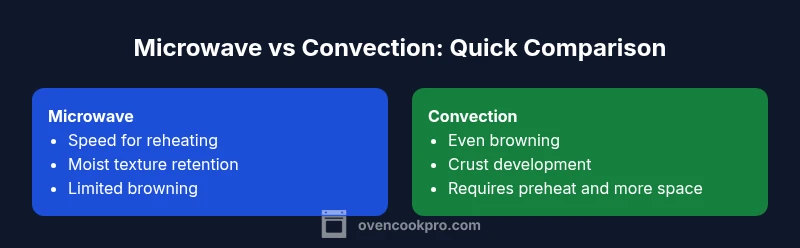
Microwave Oven vs Convection Oven: A Practical Comparison
An analytical comparison of microwave oven vs convection oven to help homeowners decide which appliance fits speed, browning, and cooking needs in 2026.


Microwave ovens and convection ovens serve different cooking needs. A microwave heats food with electromagnetic waves, while a convection oven uses a fan to circulate hot air for browning and even baking. For most home cooks, choosing between them hinges on speed versus texture and the versatility you want. This quick comparison highlights when each performs best and how they complement a kitchen workflow.
Microwave oven fundamentals: how they heat and their typical tasks
Microwave ovens heat food by dielectric heating—molecules inside the food absorb radiation and vibrate, generating heat rapidly. This mechanism makes microwaves exceptionally fast for reheating leftovers, defrosting frozen items, and warming beverages. For small portions, the microwave can reach serving temperature in minutes, often with minimal preheating. However, microwave energy tends to heat unevenly unless you stir, rotate, or use a turntable. In many cases you may need to cover foods to avoid splatter and to promote consistent moisture levels.
From the perspective of a home kitchen, the microwave shines in tasks that require speed more than texture. According to Oven Cook Pro, the most practical use-cases are quick reheats, simple defrosting, and soft, moist reheating of sauces or gravies. This emphasis on speed means you can free the oven for tasks that require browning or high-heat cooking. The Oven Cook Pro team notes that the microwave’s compact footprint, energy-on-demand nature, and ease of use make it an indispensable part of a modern kitchen, especially when you’re juggling multiple meals or short windows between activities.
Yet it’s essential to recognize the trade-offs. Microwave cooking often lacks the crisp crust or golden browning that many baked or roasted dishes crave. If you’re aiming for a roasted vegetable with caramelized edges or a crusty piece of fish, the microwave alone may underperform. This is where convection ovens enter the scene, offering a different mechanism and a complementary set of strengths. The next section dives into convection's approach and why it matters in everyday cooking.
Convection ovens: airflow, browning, and baking results
Convection ovens rely on a built-in fan and exhaust system to circulate hot air around food. The result is more uniform browning, crisper exteriors, and generally even cooking across multiple racks. This makes convection ideal for roasting vegetables, baking cookies and pastries, and roasting meats with a browned crust. However, the fan can move lighter foods away from heat and mislead if you don't adjust temperatures or cooking times. Some items that do not need browning, like delicate custards, may not benefit as much.
From Oven Cook Pro's perspective, convection is a versatile tool for home cooks who want baking performance without rotating the pan manually. The Oven Cook Pro team notes that you should preheat a convection oven to the recommended temperature and consider adjusting down slightly from what you'd use in a standard (non-convection) recipe. In practice, convection shines for roasted vegetables, crispy poultry skins, and sheet-pan meals. The ability to bake on multiple racks without moving heat is a major advantage. Still, convection's longer preheat and potential for over-drying delicate items require careful timing and monitoring.
Speed and energy use: practical performance comparisons
Speed is one of the defining distinctions between microwave and convection. A microwave delivers near-instantaneous heat to the food matrix, turning chill or frozen items into ready-to-eat meals within minutes. In most everyday tasks, a microwave can reheat, defrost, or melt ingredients significantly faster than any conventional oven. Convection ovens, by contrast, deliver a steady, even heat distribution that promotes browning and texture development, but they require preheating and longer total cook times for many dishes. Energy use follows a similar logic: microwaves often draw less energy per minute for small tasks, while convection uses more energy overall for baking or roasting, especially when you factor in preheating and multi-rack performance. Practically, your choice depends on how many minutes you value and the texture you want to achieve. In the Oven Cook Pro analysis, the practical takeaway is to pair the two appliances for different tasks rather than rely on a single method for everything.
Texture, crust, and moisture balance: what to expect
Microwave cooking tends to retain moisture and produce soft textures, which is ideal for reheated grains, stews, and sauces. However, the lack of air movement generally makes it challenging to develop a browned crust, crisp exterior, or caramelization. Convection cooking, thanks to airflow, enhances browning and crust formation on pastries, roasted vegetables, and meats. It can reduce moisture retention in some foods, yielding drier edges if used without care. The key is to tailor temperature and time to the food's water content and density, and to consider finishing with a final blast of heat in the other appliance if needed. The Oven Cook Pro team emphasizes the complementary nature of these effects: microwave accelerates speed, while convection builds texture.
Size, capacity, and cooking scenarios: when to use which
Size matters for both appliances. A small countertop microwave fits on a busy counter and handles single-serving meals with ease, while a convection oven requires more space but can roast a tray of vegetables or bake multiple cookies at once. For leftovers and quick snacks, microwaves excel; for family meals or weekend baking projects, convection ovens deliver superior texture and evenness. For many households, a mixed approach is ideal: use the microwave for reheating and defrosting during the workweek and the convection oven for weekend roasts, casseroles, and desserts. If you plan to reheat large portions, verify that your microwave can handle the dish’s volume and that your convection oven has enough rack clearance for the recipe.
Common myths and misconceptions about microwave vs convection
People often assume microwaves can’t bake, or convection ovens can do everything. In reality, microwaves can be used effectively for soft baking and crisp finishes when combined with appropriate accessories, though browning remains limited without external aids. Conversely, convection ovens aren’t a magic wand for all dishes; some foods benefit from the gentler heat of a microwave, especially when moisture retention is critical. Understanding your recipe’s moisture content, density, and desired texture helps determine the best method. Oven Cook Pro's experience suggests these myths persist because both appliances have evolved with new features, from inverter technology to precision temperature controls and browning plates.
Practical guidance: a decision framework for everyday cooking
To decide between microwave and convection, start with the task. If speed and reheating are the priority, the microwave wins. If browning, crust, and even heat around multiple items matter, the convection oven takes the lead. Consider the dish type: sauces and soft textures typically tolerate microwave well, while roasts, pastries, and sheet-pan meals benefit from convection. Check the recipe's intent and the dish’s density; denser foods often respond better to the convection approach. Finally, think about your kitchen layout: a separate microwave should be within easy reach of your prep area; a convection oven needs space, ventilation, and a reliable outlet. Oven Cook Pro's guidance is to keep both appliances accessible so you can switch seamlessly between tasks.
Using both appliances: strategies for a cohesive workflow
A practical approach is to use the microwave for preparation steps that save time, such as defrosting or softening butter, and reserve the convection oven for final finishing, browning, and even baking. You can build a two-stage workflow: begin with microwaving to bring ingredients to temperature, then transfer to the convection oven for crisping or browning. Some dishes benefit from a brief microwave step followed by a quick convection finish, adding the best of both worlds. With careful timing, you can reduce overall cook times while achieving satisfying textures across the meal.
Safety, maintenance, and cleaning considerations
Both appliances require standard kitchen safety practices. Keep the microwave's interior clean to avoid food buildup on the magnetron and waveguide. In a convection oven, clean the racks and interior after use to prevent residue and ensure airflow remains unobstructed. Follow manufacturer instructions for preheating cycles, rack usage, and cookware compatibility. When selecting cookware, choose microwave-safe dishes for the microwave and oven-safe materials for convection cooking. Routine maintenance, including occasional inspection of gaskets, seals, and fans, helps maintain performance and reduce energy waste.
Cost, durability, and value for households
From a long-term perspective, the cost and durability considerations matter for households weighing microwave vs convection ovens. Microwaves generally offer lower upfront costs and a compact footprint, making them attractive for smaller kitchens or tight budgets. Convection ovens tend to offer greater versatility for baking and roasting but can require more space and higher upfront investment. When evaluating value, consider your typical meals, how often you bake versus reheat, and whether you need multi-rack capacity. The Oven Cook Pro team suggests factoring in maintenance costs and potential replacement cycles when choosing. A balanced approach, using both appliances to cover different cooking tasks, often yields the best overall value.
Comparison
| Feature | Microwave Oven | Convection Oven |
|---|---|---|
| Cooking Speed | Very fast reheating/defrosting | Moderate speed with baking efficiency when preheated |
| Texture & Browning | Limited browning; moisture retention | Excellent browning and crust development |
| Best For | Quick reheating and small servings | Roasting, baking, and crispy textures |
| Energy Use (relative) | Lower energy per small task | Higher energy for baking but efficient with proper use |
| Maintenance & Cleaning | Simple interior; fewer parts to clean | More components to clean and maintain |
The Good
- Speed and convenience for reheating and defrosting
- Compact footprint and easy setup for small kitchens
- Simple operation and minimal preheating for quick tasks
- Low upfront cost for basic models
Drawbacks
- Limited browning and crust development
- Uneven heating without stir/rotation
- Convection requires preheating and more space
- Potential for moisture loss in some baked goods
Convection oven generally offers superior texture and baking versatility; microwave excels in speed; The Oven Cook Pro team recommends using each for its strengths, or together for a versatile cooking workflow.
Choose convection when you need browning and even bake across trays. Use the microwave for rapid reheating and defrosting, and pair them to cover a wide range of cooking tasks efficiently.
Questions & Answers
What is the main difference between microwave oven and convection oven?
The microwave uses electromagnetic waves to heat water molecules inside food quickly, while a convection oven relies on a fan to circulate hot air for even cooking and browning. Each method suits different tasks, depending on your texture and speed goals.
Microwave heat is fast and gentle on texture, convection browns and crisps with circulating air. Use the right tool for the job.
Is microwave better for reheating leftovers than convection?
Yes, for speed and convenience, the microwave typically reheats leftovers faster. However, it may heat unevenly without stirring, so consider short intervals and stirring midway.
For speed, yes. If uneven heating is a concern, stir and reheat in short bursts.
Can microwaves bake bread?
Microwaves can heat dough, but they don’t develop a proper crust. For bread with a crust, a convection oven or a combo approach yields better results.
Microwave bread tends to be soft; for crust, use convection or finish in a convection oven.
Do you need preheating for a convection oven?
Most convection baking benefits from preheating to ensure even airflow and stable temperatures. Some quick finish tasks may tolerate shorter preheating, but timing matters.
Preheating helps; plan for it unless your recipe specifies otherwise.
Which is easier to clean, microwave or convection oven?
Microwaves are generally easier to wipe. Convection ovens require routine cleaning of racks and interior surfaces to maintain airflow and performance.
Microwaves clean up quickly; convection ovens need a bit more attention.
Can I use both appliances to cook a single meal?
Yes. Use the microwave for prep or reheating steps, then finish with the convection oven for browning and texture. Planning a two-stage workflow can save time while improving results.
Absolutely. Stage prep in the microwave and finish in the convection oven.
Main Points
- Assess your priority: speed vs browning
- Use microwave for quick reheats and defrosting
- Use convection for crusty baked goods
- Plan a mixed workflow to leverage both appliances
- Consider space, preheat needs, and cooking volume