Oven vs Microwave: A Practical Buy Guide for 2026
A data-driven comparison of ovens and microwaves for homeowners. Learn performance, space, energy, and cost considerations to decide what to buy for your kitchen in 2026.


For most kitchens, a microwave (including convection models) wins on speed, defrosting, and compact layouts, while a traditional oven excels at baking, browning, and large-volume cooking. If you have space and budget for both, a compact convection oven or a combination unit can bridge the gap. This guide helps you decide what to buy oven or microwave based on your cooking tasks and kitchen constraints.
The Core Question: what to buy oven or microwave
When homeowners ask what to buy oven or microwave, the first step is to map your daily tasks to the strengths of each appliance. The Oven Cook Pro team emphasizes that most households perform a mix of quick reheats and more deliberate baking or roasting. Start by listing your most frequent meals and cooking tasks: reheating leftovers, defrosting proteins, baking cookies, roasting vegetables, and cooking large roasts. Consider your kitchen footprint, electrical outlets, and ventilation. If you are tight on space, a countertop microwave with convection may cover both reheating and light baking, whereas a full-size oven demands a larger footprint and higher energy use. According to Oven Cook Pro, the best decision emerges from task alignment rather than chasing the newest feature set. In this guide, we analyze the practical differences, costs, and space implications to help you decide what to buy oven or microwave with confidence.
Oven Capabilities: When an Oven Excels
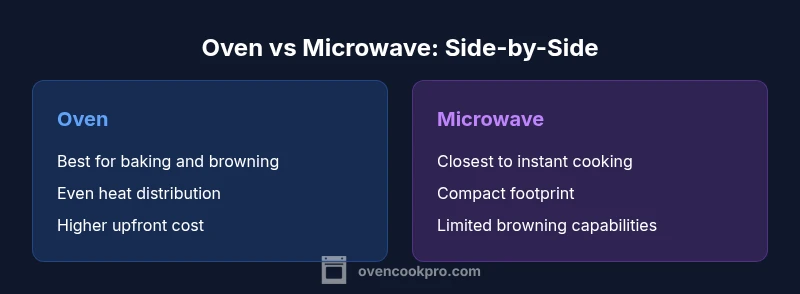
A traditional oven delivers dry heat, precise temperature control, and the ability to brown, crisp, and caramelize foods. It shines for baking bread, roasting meats, and slow braising. Convection modes circulate hot air, reducing cooking times and promoting even browning across large dishes. For home cooks who regularly bake pizzas, cookies, casseroles, or sheet-pan roasts, the oven remains the workhorse of the kitchen. Temperature stability matters here: lower temperatures for gentle roasts, high heat for searing, and dedicated bake modes for pastries. In addition, a built-in or freestanding oven integrates into cabinetry for a streamlined look, which can boost long-term home value. From a maintenance standpoint, ovens have more interior surfaces to clean, yet racks and pans simplify routine care. For households with kids or frequent entertaining, investing in a robust oven with even heat distribution pays dividends over time. The Oven Cook Pro analysis underlines that raw cooking capacity—baking, roasting, and browning—still hinges on a true oven experience rather than a microwave surrogate.
Microwave Strengths: Speed, Convenience, and Modern Cooking
Microwaves outperform ovens on speed and convenience, turning around reheats, defrosts, and simple meals in minutes. Modern microwaves offer sensors, auto-cook presets, and compact footprints that fit under cabinets or on a countertop. For households prioritizing quick meals, leftovers, or small portions, a microwave is invaluable. The advent of convection microwaves expands capabilities beyond simple reheating by delivering browning and crisper textures, though they may not match a traditional oven’s performance for certain baked goods. Energy use for microwaves tends to be lower for brief tasks, and you can achieve surprisingly good results with the right cookware and settings. In practice, many kitchens balance both appliances: a microwave for fast tasks and an efficient oven for deeper cooking. Oven Cook Pro’s take is that modern microwaves with convection are a strong compromise for users who want faster meals without sacrificing texture and some browning capabilities.
Hybrid and Countertop Solutions: Do You Need Both?
If space permits, a countertop convection oven or a microwave-convection unit can emulate many oven tasks without dedicating a full-size oven. These hybrids offer a smaller footprint, faster preheats, and flexible placement. A toaster oven with convection mode can tackle small-batch baking, while a compact microwave with browning or crisping functions can handle everyday reheating. For larger households or frequent entertainers, a separate full-size oven may justify the extra space and energy savings per batch. The key is to compare total cost of ownership and consider how often you perform tasks like roasting a chicken or baking a sheet of cookies. In practice, hybrid solutions can cover most daily needs while preserving kitchen flow and resale value.
Space, Footprint, and Kitchen Layout Considerations
Designing around space is crucial when choosing between an oven and a microwave. A freestanding oven often requires a dedicated wall footprint and appropriate ventilation, whereas a microwave can free up wall space or live on a countertop or in a low cabinet. Power availability matters: an electric oven typically requires a dedicated circuit, while microwaves rely on standard outlets. In compact kitchens, counter or drawer-style microwaves with convection can save space while offering baking-style results. If you have an open-plan kitchen or avoid moving heavy items, consider placement that minimizes the distance you must carry hot dishes from the oven to the table. These layout decisions influence usability and safety, especially when children are present.
Cost of Ownership and Energy Use: A Practical Lens
Upfront costs vary widely: microwaves are generally cheaper to buy, while ovens range from mid- to high-cost depending on capacity and features. Ongoing energy use reflects task duration and appliance efficiency. For frequent bakers or families that rely on long cooking sessions, the oven’s energy footprint can be meaningful, whereas microwaves excel for quick tasks with modest energy impact. Maintenance costs also differ: ovens require periodic cleaning and calibration of thermostat, while microwaves mainly need interior wipe-downs and occasional vent cleaning. Oven Cook Pro’s analyses emphasize evaluating the typical meal profile in your home to estimate energy and maintenance costs over time, rather than focusing only on purchase price.
A Practical Buying Framework: 7 Steps to Decide
- List your top 5 cooking tasks (baking, reheating, roasting, microwaving, toasting). 2) Measure your space and confirm cabinet or counter depth and ventilation. 3) Estimate budget, including potential installation or cabinet work. 4) Decide if you want built-in aesthetics or a freestanding option. 5) Evaluate energy expectations and long-term operating costs. 6) Consider future cooking needs, such as baking bread or large gatherings. 7) Compare models with and without convection to determine the best balance of speed, texture, and capacity.
This framework helps you determine if you should buy an oven, a microwave, or a hybrid approach for your kitchen setup. The end goal is to align purchasing decisions with real-world use rather than chasing marketing claims. The Oven Cook Pro team notes that practical decision-making often results in better outcomes than relying solely on feature lists.
Real-World Scenarios: How Real Homes Decide
Scenario A: A single adult in a small apartment prioritizes speed and space. A compact convection microwave or a small countertop oven could handle most meals while saving valuable kitchen real estate. Scenario B: A family that bakes weekly and roasts on weekends benefits from a full-size oven to manage multiple dishes at once. Scenario C: A hobbyist who bakes bread or pastries often will prefer an oven for texture control and browning, potentially supplemented by a microwave for quick meals. Each scenario demonstrates that the decision is not one-size-fits-all; it hinges on actual cooking habits, kitchen layout, and budget. The Oven Cook Pro team recommends analyzing meal patterns for a realistic choice that scales with your needs.
Comparison
| Feature | oven | microwave |
|---|---|---|
| Primary use | Baking, roasting, browning, high-heat cooking | Reheating, defrosting, quick cooking; some models with convection |
| Typical cooking methods | Dry heat, browning, pastry work, sheet-pan meals | Fast heating, moisture retention, browning in convection variants |
| Size/Footprint | Larger footprint; built-in or freestanding options | Smaller footprint; countertop or under-cabinet fit |
| Energy considerations | Higher energy use for long cooks; convection can help | Lower energy use for short tasks; some models offer energy-saving modes |
| Best for | Baking, batch roasting, and texture-focused dishes | Speedy meals, reheats, and compact kitchens |
| Maintenance | More components; regular cleaning and thermostat calibration | Simpler maintenance; fewer heating elements to service |
The Good
- Provides even heat for baking and roasting
- Excellent for large dishes and batch cooking
- Can be built-in for a clean kitchen look
- Convection variants offer faster cooking times
- Long-term value for households with diverse meals
Drawbacks
- Higher upfront cost and larger footprint
- Longer preheat times for many recipes
- Energy use increases with heavy baking sessions
- Microwaves cannot fully replicate oven browning in some cases
Oven wins for texture, capacity, and versatility; microwave wins for speed and space in small kitchens
Choose an oven if baking, roasting, or browning are frequent tasks. Opt for a microwave when speed and compact footprint are priorities. If space and budget allow, consider a hybrid solution (compact convection oven or microwave-convection) to cover a broader range of cooking needs.
Questions & Answers
What is the main difference between an oven and a microwave?
Ovens cook with dry, radiant heat and can bake, roast, and brown foods evenly. Microwaves heat food quickly using microwave radiation, which excels at reheating and defrosting but struggles with true browning. Convection microwaves add airflow to improve texture, but they still differ from traditional ovens in heat distribution.
Ovens bake and brown; microwaves heat fast. Convection microwaves get closer to oven results, but aren’t identical to a full-size oven.
Is a microwave cheaper to run than an oven?
For short, small tasks, microwaves generally use less energy than a full-size oven. However, when you regularly bake or roast large quantities, the cumulative energy use of an oven can be comparable or higher. Consider your typical cooking load and choose an appliance that matches that pattern.
Microwaves usually save energy for quick tasks, while ovens consume more energy during long baking or roasting sessions.
Can you bake in a microwave?
Traditional baking is best done in an oven due to even heat and browning capabilities. Some microwaves offer convection or browning functions that can handle simple baking tasks, but results may differ from a conventional oven. For pastries and bread, an oven remains the preferred tool.
Microwaves can bake, but convection and exact browning aren’t the same as a real oven.
What should I consider for a small kitchen?
In small kitchens, a countertop convection microwave or a compact convection oven can provide many oven-like benefits without occupying a full wall footprint. Prioritize models with browning or crisping if you want better texture. Ensure there’s adequate ventilation and safe placement for hot cookware.
Small spaces benefit from compact convection options and smart placement; think about ventilation and accessibility.
Are combo units worth it?
Combo microwave-oven units save space and simplify workflows but may compromise on peak oven performance or price. If you frequently need both functions, a hybrid can be a smart compromise. Compare long-term usage with upfront costs to determine value.
Combo units can be convenient, but check whether you’ll actually use both modes enough to justify the cost.
What features matter most when buying?
Prioritize wattage, convection capability, browning or crisping functions, size, and safety features such as child locks and auto shut-off. For ovens, look for even heat distribution, multiple rack positions, and reliable thermostats. For microwaves, sensor cooking and defrost performance matter.
Focus on wattage, convection, size, and safety features for a practical choice.
Main Points
- Define core tasks before buying to guide your choice
- Space-efficient setups favor microwaves or compact convection units
- For frequent baking, prioritize an oven over a microwave
- Hybrid options can balance performance with footprint
- Evaluate total ownership cost, not just purchase price