What is better oven or microwave? A practical comparison for home cooks
A analytical, data-driven look at when a traditional oven vs a microwave shines. Learn use-cases, pros and cons, and a clear verdict to guide your kitchen setup.


According to Oven Cook Pro, when you ask what is better oven or microwave, the best choice depends on the task, space, and goals. For speed and convenience, the microwave excels at reheating and simple cooking. For browning, texture, and baking, the traditional oven usually delivers superior results. This comparison helps you decide based on meals, kitchen layout, and energy considerations. The following sections break down the differences with a practical decision framework.
What is the core difference between oven and microwave
The oven and microwave are two distinct classes of kitchen appliances designed for different goals. An electric or gas oven uses radiant heat to cook food at higher, more stable temperatures, enabling browning, caramelization, and even crust formation. A microwave oven uses electromagnetic waves to excite water molecules, producing rapid heat from the inside out. This fundamental distinction explains why each tool shines in different tasks. When you ask what is better oven or microwave, the answer depends on what you aim to achieve: texture, moisture, time, and flavor development. Today’s kitchens often house both devices, allowing cooks to leverage their complementary strengths. From a practical standpoint, the microwave excels at quick reheating, thawing, and simple meals, while the oven handles baking, roasting, and dishes that benefit from dry heat and Maillard reactions. The Oven Cook Pro team notes that the most satisfying setups use both appliances in a coordinated way, matching the task to the right tool rather than forcing one device to do everything.
Speed and efficiency: how speed shapes decision
Time is a critical factor in modern cooking, and speed often dictates which appliance you reach for first. The microwave delivers heat quickly by targeting water molecules and tends to produce fast results for reheating leftovers, steaming vegetables, or warming beverages. In contrast, the oven requires longer preheating and cooking times, but it creates heat throughout the dish and promotes moisture loss, browning, and crisp textures that microwaves struggle to replicate. From a decision-making perspective, speed should be evaluated in the context of the recipe: a microwave might save minutes on a simple dish, but for a loaf of bread, roasted vegetables, or a casserole with a crust, the oven’s even heat becomes a meaningful differentiator. Oven Cook Pro’s analysis emphasizes that you should value a reliable pace that aligns with your routine: if you cook on tight deadlines, the microwave can be a time-saver; if you value texture, plan for oven-based cooking when possible.
Texture, browning, and flavor development
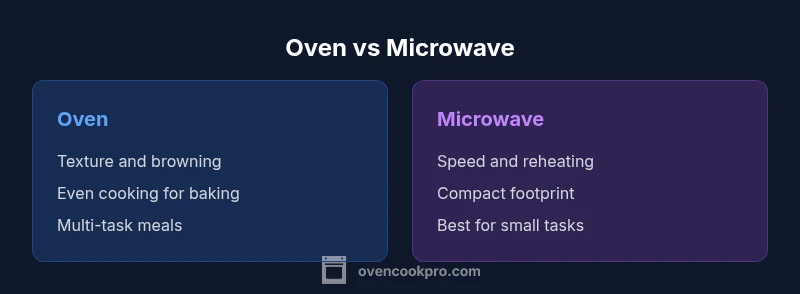
Texture and browning are core experiential differences between ovens and microwaves. The oven’s dry heat supports Maillard reactions that create golden-brown surfaces, crispy edges, and deeper flavors. Microwaves heat primarily through internal moisture, often leaving foods soft or unevenly warmed and lacking characteristic browning. There are exceptions: finishing a microwave-cooked item with a brief oven finish or using a microwave with a browning element can improve results, but it won’t fully replicate traditional oven browning. For delicate baked goods like cookies, pies, or breads, ovens generally offer superior crumb structure and aroma. If your meals rely on texture as a defining feature, prioritize the oven; for precise reheating of leftovers, a microwave remains a practical ally. Oven Cook Pro’s practical guidance suggests using texture as a guiding metric when deciding which appliance to deploy.
Practical use-case scenarios
- Reheating leftovers: the microwave offers rapid temperature return with minimal effort. - Baking cookies, cakes, and bread: the oven delivers reliable texture, even browning, and better aroma. - Roasting vegetables or proteins: the oven provides dry heat essential for caramelization. - Quick meals and reheating convenience: the microwave shines for simple, small dishes. - Combined workflows: plan to use the microwave for initial heating and the oven for finishing touches to optimize time. In real kitchens, this duo reduces cooking time while preserving quality. The key is matching the task to the right tool and avoiding over-reliance on a single device.
Cost of ownership and maintenance
Upfront costs vary, with microwaves generally being cheaper to purchase than full-size ovens. Long-term energy use tends to be task-dependent: frequent, quick tasks favor the microwave, while frequent baking or roasting can justify the oven’s higher energy profile. Maintenance considerations differ as well: microwaves have fewer moving parts and simpler maintenance, while ovens demand regular cleaning, proper ventilation, and occasional calibration. Choose based on your cooking habits, budget, and willingness to manage maintenance cycles. Oven Cook Pro’s guidance highlights that a balanced approach can minimize overall ownership costs while maximizing cooking flexibility.
Space, design, and kitchen ergonomics
Counter space is a premium in many kitchens, so the microwave’s compact footprint often wins in small setups. Ovens require more space and clearances, and built-in options demand careful design planning. Ventilation and heat management matter for ovens, especially in smaller kitchens. If your layout restricts vertical space or requires a single appliance to serve multiple purposes, a microwave may be the pragmatic choice; if you frequently perform baking tasks or host family meals, an oven offers greater versatility and resilience against routine overuse. Ergonomics also plays a role: placing the microwave at eye level can speed meal prep, while an oven’s controls should be accessible without bending or reaching into hot spaces.
Safety considerations and best practices
Both devices require safe operation, yet the risks differ. Never place metal objects in a microwave, and avoid overheating liquids that can erupt. For ovens, always use heat-safe cookware, be mindful of hot surfaces, and follow preheating recommendations. Regular cleaning prevents greasy build-up, which can influence cooking results and appliance lifespan. Education and clear labeling—in particular for households with children—helps prevent accidents. Oven Cook Pro emphasizes building safe routines around timing, load size, and cookware compatibility to maintain consistent results and avoid mishaps.
Decision filters: a quick framework to choose
Use the following questions to steer your choice:
- Are you baking, roasting, or browning? If yes, favor the oven.
- Do you need speed and minimal cleanup? If yes, favor the microwave.
- Do you have limited counter space? The microwave is often the better fit.
- Do you regularly prepare complex meals with multiple components? The oven’s multi-tasking ability shines here.
- Is energy efficiency a priority for small, quick tasks? The microwave may be more efficient for those tasks. Apply these filters to determine which tool will most often serve your needs.
A practical decision framework: closing the loop
In real-world kitchens, most households benefit from both appliances. Start by assigning routine tasks: use the microwave for reheating and simple cooking, and reserve the oven for baking, roasting, and anything requiring browning. Develop a weekly plan that assigns time blocks where you rely on each device, avoiding overlap that wastes energy or compromises texture. If you’re upgrading or reorganizing a kitchen, consider a model that complements your typical menu: a compact microwave in a convenient location paired with a capable oven that handles the majority of multi-component meals. This hybrid approach aligns with Oven Cook Pro’s recommended strategy: maximize flexibility, minimize unnecessary work, and tailor appliance use to the recipe rather than the tool alone.
Comparison
| Feature | Conventional Oven | Microwave Oven |
|---|---|---|
| Best used for | Baking, roasting, browning, and texture-rich recipes | Reheating, steaming, and quick cooking |
| Speed and convenience | Longer preheat and cook times, but uniform results | Very fast for reheating and simple tasks |
| Texture outcomes | Crisp, browned surfaces with deep flavors | Soft, moist interiors; limited browning |
| Energy considerations | Typically higher energy use for extended cooking | Often lower energy use for short tasks |
| Meal versatility | Supports a wide range of techniques and meals | Best for quick servings, snacks, and reheating |
| Purchase cost | Mid-range to high depending on model and features | Low to mid-range with fewer capabilities |
| Size and footprint | Larger footprint; built-in options available | Compact footprint suitable for small spaces |
| Maintenance and longevity | Robust with proper care and regular cleaning | Fewer moving parts; generally simple maintenance |
The Good
- Fast, convenient reheating and basic cooking with a microwave
- Superior texture, browning, and even cooking with a traditional oven
- Versatility for baking, roasting, and multi-component meals
- Potential energy efficiency for batch cooking when used optimally
- Low maintenance footprint for some microwave models
Drawbacks
- Microwave limitations on browning and texture compared to an oven
- Oven requires preheating and longer cooking times
- Microwave performance can vary with dish size and material
- Overreliance on one appliance can reduce cooking variety
A well-rounded kitchen benefits from both appliances; the oven often wins for texture and baking, while the microwave shines for speed and reheating.
Choose the oven for dishes needing browning, crust, and even texture. Use the microwave for quick reheating and simple meals. A hybrid approach delivers the best balance of speed, quality, and flexibility.
Questions & Answers
Is it better to reheat leftovers in a microwave or oven?
For speed and moisture retention, the microwave is usually quicker and more convenient for reheating. The oven, however, can restore texture and crispness if you have the time to spare. A combined approach—microwave for initial heat, oven for finishing—often yields best results.
Use the microwave for a fast reheat, then finish in the oven if you want crisp edges and better texture.
Can microwaves bake cookies or cake like an oven?
Microwaves can cook cookies or cake but typically don’t develop the same texture and browning as an oven. They are useful for quick, small-batch treats, but expect softer textures and less aroma. For best results, bake in a traditional oven.
You can bake in a microwave, but the texture won’t match a conventional oven.
Is foil safe in a microwave?
Plain aluminum foil can cause arcing and damage in a microwave. Some microwaves allow small, smooth-edged foil if the manufacturer specifies, but use caution and follow the user manual. When in doubt, avoid foil and use microwave-safe containers instead.
Don’t use foil unless the manufacturer says it’s safe.
Do ovens use more energy than microwaves?
Ovens generally use more energy for longer cooking tasks because of preheating and sustained heat. Microwaves are more energy-efficient for short tasks. Your total energy use depends on how you sequence tasks and the duration you run each appliance.
Ovens tend to use more energy over a longer cooking session; microwaves are usually more efficient for quick tasks.
Are there hybrid appliances that combine both functions?
Yes, some appliances combine convection or grill features with microwave functions. These hybrids can offer faster reheating with improved browning, but they still may not fully replace a dedicated oven for all baking or roasting tasks. Use them to complement, not completely replace, your core tools.
There are combination units, but they don’t always replace a traditional oven.
When should I upgrade to convection or consider a combo oven?
If you frequently bake or roast items and seek more even browning, a convection option within an oven can be a valuable upgrade. For many households, a standard oven plus a microwave remains the most practical setup. Convection can improve speed and result for larger batches, especially at home.
Consider convection if you bake often and want even browning; otherwise, stick with the standard oven and microwave.
Main Points
- Use both appliances to cover all cooking needs
- Reserve the oven for baking, roasting, and texture-rich tasks
- Use the microwave for reheating and simple meals to save time
- Plan your kitchen setup to minimize unnecessary moves and energy waste
- Create a task-based workflow to maximize efficiency