Oven or Microwave? A Practical Comparison for Home Cooks
Explore the differences between ovens and microwaves, how to tell them apart, and when each is best for recipes. Is it oven or microwave? This guide clarifies heating methods, timing, and safety for everyday cooking.


Is it oven or microwave? The two appliances heat food in fundamentally different ways. An oven uses radiant heat or hot air to bake and brown, while a microwave uses microwaves to heat water molecules for fast warming. When identifying the device, check the door label, interior rack design, and heat source to distinguish between oven and microwave.
What Distinguishes an Oven from a Microwave
If you’re asking is it oven or microwave, you’re not alone. The answer hinges on how each appliance heats food and what results you can expect. Ovens rely on radiant heating from electric coils or gas flames, plus optional convection fans that move hot air around the food. This method yields browning, crusts, and even cooking across larger dishes. Microwaves heat primarily through electromagnetic waves that excite water molecules inside the food. This wave-based heating is exceptional for rapid warming but less capable of browning. Because microwaves heat unevenly in thicker foods, many cooks finish dishes in a conventional oven or use a browning accessory to mimic oven-like texture. Understanding these differences helps you select the right tool for a task—whether you want a golden crust or a quick warm-up—and reduces recipe mistakes. In practice, you will often use both appliances in complementary ways, depending on your goal, the quantity, and the time you have.
Core Heating Methods and What They Do to Food
Two core technologies drive the user experience: radiant/convection heating in ovens and microwave heating in microwave ovens. Radiant heat comes from coils or gas burners, supplemented by a convection fan that circulates hot air to create more uniform cooking. This yields robust browning, deeper flavor development, and consistent texture on large roasts, casseroles, and sheet-pan meals. Microwave heating, on the other hand, involves microwave radiation that excites water molecules. The result is rapid warming and minimal prep time, but it can leave edges soft or soggy if moisture is trapped or foods are over-packed. The practical takeaway is simple: choose radiant heating for texture and even cooking on bigger items; choose microwaves for speed and convenience on smaller portions. When you mix methods (for example, starting a dish in a microwave then finishing in the oven), you can achieve both speed and crust. The key is to think through the end texture and moisture balance you want before you begin.
Common Use Cases and Limitations
Ovens excel at baking bread, roasting vegetables, and cooking large casseroles where even heat and browning matter. They handle high-heat searing followed by slow cooking routes, which helps develop complex flavors. Microwaves shine for reheating leftovers, defrosting frozen ingredients, and cooking small portions where speed is essential. They are less forgiving for texture-heavy outcomes and rarely produce crisp, browned surfaces unless used with accessories like browning trays. A practical rule of thumb: use the oven when you want texture and depth; use the microwave when time is the dominant constraint and you’re reheating or cooking small, uniform portions. For many home cooks, a hybrid approach—microwave for speed, oven for finish—delivers best-in-class results.
How to Identify Your Appliance at a Glance
To quickly tell them apart, look for key cues: ovens typically have a larger interior, multiple racks, and a vent at the top or back; microwaves have a compact cavity with a rotating turntable and control panel on the front door. Check the manufacturer label on the door frame or the inside of the door for model information. If you’re unsure, consult the manual or the back panel for wattage or mode descriptions. Understanding the exterior features helps you choose the correct cooking approach without trial and error. Finally, note any accessory slots for baking stones or broiling elements—these are indicators of a traditional oven, not a microwave.
Convection vs Radiant Heating: Does It Matter?
Convection is a sub-type of radiant heating that uses a fan to circulate hot air, speeding cooking and promoting even browning. Not all ovens have a convection mode, but many do, and it makes a noticeable difference for sheet-pan dinners and baked goods. Microwaves do not rely on convection; they heat items by exciting water molecules. Some microwave models include convection or grill features, blending technologies to offer faster reheating with browning capability. When deciding between devices, you should weigh whether you need the crust and texture that convection provides or the speed and simplicity of microwaves. If you frequently bake with crisp edges, a convection oven is often worth the investment; if you mostly reheat or cook small items, a microwave may suffice.
Impact on Food Quality: Texture, Moisture, and Flavor
Texture and moisture are the main quality levers when choosing between these appliances. Ovens promote Maillard browning, crust formation, and even cooking, producing richer flavors in bread, roasted vegetables, and casseroles. Microwaves tend to heat uniformly inside, but can create uneven textures if the food is thick or dense, sometimes producing rubbery exteriors or soggy interiors. For best results, assess your dish’s texture goals: if you want a crispy crust and deep caramelization, the oven is the better tool; if you want fast reheating or rapid defrosting with minimal wait, the microwave wins. You can also combine methods—microwave to heat through quickly, followed by oven finishing for texture.
Energy Efficiency and Time Considerations
Energy efficiency and time are often the deciding factors in a busy kitchen. Ovens, especially when preheating, consume more energy and time for large meals, but they can be economical per serving when cooking multiple dishes together. Microwaves generally use less energy for small portions and reheat tasks, delivering quicker results with minimal preheating. The trade-off is texture and browning; speed comes at the cost of crust development. If you’re cooking a single serving or reheating a portion, the microwave is typically the most energy-efficient choice. For family-sized meals or dishes requiring caramelization, the oven’s longer duration yields better results.
Safety Protocols When Using Each Appliance
Safety varies by device. When using an oven, follow standard precautions: use oven mitts, avoid overfilling pans, and keep an eye on fumes or smoke. Ensure racks are in the correct position to prevent tipping, and allow the appliance to preheat only as needed. For microwaves, avoid metal objects, use microwave-safe containers, and distribute food evenly to prevent hot spots. Never run a microwave empty, and monitor for arcing or unusual smells. Since both appliances involve heat, keep children away and clean spills promptly to prevent slippery floors and wiring hazards.
Hybrid Scenarios: When a Dual-Device Kitchen Helps
A well-equipped kitchen often benefits from a hybrid strategy. Use the microwave for quick reheating or defrosting, followed by a brief oven finish to restore texture and moisture balance. For baked items that require a crust, start in the oven; for dense casseroles, consider a microwave-assisted pre-cook to reduce overall time. By understanding each appliance’s strengths, you can optimize meal prep, save energy, and improve outcomes. In some kitchens, double-duty appliances with combined microwave-convection modes can offer the best of both worlds, but be mindful of recipe adaptations and recommended cook times.
Quick Skill Checklist: Is It Oven or Microwave?
- Determine heating method required by the recipe: browning vs quick warming.
- Check the thickness and density of the food; thick items often fare better in an oven.
- Consider time constraints and energy use.
- Choose the appliance that aligns with texture goals: crispness and browning (oven) or speed (microwave).
- If unsure, start with microwave for initial heat, then finish in the oven for texture.
Common Myths Debunked about Ovens and Microwaves
Myth: Microwaves cook food from the inside out. Truth: Microwaves heat water molecules inside, but heat distributes outward as the food absorbs more moisture. Myth: The microwave always makes foods soggy. Truth: With proper packaging and moisture control, microwaves can heat safely without sogginess. Myth: Oven cooking is always slow. Truth: Some oven-equipped meals can be fast when using high heat and convection. Understanding these myths helps you use each appliance more effectively and avoid unnecessary frustration.
Comparison
| Feature | Traditional Oven | Microwave Oven |
|---|---|---|
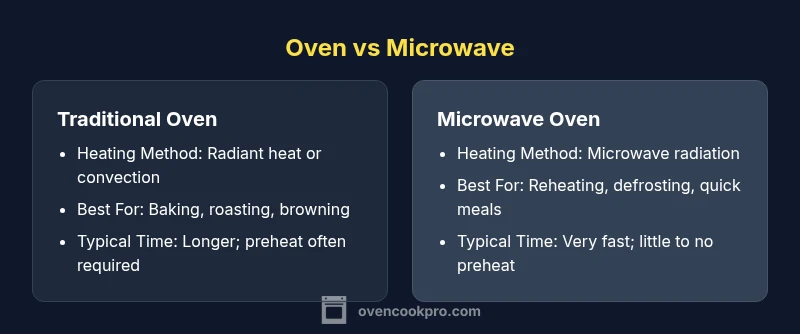
| Heating Method | Radiant heat or convection hot air | Microwave radiation heats water molecules |
| Best For | Baking, roasting, browning large portions | Rapid reheating, defrosting, small portions |
| Cooking Speed | Longer overall cook times, slower start due to preheating | Very fast heating, minimal preheat |
| Texture Outcome | Crisp crusts, even browning throughout | Moist interiors, limited browning without accessories |
| Energy Use | Typically higher energy over longer cooks | Often lower energy for small tasks |
| Temperature Range | Wide range; adjustable heat and convection | Depends on food; heating is not adjustable like oven temp |
| Ideal For | Breads, roasted vegetables, casseroles | Reheating leftovers, quick defrosting |
The Good
- Oven offers even cooking and browning for texture-rich dishes
- Microwave saves time on reheating and small portions
- Convection-capable ovens speed cooking and improve browning
- Dual appliances provide flexibility for diverse meals
Drawbacks
- Ovens require preheating and longer cook times
- Microwaves may not brown or crisp without accessories
- Microwaves can unevenly heat thicker items
For most home cooks, lean on the oven for texture-rich baking and roasting, and use the microwave for quick reheating and defrosting. A small kitchen benefits from both.
The oven is best for browning and even cooking on larger meals; the microwave excels at speed and convenience for small portions. In practice, a hybrid approach often yields the best results.
Questions & Answers
What is the fundamental difference between an oven and a microwave?
The oven uses radiant heat or hot air to cook and brown foods, while a microwave heats by exciting water molecules for rapid warming. The choice depends on desired texture and speed.
Ovens brown and bake with hot air; microwaves heat quickly by exciting water molecules. Choose based on texture and time needs.
Can I bake in a microwave?
Microwaving alone is not ideal for baking due to lack of browning. Some microwaves offer convection or browning options, but traditional baking is best done in an oven.
Microwaves aren't ideal for baking unless you use a convection or browning feature; use the oven for true baking.
Is convection considered separate from microwave?
Convection is a mode within some ovens using a fan to circulate hot air; microwaves use radiation. They are distinct technologies with different results.
Convection is oven-based heat circulation; microwave uses microwaves. They’re different technologies.
Can I adapt microwave recipes for oven use?
Yes. Oven temperatures are typically lower and cooking times longer; use standard bake settings and monitor moisture to prevent drying.
You can adapt microwave recipes to the oven by adjusting time and temperature and watching moisture.
Is it safe to use metal in a microwave?
No. Metal can cause arcing and damage. Use microwave-safe containers and always follow appliance safety guidelines.
Never put metal in a microwave; it can cause arcing and damage.
What should I use for reheating leftovers?
Microwave is usually fastest for reheating small portions; the oven can reheat more evenly and restore texture for larger portions.
Use the microwave for speed on small amounts, the oven for better texture on larger portions.
Main Points
- Identify heating method to pick the right appliance
- Use oven for browning and large dishes, microwave for speed
- Combine methods for best texture and efficiency
- Prioritize safety and packaging to avoid accidents