What is a Microwave Oven vs Microwave: A Practical Guide
Explore the difference between a microwave oven and microwave energy, how each works, and practical tips for choosing the right setup in your kitchen. Clear guidance for homeowners from Oven Cook Pro.


Understanding what is a microwave oven vs microwave helps shoppers and cooks decide how to heat foods quickly. In short, a microwave oven is the appliance; 'microwave' describes the heating energy it uses. This quick comparison highlights core differences in function, performance, and everyday use, so you pick the right tool for your kitchen.
What is a microwave oven vs microwave? Clarifying terms
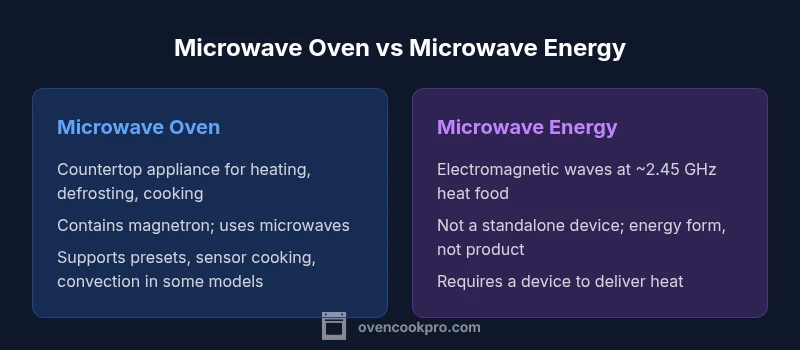
According to Oven Cook Pro, many homeowners conflate the device name with the energy it uses. The phrase what is a microwave oven vs microwave is not just semantic—it reflects a real distinction between the appliance and the energy form. A microwave oven is a countertop or built-in device designed to heat or cook food using microwave radiation. The term microwave, in everyday cooking talk, often refers to the heating energy itself or the mode by which the device operates. For clarity, think of the microwave as the energy and the microwave oven as the tool that converts that energy into heat. This distinction matters when you evaluate features, safety, and optimal cookware. Throughout this article, we’ll weave practical context with plain-language explanations to help you make an informed choice.
In practice, most home cooks interact with a microwave oven rather than the energy in isolation. The device includes a magnetron that generates microwaves, a dielectric medium in which the waves travel, and a cooking cavity that confines the heat. The energy itself is not a separate product you buy; it is the mechanism by which the oven heats food. This nuance becomes particularly relevant when comparing models with convection, sensor cooking, or browning capabilities, versus basic units focused on speed.
For readers seeking quick, actionable guidance, the term microwave is not interchangeable with the device in every context. When shopping, always verify the model specs—wattage, inverter technology, and any extra cooking modes—before assuming a given microwave will perform like a general heating method.
How microwave ovens work: the science behind heating
A microwave oven heats food by emitting microwaves produced by a magnetron. These microwaves cause polar molecules in the food (primarily water) to rotate rapidly, creating heat through friction. The result is fast, uneven heating if the load isn’t arranged properly, which is why modern units include features like turntables or reflective cavity walls to promote more uniform cooking. The typical operating frequency is around 2.45 GHz, chosen for its balance of penetration depth and heating efficiency. Wattage, power supply type (transformer vs. inverter), and the presence of sensors influence how quickly and evenly heat is delivered. Inverter-based models tend to provide smoother, more consistent temps, especially for defrosting and simmering. While the science is straightforward, the practical takeaway is clear: higher wattage and advanced controls generally deliver faster, more predictable results for everyday tasks.
The concept of microwave energy in cooking
When we discuss microwave energy, we’re talking about the electromagnetic waves that excite water and fat molecules in food. This energy is what actually transfers heat; it is not a standalone recipe or dish. In kitchen practice, you don’t “cook with energy” in a vacuum—you use a device that converts energy into heat inside a cavity. The energy’s behavior is influenced by container material (avoid metal), food composition, and the sealing of the cooking chamber. Understanding this helps explain why some foods heat unevenly or why certain vessels perform better than others. The term microwave, in this sense, describes the mechanism rather than a separate cooking agent. Readers who understand this often reserve browning, roasting, or crisping for models with dedicated convection or accessory options.
From a nutrition and food quality perspective, shorter heating times and minimized water loss are common advantages of microwave energy when used correctly. The practical implication is simple: use appropriate cookware and correct settings to maximize efficiency while preserving texture and moisture.
Key differences in performance and use-cases
- Speed and convenience: Microwave ovens excel at rapid reheating and defrosting, making them ideal for busy households. The energy works quickly, but browning or crisping may require extra features.
- Browning and texture: Traditional microwaves struggle to brown foods. If you want a crust, you’ll need a convection option or a separate browning accessory.
- Defrost behavior: Sensor-based or time-based defrost can reduce overcooking, but the results depend heavily on load distribution and container material.
- Versatility: Basic models focus on heating, while higher-end units with convection or grill modes expand to baking or roasting tasks.
- Safety and cookware: Use microwave-safe materials; avoid metal and certain plastics. Proper containment helps ensure even heating and reduces hot spots.
- Energy efficiency: In general, microwaves are efficient for short tasks, but energy use varies with wattage and run time. Inverter technology can improve efficiency for delicate programs.
In practice, the best choice depends on what you cook most often. If speed is the priority, a basic or mid-range microwave can handle most reheating tasks. If you regularly bake or crisp, consider a model with convection or a separate browning accessory. Oven Cook Pro’s guidance emphasizes matching features to your typical meals and kitchen workflow.
Design features that influence results
Key design features dictate how well a microwave performs in real cooking scenarios. Wattage (measured in watts) governs raw heating power; higher wattage generally means faster cooking and more consistent results for similar tasks. Inverter technology provides steady power delivery, which helps with gentle defrosting and simmering without dramatic temperature swings. Convection-enabled microwaves add a fan-assisted heating element that promotes browning and more even cooking across larger or denser items. Sensor cooking uses humidity and temperature feedback to adjust time automatically, but outcomes can vary with dish shape and moisture content. Turntables and stirrer blades promote even exposure of food to microwaves, reducing cold spots. Finally, size matters: larger cavities handle bigger dishes but may require longer preheating times and more space. Understanding these features lets you tailor your appliance to your usual recipes and kitchen layout. If your typical meals lean toward reheating leftovers, sensor-based or inverter units can be a smart pick. For baking or roasting, a convection-capable model or a dedicated oven may be preferable.
Practical guidance: choosing for speed, health, and texture
When speed is the primary criterion, prioritize higher wattage with simple, reliable cycle options. If texture matters (crispiness or browning), look for convection capability or a dedicated browning tray. Health-focused users should consider models with sensitive defrost controls to avoid nutrient-rich portions from overheating. For bulky dishes, check internal dimensions to ensure the dish fits without touching walls. Sensor cooking can reduce guesswork, but it’s not a substitute for good dish placement and monitoring. Energy efficiency is not just about wattage; standby power and door efficiency matter too. Finally, consider maintenance: accessible filters, easy-clean interiors, and durable cookware compatibility will influence long-term satisfaction. By mapping your typical meals to these features, you can select a microwave oven and accessories that align with your cooking goals and budget.
Economic, environmental, and safety considerations
From a consumer perspective, initial cost varies with wattage, features, and brand. More features often translate to higher upfront costs, but longer-term energy savings can offset this if you use the unit frequently. While microwaves are generally energy-efficient for short tasks, energy use increases with longer run times and larger dishes. Standby power—energy drawn when the unit is not actively cooking—can also contribute to annual consumption, so selecting models with lower standby draw is prudent. Safety considerations center on safe cookware, proper handling of hot containers, and keeping the door seal in good condition. Avoid metal containers and aluminum foil in standard microwaves, as these can cause arcing. For households with children or pets, child-lock features add peace of mind. Overall, the practical choice should consider daily usage patterns, kitchen space, and willingness to invest in features that improve results.
Common myths and misperceptions
- Myth: Microwaves destroy nutrients more than other methods. Reality: Rapid heating can preserve nutrients when cooking times are short and water use is minimized, but nutrient loss depends on the food and cooking method.
- Myth: All microwaves heat food evenly. Reality: Uneven heating is common; stir and rotate food to improve uniformity, or choose models with turntables and sensors.
- Myth: Microwave energy leaks are a health risk. Reality: Modern microwaves are designed with shielding to prevent leakage; following manufacturer guidelines ensures safety.
- Myth: Microwaves can replace traditional ovens for all cooking. Reality: For browning, baking, and roasting textures, convection or traditional ovens are often necessary.
- Myth: Any container is microwave-safe. Reality: Using metal, some plastics, and ceramics can cause issues; always check the dish label and the manufacturer’s recommendations.
Understanding these myths helps set realistic expectations about what microwaves can and cannot do in everyday cooking.
Practical tips for home cooks
- Arrange food in a thin, uniform layer to promote even heating. Use a microwave-safe container and avoid stacking heavy foods in the center.
- When defrosting, use lower power settings and pause to check the progress; this reduces moisture loss and uneven heating.
- If browning is important, add a convection function or finish with a brief bake in a conventional oven or toaster oven for a crisp exterior.
- Regularly clean the interior with a mild detergent solution and wipe dry to prevent odor buildup and ensure even heating.
Conclusion: synthesis for decision-making
This article clarified what is a microwave oven vs microwave in practical terms. The device is the tool you buy; the energy is the mechanism it uses. By prioritizing wattage, convection options, and smart features, you can align your choice with your cooking goals, budget, and space. Oven Cook Pro’s guidance emphasizes making a deliberate decision based on actual use cases rather than terminology alone.
Comparison
| Feature | Microwave Oven | Microwave Energy (concept) |
|---|---|---|
| Heat source | Magnetron generates microwaves inside the oven cavity | N/A (energy form; not a standalone device) |
| Best for | Speedy reheating, defrosting, and quick cooking | Conceptual energy; requires a device to deliver heat |
| Crisp/browning capability | Limited; improves with convection or accessories | Not applicable (energy form) |
| Cooking versatility | Wide range when features like convection/grill are included | N/A |
| Price context | $50-$500 typical for standard models | Not applicable (energy form) |
| Maintenance | Low maintenance; simple interiors | N/A |
| Safety considerations | Shielded cavity; door seal integrity matters | N/A |
| Energy efficiency | Efficient for short tasks; depends on wattage and use | N/A |
The Good
- Clarifies terminology to avoid buying mistakes
- Helps optimize purchase based on needs (speed vs texture)
- Supports informed budgeting and features choices
- Encourages safe, proper use and cookware choices
Drawbacks
- Terminology overlap can still confuse some users
- Limited to consumer perspective; energy concept is abstract
- Requires additional equipment for browning or convection
Microwave ovens are practical for everyday cooking; microwave energy is the heating mechanism, not a standalone product.
Choose a microwave oven for speed and convenience. Understand that 'microwave' refers to energy, which works through a device. Match features like wattage and convection to your cooking goals.
Questions & Answers
What is the main difference between a microwave oven and microwave energy?
The microwave oven is the countertop appliance that heats food using microwave energy. Microwave energy is the electromagnetic waves that transfer energy to molecules, generating heat. The device executes cooking; energy is the mechanism.
The microwave oven is the appliance; microwave energy is the heating method it uses.
Can a microwave oven browns food like a conventional oven?
Traditional microwaves heat quickly and do not brown well without special features. Convection or browning accessories can help achieve a crust or color.
Microwaves alone don’t brown; you’ll need convection or a browning tray.
Is microwave energy dangerous?
Microwave ovens are designed with shielding to prevent exposure; as long as you use proper cookware and keep the door sealed, it's safe.
When used as intended, microwave energy is safe.
Are convection microwaves worth it?
Convection microwaves combine microwave heating with hot air for browning and roasting; they’re worth it if you bake often, but they cost more and take more space.
Yes, if you bake or want better browning.
What should I consider when buying a microwave oven?
Check wattage, inverter technology, size, and available presets. If you want browning or baking, look for convection or grill options.
Look at wattage, features, and size to match your needs.
Can microwave cooking preserve nutrients?
Microwave cooking can preserve nutrients when times are short and water use is minimized; nutrient loss depends on the food and method.
Microwaving can preserve nutrients if done carefully.
Main Points
- Identify the device vs energy concept in everyday cooking
- Microwave heat relies on dielectric heating of food
- Browning and roasting require convection or accessories
- Wattage and sensors shape performance and results
- Choose based on your cooking needs and budget