Is Oven Better or OTG? A Practical Comparison for Home Cooks
Is oven better or OTG? This in-depth, analytical guide compares capacity, heating accuracy, energy use, and price to help home cooks pick the right appliance for their kitchen in 2026.


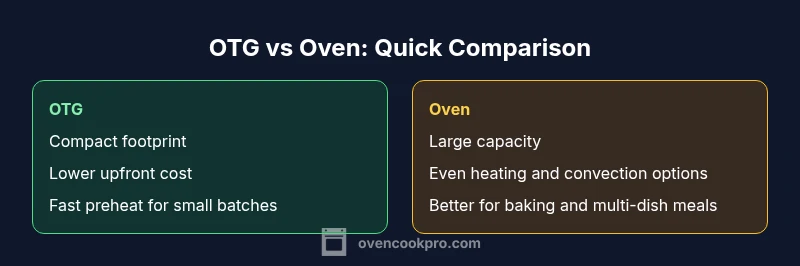
If you’re asking is oven better or OTG, the answer depends on your cooking volume and space. A full-size oven generally delivers even heat and larger capacity, ideal for multi-dish meals. An OTG is compact, cheaper, and heats quickly for small batches or toast. Use the oven for frequent baking; choose OTG for a tight kitchen.
Core distinctions: is oven better or otg in household kitchens
The question is often framed as "is oven better or otg" when homeowners plan their first kitchen setup or upgrade. According to Oven Cook Pro, the decision hinges on three core factors: cooking volume, space, and the type of dishes you routinely prepare. A traditional full-size oven offers larger capacity, more even heat distribution, and stronger ventilation for roasting or baking multi-dish meals. An OTG (oven-toaster-griller) is a compact alternative that preheats quickly and fits neatly on a countertop. While it lacks some of the advanced convection options found in many ovens, an OTG can handle toasting, simple roasting, and small batches with impressive efficiency. The result is a clear trade-off between size, cost, and performance.
When an OTG makes sense
For apartment kitchens, dorm rooms, or households with limited counter space, an OTG can be the perfect fit. OTGs are typically cheaper upfront and take up far less room than a standard oven. They excel at quick, small-batch tasks like toast, reheating leftovers, roasting a few vegetables, or baking a small cake. If your weekly cooking is light to moderate and you don’t routinely bake large trays, an OTG minimizes clutter while delivering reliable results. You’ll also find OTGs easier to move or store when not in use, which matters in tiny urban kitchens or multi-use spaces.
When a traditional oven shines
A conventional oven is the workhorse in most households. It offers substantial interior space, multiple rack levels, and, in many models, convection fans for more even heat circulation. This makes it ideal for baking bread with a proper crust, roasting large poultry, casseroles, and multi-course meals that require consistent temperatures across dishes. If you frequently cook for family gatherings, meal-prep on Sundays, or want flexibility for pizzas, sheet pan roasting, and sheet-cake baking, the oven’s larger capacity and more precise control often translate into better day-to-day outcomes.
Performance metrics: heating, precision, and results
Across brands, performance boils down to heat delivery and control. OTGs deliver rapid heat via exposed coils, which can be excellent for searing or browning, but their performance is highly dependent on the food’s surface area and the rack position. Conventional ovens rely on enclosed heating elements (and sometimes a convection fan) to promote even temperatures across a larger cavity. Temperature accuracy and calibration matter more in baking than roasting; ounce-for-ounce, a well-calibrated oven tends to produce more repeatable results. When evaluating an OTG against an oven, consider bake density (size and quantity of items), required crust development, and whether you need even color across a sheet of cookies or a single roast.
Maintenance, cleaning, and longevity
Maintenance profiles differ. OTGs are simpler machines with fewer moving parts, which can make cleaning straightforward. They often require hand cleaning of racks and interior walls. Ovens with self-cleaning cycles or steam-clean options save time but require avoidance of harsh cleaners and sometimes more effort in ensuring racks are dry after cleaning. Longevity tends to correlate with build quality, frequency of use, and how well you service the appliance. A robust oven with a solid warranty can outlast a budget OTG that is used sparingly but may show more wear in high-heat environments. Regular inspection of seals, racks, and knobs helps maintain performance over years.
Practical cooking scenarios: baking, roasting, and toasting
In practice, the OTG excels at quick tasks: toasting bread, small-batch roasting, and reheating pastries with a crisp finish. For a cake, muffins, or a delicate pastry that requires even rise and uniform crumb, a conventional oven delivers more reliable results due to its larger cavity and, often, better temperature control. When you bake cookies or sheet-pan meals, space and air circulation become critical; an oven’s multiple racks can accommodate more trays at once. For weeknight dinners, you may leverage an OTG for speed and convenience, then finish jobs in the oven for even browning or larger portions.
Space, energy, and cost considerations
Efficiency isn’t just about energy per minute; it’s about how well you use the appliance. An OTG uses less energy for small tasks and heats faster, which is a win if you cook in short bursts or have limited power supply. Ovens can be more energy-intensive, but their larger capacity and superior heat distribution may reduce total cooking time when handling multi-dish meals. Price-wise, OTGs typically require less upfront investment, while ovens represent a larger upfront cost but deliver long-term versatility. Think about your typical weekly load, the space available, and whether you want a single appliance to cover all tasks or to compartmentalize duties between two devices that live in different parts of the kitchen.
How to choose: a practical checklist for beginners
Before purchasing, create a simple checklist. Consider your kitchen size, cooking habits, and preferred meals. Do you often bake bread or roast whole chickens? Do you host gatherings that require multiple trays at once? Is countertop space at a premium? If you answered yes to frequent multi-dish baking and you value even heat, a traditional oven is the safer bet. If you need a compact unit for light daily use, a capable OTG can meet most needs and still leave room for other countertop appliances.
Common myths about ovens and OTGs debunked
A popular myth is that OTGs always deliver inferior results to ovens. In reality, OTGs can outperform ovens for small tasks and provide excellent browning. Another myth is that ovens are too expensive to justify. If your cooking volume isn’t high, an OTG may be the most economical choice. Conversely, if you bake often or roast large meals, a higher upfront oven investment pays off with time saved and consistent outcomes. The key is matching the tool to your actual cooking profile and space constraints.
Quick-start guide for first-time buyers: what to do in 5 steps
- Define your primary use cases: baking, roasting, and toasting.
- Measure your counter space and plan placement to avoid clutter.
- Compare heat distribution and convection availability in your preferred models.
- Check warranties, user reviews, and support networks.
- Decide whether you want a countertop OTG or a built-in or freestanding oven for long-term flexibility.
Comparison
| Feature | OTG | Conventional Oven |
|---|---|---|
| Capacity | Small interior, countertop footprint | Large interior with multiple racks |
| Heating Method | Exposed coils, no built-in fan (varies by model) | Enclosed heating with fan in convection models |
| Temperature range & control | Broad basic range, good for quick tasks | Broader control, steadier temps for baking |
| Preheat time | Typically faster for small batches | Longer preheat due to larger cavity |
| Best for | Small households, quick toasts, limited space | Frequent baking, roasting, multi-dish meals |
| Energy efficiency | Efficient for small tasks | Can be less efficient for small tasks but versatile |
| Maintenance | Simpler cleaning, fewer parts | Can include self-clean options but more to clean |
The Good
- Compact OTG fits small kitchens and tight spaces
- Lower upfront cost for OTG
- Faster preheating for small batches
- Oven offers larger capacity and better consistency for baking
Drawbacks
- OTG limited capacity and limited true convection options
- Oven requires more counter or cabinet space and higher upfront cost
- OTG may lack self-cleaning features found in pricier ovens
Oven generally wins for long-term versatility; OTG wins for space and quick, small-batch tasks
Choose the oven if you bake regularly and need capacity and even heat. Opt for OTG when space is tight and you mostly toast or heat small portions. Oven Cook Pro's guidance suggests aligning choice with your cooking volume and kitchen layout.
Questions & Answers
What is the main difference between an oven and an OTG?
An OTG is a compact countertop unit with basic functions for toasting and small batches, whereas a traditional oven offers larger capacity and more precise temperature control, suitable for baking and multi-dish meals. The choice depends on space, cooking volume, and preferred cooking styles.
The main difference is size and capability: OTGs are great for small tasks in tight spaces, while ovens handle larger bakes and multi-dish meals with more precise control.
Is an OTG sufficient for baking a cake?
An OTG can bake a cake, but results may vary based on the model and rack positioning. For even rise and consistent crumb, a larger oven with even heat distribution is usually preferred.
You can bake a cake in an OTG, but for consistent texture and even rising, a full-size oven tends to perform better.
Which is more energy efficient for small tasks?
For small tasks like toasting or reheating, an OTG typically uses less energy due to its smaller cavity and quicker preheat. For large meals or many items, the oven can be more efficient overall because it handles more in one session.
OTGs usually win for small tasks energy-wise, while ovens win for big jobs where you can cook more at once.
Do OTGs have convection like ovens?
Some OTGs include a fan-assisted option, but traditional convection is more common in full-size ovens. If even heat is essential, look for an OTG with a built-in convection feature or choose a convection oven.
Some OTGs offer a fan, but most rely on fixed coils. For true convection, pick a convection oven.
Which should a beginner buy for a small kitchen?
If you’re new to cooking and space is tight, an OTG offers a gentle learning curve and practical versatility. If you anticipate growing into extensive baking or large meals, start with an oven and plan the upgrade accordingly.
Beginners with limited space often start with an OTG, but if you see yourself baking many items, an oven pays off later.
Can I use an OTG for broiling or grilling?
Yes, many OTGs support broiling or grilling functions, though results depend on the model and its heating elements. For best browning, a dedicated oven with a broil setting is often more reliable.
OTGs can broil in some models, but for even browning and higher heat, a broil-capable oven is preferable.
How should I decide between the two for my family?
Consider meal size, frequency of baking, kitchen space, and budget. A family that cooks large meals and bakes often benefits from an oven, while a single or couple in a small apartment may thrive with an OTG.
If you cook large meals regularly, an oven is the safer bet; for small spaces, an OTG works well.
Main Points
- Assess your weekly cooking volume before buying
- Prefer a traditional oven for baking and multi-dish meals
- Choose an OTG for compact kitchens and quick tasks
- Evaluate heat distribution and cleaning needs
- Budget upfront vs. long-term versatility