Oven vs Toaster Oven: A Complete Comparison for Home Cooks
A practical, evidence-based comparison of ovens vs toaster ovens, focusing on performance, versatility, energy use, and value to help you choose the right tool for your kitchen.


Choosing between an oven and a toaster oven affects meal speed, space, and versatility. In short, the oven vs toaster oven decision hinges on how you plan to cook most often: bake large batches in a full-size oven, or quickly toast, broil, and small dishes in a compact toaster oven. This guide compares performance, cost, and practicality to help you decide.
What the oven vs toaster oven comparison means for your kitchen
A clear-eyed choice between a full-size oven and a countertop toaster oven can redefine weeknight dinners and weekend baking alike. The keyword here is flexibility: you want predictable results, minimal Hassle, and a setup that fits your space and budget. The oven vs toaster oven decision is not simply about size; it's about how you plan to cook most often. According to Oven Cook Pro, many homes underestimate the impact of preheating and heat distribution on meal times and energy use. In practice, the right choice depends on your typical load, the foods you cook, and how much room you have on the counter. For families who regularly bake sheet pans or roasts, a traditional oven remains the workhorse. For singles, couples, or busy households needing quick snacks and reheats, a toaster oven can be an indispensable ally. The rest of this guide breaks down key criteria—space, speed, versatility, energy, and cost—so you can decide with confidence.
Quick differences at a glance
- Footprint and placement: full-size ovens require a built-in kitchen footprint or standalone range, while toaster ovens sit on the counter.
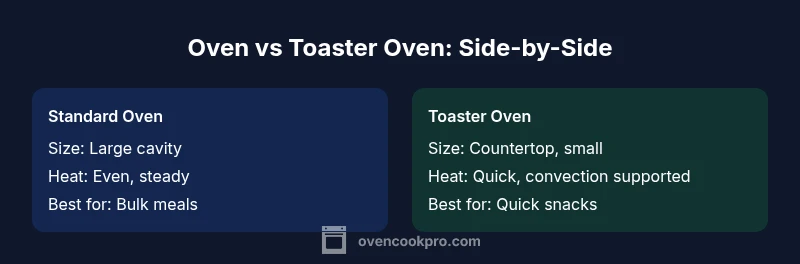
- Cooking scale: standard ovens handle large trays and whole roasts; toaster ovens excel at single-dish meals and small batches.
- Heating and convection: many toaster ovens include convection fans; traditional ovens rely on larger radiators and even heat across a bigger cavity.
- Preheat and cook time: toaster ovens often heat up faster for small tasks; full-size ovens take longer to reach temperature for bigger meals.
- Energy use and cost: smaller appliances consume less energy per task but may require more frequent purchases if you outgrow capacity.
These contrasts help you map your needs against existing kitchen space and cooking style.
Performance: heating speed, control, and consistency
Performance is where the oven vs toaster oven split becomes tangible. A full-size oven delivers broad, even heating across a large cavity, enabling reliable browning on sheet pans and roasts. Temperature control tends to be precise, with steady results for recipes that demand exact temps. A toaster oven, especially with convection, heats quickly and responds fast to temperature changes, which is ideal for toasting, small-batch baking, and reheat jobs. However, its smaller cavity can lead to uneven heat with bulky items or when using multiple racks. Practical test scenarios show that a toaster oven shines for cookies or croissants baked in a single tray, while a traditional oven handles multi-dish roasts more predictably. The best approach is to map your weekly meals to these heating profiles and align expectations about consistency and browning. Modern toaster ovens with smart preheat and convection modes reduce these gaps, but still wont match a full-size oven for large volumes.
Size, capacity, and layout considerations
Counter space is a scarce resource in many kitchens, and this is where size matters most. A standard oven occupies a dedicated kitchen footprint, often integrated into a range or wall oven setup, with a large cavity that can handle sheet pans, baking sheets, and even large roasts. By contrast, toaster ovens sit on the counter and offer a much smaller interior cavity. Capacity differences arent just affect how many items you can bake at once; they also influence how much heat is reflected back into your kitchen, which can impact cooling and overall energy use. If you cook for a crowd or routinely bake multiple dishes simultaneously, a full-size oven reduces the need to rearrange or rewarm. If your kitchen is tight on space, a toaster oven provides essential functionality without sacrificing counter real estate. In both cases, plan for ventilation and clearance around the appliance to ensure safe operation and efficient heat management.
Cooking versatility: what you can cook and how
Ovens and toaster ovens diverge in the breadth of tasks they support. A full-size oven is the backbone of serious baking, roasting, and multi-dish meals, especially when youre preparing large trays of vegetables, meats, or desserts. It also handles casseroles, sheet-pan dinners, and timed roasts with careful temperature control. A toaster oven excels at quick breakfasts, snacks, reheating leftovers, and small-batch baking — think a single sheet of cookies or a mini pizza. For most households, a toaster oven complements the main oven, acting as a fast, do-it-now option for small tasks. If you bake regularly for a family, the full-size oven removes the need for second rounds; for daily snacks or dorm-friendly cooking, a toaster oven is a pragmatic, space-saving alternative.
Energy use, cost per use, and total cost of ownership
Energy efficiency is a central consideration when weighing oven vs toaster oven. A full-size oven consumes more energy per session, especially for large meals, but fewer per-item if youre cooking in bulk. A toaster oven generally uses less energy per use due to its smaller cavity and shorter preheat times, making it more economical for quick tasks. Over the long term, your total cost of ownership depends on cooking frequency, batch sizes, and how often you replace or upgrade appliances. The Oven Cook Pro analysis shows that for households with frequent small-batch cooking, a toaster oven can lower energy costs, while families cooking large meals benefit more from a traditional oven’s efficiency per dish. For optimization, use the toaster oven for quick tasks and reserve the full-size oven for bulk cooking.
Maintenance, cleaning, and safety considerations
Maintenance routines shape long-term performance and safety for both appliances. A full-size oven benefits from periodic self-cleaning or manual cleaning to prevent baked-on residue, which can affect heat distribution. A toaster oven requires more frequent cleaning due to smaller cavities that trap crumbs; regular crumb tray emptying and door seals inspection keep performance steady. Fire safety should guide placement and usage: ensure adequate clearance from walls or cabinets, avoid overcrowding inside the cavity, and use heat-resistant gloves when handling hot trays. If you notice uneven browning, hotspots, or persistent odors, check heating elements and seals for wear and replace components as needed. Regular maintenance extends life and preserves energy efficiency across both devices.
Budgeting and value: when to upgrade or buy
Budgeting for an oven vs toaster oven involves upfront cost and ongoing energy use. A traditional full-size oven typically carries a higher upfront price, with longer-term savings through bulk cooking efficiency. Countertop toaster ovens are cheaper to buy but may require more frequent replacement if your cooking scale grows. Consider your kitchen layout and typical meal sizes when deciding. For households that bake in bulk weekly, the long-term value of a full-size oven often outweighs the initial cost; for smaller households or limited counter space, a quality toaster oven can provide a strong return on investment. In short, balance upfront price with anticipated usage to determine the best fit.
Common myths and real-world scenarios
Myth: A toaster oven can fully replace a full-size oven. Reality: While versatile, toaster ovens cant handle large sheets or multiple dishes at once, making them best as a supplement. Myth: Convection models are always better. Reality: Convection helps even heat and faster cooking but can require lower temperatures and vigilant monitoring for delicate bakes. Real-world scenario: A family that bakes cookies weekly may benefit from a toaster oven for snacks, while weekly roasts and sheet-pan dinners are more efficiently handled by a full-size oven. The key is to combine both tools for maximum efficiency without sacrificing quality.
A practical decision framework: 4 steps to choose
- Assess your kitchen space and counter habits. If counter space is tight, a toaster oven is attractive; if you have room for a larger appliance, a full-size oven offers greater versatility. 2) Analyze your cooking load. If you cook large meals weekly, the full-size oven reduces repetitive reheats. 3) Evaluate energy usage and monthly costs. Use the toaster oven for small tasks to curb energy draw; reserve bulk cooking for the main oven. 4) Consider long-term value and maintenance. A higher upfront investment in a good oven can pay off through years of efficient performance. Guided by these steps, you can choose confidently and avoid common regret.
Authority Sources
- Energy.gov: https://www.energy.gov/energysaver/appliances
- ConsumerReports.org: https://www.consumerreports.org/cookware-toasters/
- Extension or university resources (general guidance): https://extension.illinois.edu
Final Thoughts on the Oven vs Toaster Oven decision
Choosing between an oven and a toaster oven is not one-size-fits-all. The best option depends on how you cook, how much space you have, and your budget. The Oven Cook Pro team recommends prioritizing versatility and efficiency: use the full-size oven for bulk cooking and the toaster oven for quick, small-batch tasks. With thoughtful placement and a clear plan for cooking scenarios, you can optimize your kitchen setup for everyday meals and weekend projects alike.
Comparison
| Feature | Standard Oven | Toaster Oven |
|---|---|---|
| Size & Capacity | Large capacity suitable for sheet pans and roasts | Compact interior that fits on a counter; limited large-item capability |
| Heating Method | Conventional heating with multiple racks | Top/bottom heat with optional convection in many models |
| Preheat Time | Longer preheat, especially for large meals | Shorter preheat; quick to start cooking |
| Energy Use | Higher energy per session for bulk meals | Lower energy per session for small tasks |
| Versatility | Baking, roasting, multi-dish meals | Toasting, small-batch baking, reheating, broiling |
| Price Range | $400-1500+ (depends on oven type) | $100-400 ( countertop models) |
| Best For | Bulk cooking, family meals, built-in or range ovens | Small households, dorms, limited counter space |
The Good
- Supports bulk cooking and even browning for large meals
- Long-term energy efficiency per dish when used for big batches
- High versatility for roasting, baking, and multi-dish meals
- Can improve workflow by freeing up the main oven for other tasks
- Durable, often built to last with proper maintenance
Drawbacks
- Higher upfront cost for a full-size oven
- Takes more space and may require dedicated mounting or ventilation
- Longer preheat times for large meals or multiple trays
- Can overkill small, quick tasks if used unnecessarily
Full-size ovens win for bulk cooking; toaster ovens win for quick tasks and space-constrained kitchens
If you cook large batches regularly, the full-size oven provides efficiency and capacity. If you mainly reheat, toast, and bake small quantities, a toaster oven offers speed and space savings. For most households, a hybrid approach—using both as needed—delivers the best balance of performance and value. The Oven Cook Pro team believes this combination often yields optimal daily results.
Questions & Answers
Can a toaster oven replace a full-size oven for everyday cooking?
A toaster oven can handle many quick tasks and small-batch bakes, but it generally cannot replace a full-size oven for large meals or multiple trays. If your cooking needs routinely involve bulk roasting or sheet-pan combinations, a full-size oven remains essential.
A toaster oven is great for small jobs, but for big family meals, you’ll still want a full-size oven.
Is a convection toaster oven worth it?
Convection in a toaster oven helps with faster, more even browning and can improve results for cookies and roasted vegetables. It can be worth it if you value speed and evenness for smaller batches, but you may need to adjust temperatures slightly compared to non-convection settings.
Convection can help with even browning in small batches, which is handy for cookies and roasting.
Can I bake cookies in a standard oven and a toaster oven?
Yes, you can bake cookies in both, but you may need to adjust bake times and temperatures. A toaster oven usually bakes on a single rack and with convection, so monitor closely to avoid over-browning. A standard oven offers more control for larger batches.
Both can bake cookies; just watch timing and temperature, especially in a toaster oven.
What foods are best suited for a full-size oven?
Bulk roasting, large sheet-pan meals, casseroles, and items that require even heat over a large space are best suited for a full-size oven. These tasks benefit from the oven’s capacity and consistent temperature across a wide area.
Large meals and even heating are where a full-size oven shines.
How should I decide which appliance to buy first?
Start with your typical cooking load and space. If you frequently cook large meals or bake multiple trays, prioritize a full-size oven. If you mainly reheat snacks or need a compact solution, a toaster oven is a smart, space-saving first purchase.
Think about your usual meals and space to decide what you need first.
Do these appliances differ much in energy use?
Yes. A full-size oven generally uses more energy per session, especially for large meals, while a toaster oven tends to consume less energy per task. The choice depends on how often you cook and the typical dish size.
Energy use varies; big meals use more energy in ovens, small tasks use less in toaster ovens.
Main Points
- Choose bulk-capacity first for frequent large meals
- Use toaster oven for snacks and quick tasks to save energy
- Match appliance to kitchen space and counter layout
- Plan for a complementary setup rather than a single-solution approach
- Monitor maintenance and heat behavior to maximize longevity