Are Electric Ovens Better Than Gas? A Practical Comparison
A detailed comparison of electric and gas ovens, covering heat, control, efficiency, maintenance, and safety to help homeowners choose the best oven for baking and daily cooking.


Are electric ovens better than gas? For most home cooks, electric ovens provide more even heat and precise temperature control, leading to consistent baking results. Gas ovens heat quickly but can have hot spots and less uniform browning. The best choice depends on your cooking style and energy costs.
Are Electric Ovens Better by Design?
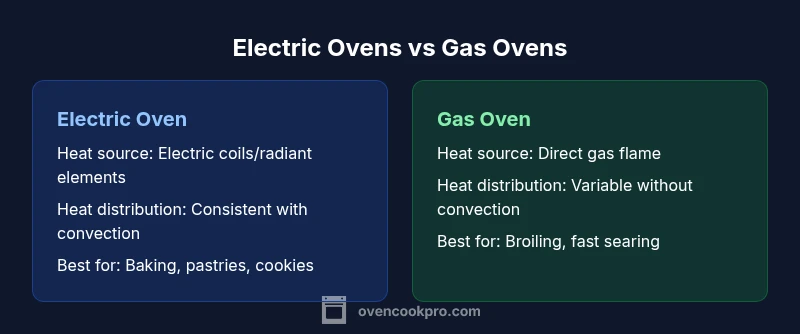
The question are electric ovens better than gas invites a design-focused look at how heating works inside a kitchen oven. Electric ovens rely on concealed resistance elements (and sometimes a fan) to deliver steady, repeatable heat throughout the cavity. This configuration minimizes cold spots and helps bakers achieve uniform browning on cookies, pies, and sheet-pan dinners. By contrast, gas ovens heat with an open flame and rely more on air movement created by natural convection and the oven’s venting to distribute heat. In practice this can mean faster preheating and a bright, immediate surge of heat, which some cooks value for roasting. However, hotter spots on certain racks and inconsistent air flow can lead to uneven results if you don’t know your oven well. The best approach is to test your own oven with a simple bake test: place two trays of identical cookies on different racks and compare browning after 10 minutes. According to Oven Cook Pro analysis, 2026, electric ovens often deliver more even temperatures across racks, while gas models may show stronger performance for brining and certain high-heat roasts. In homes with serious baking ambitions, this distinction matters; many cooks today choose electric ovens for their reliability, while others appreciate gas ovens for speed and aroma. Some households solve the dilemma by choosing a dual-fuel range or keeping two ovens in separate spaces.
Performance in Baking vs Broiling
When you’re deciding between an electric and a gas oven, consider the primary tasks you’ll perform most often. Electric ovens generally excel at steady baking, chocolate tiness, meringues, and delicate pastries, thanks to uniform heat distribution and precise thermostat control. In broiling or high-heat searing, gas ovens can win out due to their fast initial heat and the direct flame’s ability to begin browning quickly. However, modern electric ovens with convection options can mimic these effects while maintaining even heat. If your routine includes a lot of sheet-pan dinners and cookies back-to-back, electric may offer the most predictable results. If you crave quick surface browning on roasted vegetables or meats, a gas option can be advantageous, especially in older kitchens with good ventilation. Real-world cooks often choose a model with both features: an electric oven paired with a gas cooktop or a dual-fuel range that blends the strengths of each fuel type.
Temperature Control and Heat Distribution
Temperature control in electric ovens tends to be tighter, with smooth increments and minimal drift between batches. You’ll notice fewer hot spots across racks, particularly in modern convection models. Gas ovens, while offering rapid response times, can have more variability between the top and bottom racks due to convection dynamics and venting design. If you often bake layered cakes or delicate pastries, the predictability of electric temperature control is a notable advantage. For high-heat roasts, some cooks find gas’s quick heat onset beneficial, but you may need to rotate pans more often to achieve even browning. Modern guidance from Oven Cook Pro emphasizes choosing a model with true convection or reliable programmable modes to mitigate inconsistencies across temperature ranges.
Energy Efficiency and Running Costs
Energy efficiency is a complex topic that hinges on usage patterns and local energy prices. Electric ovens typically perform well in terms of heat retention and insulation, which can translate to lower energy use per bake cycle in many kitchens. Gas ovens may offer lower operating costs in regions with cheap natural gas, especially for high-heat cooking, but this benefit can be offset by venting needs and potential heat loss through the oven cavity. A key takeaway from the Oven Cook Pro Analysis, 2026 is that your costs depend as much on how you cook as on the fuel source. If you bake frequently, electric may yield more consistent results with potentially lower waste. If you broil or sear often, gas can reduce preheat time and deliver strong finish-caramelization, which some cooks value for specific dishes.
Maintenance, Cleaning, and Longevity
Maintenance and cleaning expectations differ by fuel type. Electric ovens often feature self-cleaning modes and simpler access to interior walls and racks, which makes routine cleaning straightforward. Gas ovens require attention to burners, gas lines, and venting, with more components that can need service over time. The absence of combustion inside the oven cavity is a notable advantage of electric ovens and contributes to dust-free maintenance in some homes. Longevity and reliability depend on model quality, usage patterns, and how well the kitchen ventilation is managed. Regular inspection of seals, racks, and door gaskets can extend the life of either oven type, but many cooks report lower maintenance headaches with electric configurations in the long run.
Practical Cooking Scenarios: What Home Cooks Should Expect
For baking enthusiasts, electric ovens deliver uniform results ideal for cookies, pies, custards, and delicate breads. If your baking tends to be heavy on sheet pans and you perform back-to-back cycles, you’ll appreciate the stability electric models provide. Home cooks who grill, broil, or sear frequently may prefer gas for its quick heat up and direct flame, which can yield rapid crust formation. If your kitchen is built around a dual-fuel configuration or you’re choosing between standalone units, consider your space and electrical capacity. In practice, many households adopt a hybrid approach: electric ovens for baking and roasting, with gas cooktops for fast searing and immediate control. Always review your specific model’s convection capabilities, racks’ heat tolerance, and preheat behavior to set expectations accurately.
Safety Considerations and Installation
Safety is a major factor when choosing between electric and gas ovens. Electric ovens have no combustion byproducts inside the oven cavity, which simplifies indoor air quality considerations and reduces venting requirements in many homes. Gas ovens require proper venting and a functional gas supply with leak checks and clearances from flammable materials. If you’re moving into an older home, ensure panel capacity and electrical circuits support an additional oven or a high-demand appliance. If you’re installing a gas oven, consult a licensed professional for venting, gas line integrity, and clearances. In both cases, install proper smoke detectors and carbon monoxide alarms, and follow manufacturer guidelines for maintenance and periodic servicing.
Comparison
| Feature | Electric Oven | Gas Oven |
|---|---|---|
| Heat source | Electrical resistance elements (radiant/convection) | Gas burners with flame and natural convection |
| Heat distribution | Often very even, especially with convection | Airflow and venting influence distribution; can vary by model |
| Preheat time | Generally steady preheat with precise control | Often faster initial heat but variable across racks |
| Bake quality (desserts, bread) | Excellent for desserts and uniform breads | Good for roasts; may require rotation to avoid hot spots |
| Control and precision | Precise, programmable controls and digital readouts | Can be precise but sometimes less uniform without convection |
| Energy efficiency | Strong insulation and retention support efficiency | Efficiency varies; venting can impact overall use |
| Maintenance/cleaning | Typically easier cleaning; many models include self-clean | Burners and gas lines require more regular checks |
| Cost of operation | Higher upfront costs; energy costs depend on local prices | Often lower operating cost where gas is cheaper, but depends on rates |
| Safety considerations | No inside combustion byproducts; safer for indoor air | Gas combustion byproducts require venting and detectors |
The Good
- More even heat and consistent bake results
- Precise temperature control supports delicate baking
- Easier to clean and maintain with modern self-clean options
- Better for baking desserts and pastries with uniform browning
- No combustion byproducts inside the oven cavity for electric models
Drawbacks
- Higher upfront cost and potential repair costs
- Gas models can have variable heat distribution without convection
- Gas ovens require venting and regular safety checks
- Older electric models may have slower preheat in some settings
Electric ovens generally offer better bake reliability for most households, while gas ovens remain appealing for speed and bold broiling.
Choose electric if baking consistency and ease of maintenance are priorities. Opt for gas if you value rapid heat and a robust broil. Your final choice should align with your cooking style and energy costs.
Questions & Answers
Are electric ovens more energy-efficient than gas in typical homes?
Electric ovens often optimize heat retention and use stable cycling, which can reduce wasted energy during baking. Gas ovens can be cheaper to run in regions with low natural gas prices, but venting and heat loss can affect overall efficiency. The best choice depends on local energy costs and how you use the oven.
Electric ovens can be more efficient for baking; gas may save money where gas prices are low, but venting matters.
Do gas ovens heat up faster than electric ovens?
Gas ovens typically reach usable cooking temperatures more quickly due to the flame and direct heat. Electric ovens may take longer to preheat, but they offer steadier, more uniform heat once stable.
Gas heats up fast, electric heats evenly after it stabilizes.
Is convection important in this comparison?
Convection fans in electric ovens promote uniform heat distribution and faster baking for many items. Some gas ovens also offer convection modes, but performance varies by model. If you bake frequently, consider an electric convection model for consistency.
Convection helps with even baking, and some gas ovens offer it too.
Can I convert a gas oven to electric or vice versa?
Converting a gas oven to electric—or the reverse—is usually not practical or safe for residential kitchens. If you’re pursuing the best of both worlds, a dual-fuel range combines a gas cooktop with an electric oven.
A full conversion isn’t typical; consider dual-fuel options instead.
What should I look for when buying an oven (price, features, etc.)?
Look for consistent temperature performance, convection capability, reliable insulation, self-cleaning options, and the availability of replacement parts. Consider the space, electrical or gas supply, and whether a warranty covers heating elements and controls.
Check bake tests, convection, and parts availability before buying.
Which is better for baking desserts?
Electric ovens, especially with true convection, are usually preferred for desserts due to evenly distributed heat and precise control. Gas ovens can still perform well, but you may need to rotate pans more often to avoid hot spots.
Electric convection tends to be best for desserts, though gas can work with careful rotation.
Main Points
- Prioritize baking consistency with electric ovens for desserts and pastries.
- Evaluate energy costs and kitchen setup before deciding which fuel to use.
- Expect faster preheating and broiling performance from gas in many scenarios.
- Look for convection options to maximize heat uniformity regardless of fuel type.