Is Oven and OTG the Same? A Clear Side-by-Side Guide
Is the oven the same as an OTG? This analytical guide contrasts design, capacity, heating, and use cases to help homeowners choose confidently. Learn key differences and decision factors from Oven Cook Pro.


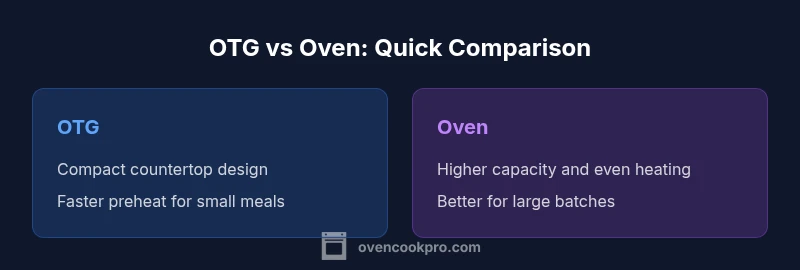
Not the same: an OTG is a compact, multi-function unit, great for small-batch baking, toasting, and broiling, while a full-size oven handles larger loads and offers more even heat across racks. For specifics on capacity, features, and pricing, see our detailed comparison chart. The choice depends on your kitchen space, typical recipes, and budget. Understanding these differences helps you avoid surprises at dinner time.
Is oven and otg same?
Is oven and otg same? The short answer is no. While both are heating appliances used for baking, roasting, and toasting, they differ in form, capacity, and intended use. According to Oven Cook Pro, is oven and otg same? In practice, they share core functions, but the differences matter for how much you cook, how evenly items heat, and how you manage energy and space in a kitchen. This distinction becomes obvious once you explore size, heating methods, and typical tasks. Homeowners who treat these as interchangeable often encounter uneven results, wasted time, and unexpected space constraints. The goal here is to map out where each appliance shines, so you can make a choice that fits your meals and your kitchen footprint.
Is oven and otg same? Many readers ask whether a countertop OTG can replace a full oven. The answer hinges on space, load, and the kind of cooking you do most often. If you routinely prepare large roasts, sheet-pan dinners, or multi-dish meals, a conventional oven offers advantages that a compact OTG cannot fully match. Conversely, for quick breakfasts, small bakes, or space-limited kitchens, an OTG can be a practical workhorse. The key is to align equipment with cooking routines rather than chasing the lowest upfront cost.
Comparison
| Feature | Oven | OTG |
|---|---|---|
| Capacity and size | Large interior, suitable for multiple racks and big trays | Compact, countertop footprint suited for small batches |
| Heating method | Upper and lower elements with convection in many models, even heat distribution | Coils or heating elements with grill function; limited convection in most models |
| Best use | Bulk baking, casseroles, pastries, and meals that feed many | Toasting, broiling, quick bakes, and limited-volume cooking |
| Preheating and cook times | Longer preheat, especially for even multi-rack loads | Faster preheat for small items and quick meals |
| Energy efficiency | Typically higher energy use for large batches, but efficient when loaded properly | Lower energy use for tiny loads, with caveats about hot spots |
| Price range | Higher upfront cost and, for built-in units, installation impact | Lower upfront cost, space-saving, but limited capacity |
The Good
- Full-size ovens offer versatility for large meals and even heating across multiple racks
- OTGs are affordable, compact, and convenient for small kitchens or shed-space jobs
- Both can bake, roast, and broil with proper rack placement and load management
- OTGs often preheat faster for single-item tasks and snack-sized batches
Drawbacks
- OTGs have limited capacity and sometimes uneven heat for large items or dense roasts
- Full-size ovens require more kitchen space and can incur higher upfront costs and installation considerations
- Specialty features (like air-fry or advanced convection) may be unevenly supported across OTGs and ovens
- OTGs may lack robust cooling and insulation for long, continuous sessions
Full-size ovens are generally better for families and serious bakers; OTGs excel as space-saving, secondary appliances.
If you regularly cook large meals or bake across multiple racks, a traditional oven delivers reliability and capacity. An OTG works well in small kitchens or as a supplementary device for quick, small-batch tasks. The choice hinges on your typical load and space constraints, not just the price tag.
Questions & Answers
Is an OTG a substitute for a traditional oven for everyday baking?
In many cases, an OTG cannot fully substitute a traditional oven for everyday baking, especially for large batches or multi-rack recipes. It lacks the interior space and, often, even heat distribution needed for larger trays. If you bake frequently for several people, a full oven provides consistency and capacity that an OTG typically cannot match.
An OTG can handle small bakes, but for daily family meals or large batches, a full oven is usually a better fit.
Can you bake bread in an OTG?
Bread can be baked in an OTG, but results depend on size and shape. A loaf that fits comfortably and is baked with proper steam and temperature control can work, but many bakers prefer a full-size oven for even crumb and crust across larger loaves.
Yes, you can bake bread in an OTG if the loaf fits well and you manage heat, but a traditional oven often yields more even crusts.
Do OTGs require preheating?
Most OTGs require preheating for best results, especially for baking and broiling. The preheat time is typically shorter for small items, but you still want a stable temperature before loading food to ensure even cooking.
Yes, preheating helps OTGs seal in moisture and achieve consistent results.
Which is safer to use in a small kitchen?
In tight spaces, an OTG can be safer due to smaller heat sources and easier reach to controls. However, both appliances require clearance for heat dissipation and careful placement away from combustibles. Always follow manufacturer guidelines.
OTGs can be simpler to fit in small spaces, but safety around heat remains essential for both.
Are OTGs and convection ovens similar?
OTGs and convection ovens share the goal of heating food, but a convection oven contains a built-in fan to circulate hot air for even results, whereas many OTGs rely more on radiant heat and simple airflow. Some OTGs offer convection options, but they are not universal.
Convection ovens use a fan for even heat; OTGs may, but not always, include convection features.
What should I consider when upgrading from OTG to an oven?
When upgrading, assess space, electrical requirements, budget, and how often you cook for multiple people. A full-size oven adds capacity and consistency, but requires more space and potentially a dedicated circuit. Plan for installation and future needs.
If you cook in larger batches regularly, upgrading to a real oven is worth it; otherwise an OTG can remain useful as a secondary unit.
Main Points
- Assess your kitchen space and typical batch sizes before buying
- Choose an oven for capacity and consistent, even heat
- Choose an OTG for small spaces and quick, flexible tasks
- Consider long-term cost and compatibility with your recipes
- Use the comparison chart to weigh features against needs