What to Do If Oven Is Too Hot: A Practical Troubleshooting Guide
Urgent, practical troubleshooting for an overheated oven. Safety first, then calibration, seals, and professional care. Oven Cook Pro guides homeowners through checks, tests, and prevention to restore safe, accurate heating in 2026.


According to Oven Cook Pro, safety comes first when the oven is too hot. Immediately switch off the oven, unplug if safe, and ventilate the area. Then verify mode settings, test your actual temperature with an independent thermometer, and begin a safe calibration check. This quick, evidence-based sequence minimizes risk while you diagnose the cause and plan the next steps.
Safety first: Immediate actions
If your oven is too hot, safety is non-negotiable. Immediately turn off the oven at the control panel. If it’s safe to reach, unplug the unit or switch off the circuit breaker to eliminate residual power. Keep children and pets away from the kitchen while heat dissipates. Open windows or use a vent to reduce heat and fumes, but avoid throwing wide, rapid door openings that can produce burns. Wear proper oven mitts before handling any racks once the unit has cooled a bit. Do not touch hot glass or metal until it is safe. If you smell gas around a gas oven, evacuate and call emergency services right away. According to Oven Cook Pro, safety steps should be prioritized even if you suspect a quick fix. Document the exact moment you notice the issue and note the settings you were using; this helps a technician diagnose quickly if needed. This triage keeps you protected as you determine the right next steps.
Why ovens overheat: common causes
Overheating happens when the appliance heats beyond the programmed setpoint. The most frequent culprits include a miscalibrated thermostat that drifts over time, a damaged or worn door gasket that leaks heat and confuses readings, blocked or failing ventilation that traps heat indoors, and a faulty convection fan in convection ovens that distributes heat unevenly. Sometimes simply using the broil setting or a high-heat mode without proper venting can trigger excessive heat. Electrical or sensor wiring problems, a worn control board, or a recently moved oven can also throw off readings. Recognizing these scenarios helps you pick a targeted diagnostic path instead of swapping parts blindly. Oven Cook Pro notes that many overheating symptoms stem from calibration and sealing issues rather than a single faulty component. A structured approach saves time and reduces risk as you work toward safe, reliable heating.
Immediate safety steps you should take
Before you begin diagnosing, lock down the hazard: turn the oven off, ensure power is cut if possible, and vent the space. If safe, unplug the appliance and switch off the dedicated circuit breaker. Keep kids and pets away; use heat-resistant gloves only after the oven has cooled to a safe level. Do not attempt to remove heating coils or racks while the unit remains hot. If you smell gas, leave the area immediately and call emergency services. Once cooled, re-check the controls and ensure you’ve selected the intended cycle. If the oven is still very hot after cooling, proceed to thermometer testing and calibration checks. These safety steps prevent burns and exposure to excess heat while you perform more precise diagnostics.
How to test accurate temperature: thermometer method
A reliable oven thermometer is your best friend here. Place the thermometer in the center of the middle rack and preheat to a common bake temperature (for example, 350°F). After the preheat cycle completes, compare the thermometer reading with the dial. If there is a consistent offset (for example, the thermometer shows 365°F when the dial is at 350°F), you may need to calibrate or replace the sensor. Repeat the test at a second temperature (e.g., 425°F) to confirm consistency. Record the readings and adjustments you make. If readings vary widely or drift in a way that defies simple calibration, the issue may be sensor wiring or the control board. Oven Cook Pro emphasizes using independent measurement to avoid chasing an illusion created by a faulty display.
Inspect hardware: seals, elements, wiring
Even small wear can cause overheating or inaccurate readings. Inspect the door gasket for cracks, tears, or gaps that allow heat to escape or re-enter, which can mislead the thermostat. Check the heating elements for visible damage, blistering, or warping. In electric coils, a damaged element can overheat a section of the oven, and a loose connection can cause intermittent readings. Inspect the insulation around the oven cavity for sagging or deterioration. For convection ovens, ensure the fan spins freely without obstruction. If you notice signs of wear, plan replacements with compatible parts. If you’re unsure, avoid DIY on heating elements and wiring; a professional should handle these components.
Calibration and adjustment: when and how
Not all ovens are user-calibratable, but many models allow a temperature correction within a small range. If your thermometer shows a consistent offset, consult the user manual for the calibration procedure, typically found under the settings or troubleshooting menu. Some ovens require sensor replacement rather than dial recalibration. After making adjustments, re-test using the thermometer at multiple temperatures to confirm accuracy. If you do not feel confident performing calibration or if the oven continues to drift after calibration, it’s time to contact a technician. The goal is stable readings within a tight tolerance so you can rely on your oven during meals.
Practical cooking tweaks to prevent overheating
While you diagnose, adapt your cooking approach to reduce risk and maintain quality. Use lower racks to minimize intense exposure to heat, and consider partial preheating or extending preheat minimally only as needed. Place food on lower racks or shift to sheet pans that conduct heat more evenly. Use an oven thermometer to monitor internal temps rather than relying solely on the dial. If you are baking, opt for shorter bake cycles and verify with a timer. For convection modes, ensure proper fan speed and avoid overloading the oven cavity, which can cause hot pockets. These adjustments help you finish meals safely while you troubleshoot the root cause.
When to call a professional and prevention plan
If initial checks show a likely mechanical issue or if you detect gas odors, electrical smells, or sparking, stop using the oven and call a licensed technician immediately. A persistent drift after calibration, damaged wiring, or a failed sensor usually requires professional service. Create a simple prevention plan: schedule annual calibration checks, clean the oven interior regularly to prevent sensor misreads, inspect the door gasket every few months, and keep the oven area clean and free of flammable materials. Document the signs of overheating and the steps you’ve taken so future technicians can diagnose more quickly. By adopting a routine maintenance mindset, you reduce the chance of future overheating and extend the life of your oven.
Quick-reference troubleshooting flow
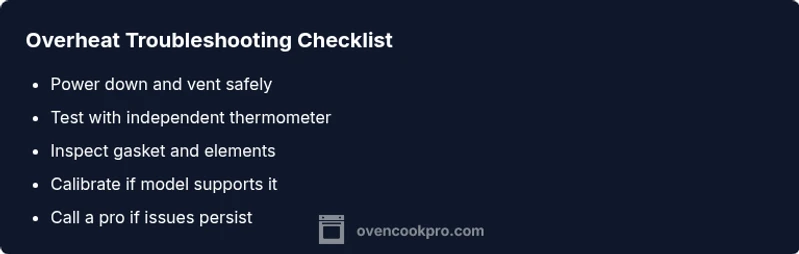
If the oven is too hot: power down → wait for cooling → test with thermometer → compare readings → calibrate if possible → inspect seals and elements → run a controlled bake test → seek professional help if issues persist.
Steps
Estimated time: 1 hour 30 minutes
- 1
Power down and cool safely
Turn off the oven at the control panel and unplug if safe. Let the oven cool completely before touching any components. Keep kids and pets away from the area during cooling.
Tip: Use a timer to avoid leaving the oven unattended while cooling. - 2
Verify mode and settings
Double-check that you’re using the intended mode (bake, roast, or convection) and not accidentally in broil or a high-heat preheat. Misselected modes can yield unexpectedly high heat readings.
Tip: Return to the standard bake setting for baseline checks. - 3
Test actual temperature with thermometer
Place an independent oven thermometer in the center of the rack and preheat to a common temperature. Compare the thermometer reading to the dial. Record offsets for multiple temps to assess consistency.
Tip: Take readings at 350°F and 425°F for a broader check. - 4
Inspect door gasket and seal
Examine the door gasket for visible cracks or gaps. A compromised seal can cause heat to escape or cause sensor misreadings. Replace if necessary following the manufacturer’s guidance.
Tip: Test the seal by closing the door on a piece of paper; if you can pull it out easily, the gasket may be worn. - 5
Check heating elements and wiring
Look for blistered, warped, or blackened elements; listen for buzzing or arcing sounds. Any signs of damage or loose wiring should be handled by a professional.
Tip: Do not attempt to touch or bend live elements. - 6
Calibrate if supported by model
If your model supports calibration, follow the manual to adjust the temperature offset. Run a subsequent thermometer test to confirm the adjustment reduced the drift.
Tip: Document the offset value you applied for future reference. - 7
Run a controlled bake test
Preheat to a moderate temp, place a pan with water or a simple bake item, and monitor how heat distributes. Compare results to thermometer readings and adjust as needed.
Tip: Avoid fully loading the oven during tests to reduce variables. - 8
Know when to call a professional
If readings remain inconsistent, if you smell gas, or if there are any electrical hazards, contact a licensed technician immediately. Do not attempt complex repairs yourself.
Tip: Ask about warranty coverage or recall notices if the oven is relatively new.
Diagnosis: Oven runs hotter than the set temperature consistently
Possible Causes
- highMiscalibrated thermostat or sensor drift
- mediumDamaged door gasket causing heat leakage and incorrect readings
- mediumFaulty heating element or temperature sensor wiring
- lowVentilation blocked or faulty exhaust
Fixes
- easyTest with an independent thermometer and recalibrate or replace the sensor as per model instructions
- easyInspect and replace door gasket if cracked, torn, or loose
- hardReplace damaged heating element or sensor wiring; consult the manual or a technician
- mediumClear vent paths and ensure exhaust is functioning; call a professional if gas oven or persistent issues
Questions & Answers
Is it safe to continue using an oven that overheats?
Not always. Persistent overheating can indicate sensor or control problems. Stop using and test with a thermometer, then calibrate if possible. If doubts persist, seek professional inspection.
Overheating can be dangerous. Stop using it and check with a thermometer before cooking again.
How do I test if my oven is calibrated?
Place an oven thermometer inside the oven, preheat to a standard temperature, and compare the reading to the dial. If the reading consistently differs, calibrate per the manual or seek service.
Use a thermometer to check accuracy, then calibrate following the manual.
What if the oven still overheats after calibration?
A persistent drift after calibration suggests sensor wiring or control board issues. If so, consult a professional technician to diagnose and replace faulty components.
If it still overheats after calibration, a professional may be needed.
Can a gas oven leak gas if it overheats?
Overheating doesn't guarantee a gas leak, but any gas odor requires immediate evacuation and a call to emergency services. Do not use switches or flames until cleared by a pro.
Gas odors are serious—evacuate and call for help immediately.
Are DIY fixes safe for an overheating broiler?
Some fixes, like gasket replacement or calibration, are DIY-friendly. Electrical or gas-related components should be handled by a licensed technician.
Some fixes you can do yourself, but avoid risky repairs.
Watch Video
Main Points
- Power down safely and ventilate before diagnosing.
- Use an independent thermometer to verify actual temperature.
- Inspect seals, elements, and wiring for obvious issues.
- Calibrate only if supported and proceed to professional help if unresolved.