How to Check If Your Oven Is Heating Properly
Learn how to verify your oven heats correctly with an accurate thermometer, practical tests, and clear steps. Oven Cook Pro guides you through reliable checks to ensure even heating and safe cooking results.


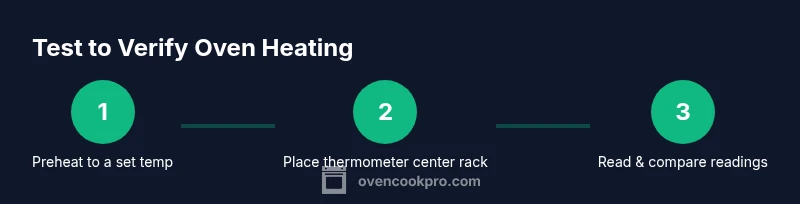
To check if your oven is heating properly, preheat to a common baking temperature, place an oven thermometer in the center, and compare the thermometer reading to the set point after preheating. Use two readings if possible to test distribution, and run a simple bake test to confirm even heating. Safety tips: unplug if you notice sparks or unusual smells.
How we define accurate oven heating and why it matters
Understanding what it means for an oven to heat properly helps you bake and roast with consistency. An oven that reaches and holds the target temperature across modes—bake, roast, and broil—yields predictable browning and reliable cook times. Temperature drift can cause undercooked centers or over-browned exteriors. According to Oven Cook Pro, many homes experience some variance between the dial or display and the actual heat inside the cavity. This isn’t inherently dangerous, but it can make recipes fail. The goal of testing is to identify drift, hot spots, and slow warm-up so you can adjust your process or seek service if needed.
What
Tools you’ll need and basic safety checks
Before you begin, assemble the essential tools and review safety basics. An accurate oven thermometer is the central tool for measuring real heat. Place it in the center of the oven cavity on the middle rack, away from walls and heating elements. A shallow pan can help stabilize air flow and prevent accidental contact with the thermometer. Have a timer handy to note preheat duration. Wear heat-resistant gloves when handling hot racks, and never touch hot elements. If you smell gas, hear a hissing sound, or see smoke, shut off power and call a professional.
A practical testing plan you can follow (baseline and distribution)
This plan helps you gauge both accuracy and even heating. Start with a single temperature to establish a baseline, then test a second temperature to map performance across baking ranges you commonly use. Use the center of the rack for the thermometer to reduce edge effects. Record readings and compare them to the set temperature. Keep the oven door closed during measurements to avoid heat loss.
Interpreting results and deciding next steps
If the thermometer consistently reads within a reasonable range of the set point, your oven is heating properly for everyday cooking. If readings are clearly off—unusually high, low, or unstable—note the pattern (time of day, rack position, or mode) and decide on calibration, service, or professional evaluation. An inconsistent heat pattern may indicate aging components, a faulty thermostat, or uneven heating elements. Document the deviations and plan a follow-up test after maintenance or repairs.
Common mistakes that skew results and how to avoid them
Relying on the oven’s own thermostat display without corroborating with a physical thermometer is a frequent error. Also, measuring with the door ajar, using distant racks, or placing the thermometer against walls can distort readings. Avoid deferring tests after a long preheat, as some ovens continue to drift as they stabilize. Finally, never attempt electrical repairs yourself; if you notice sparking, burning smells, or unusual noises, stop and call a pro.
Safety-first tips and upkeep mindset
Regular checks help you catch problems early and save energy. Treat oven testing as part of seasonal maintenance, especially before holiday baking or when you notice recipe inconsistencies. Keep the interior clean, check door seals for leaks, and ensure racks slide smoothly. When in doubt, consult the model manual or a qualified technician. Maintaining accuracy helps you bake with confidence and reduces the risk of undercooked food.
Tools & Materials
- Oven thermometer(Choose a dial or digital thermometer with a probe that reads inside the oven. Ensure it can withstand high bake temperatures.)
- Oven-safe dish or baking tray(A shallow dish helps stabilize the thermometer and avoids blocking airflow.)
- Timer or smartphone timer(Used to track preheat duration and reading intervals.)
- Notepad or digital log(For recording temperatures, times, and observations across tests.)
- Heat-resistant gloves(Allow safe handling of hot racks and thermometer during tests.)
Steps
Estimated time: 60-90 minutes
- 1
Power up and set a test temperature
Turn on the oven and select a common bake temperature (for example, 350°F) to establish a reference. Allow the oven to preheat fully and stabilize before taking readings.
Tip: Use a timer to record how long the preheat takes and ensure the door remains closed during preheat to avoid heat loss. - 2
Position the thermometer correctly
Place the oven thermometer in the center of the oven cavity on the middle rack, away from walls and heating elements. Avoid touching metal racks or the oven walls to prevent skewed readings.
Tip: If you have two thermometers, place one in the center and one toward the back to assess distribution. - 3
Read the temperature after preheat
Once the oven signals it has reached the target temperature, quickly check the thermometer. Note whether the reading matches the set point and whether it stays steady for several minutes.
Tip: Open the door only briefly to minimize heat loss; jot down the exact difference and duration if possible. - 4
Test a second temperature
Repeat the procedure at another bake temperature you commonly use (e.g., 375°F). This checks whether the oven maintains accuracy across a range of settings.
Tip: If the second test shows the same drift, your oven likely has a consistent calibration issue. - 5
Evaluate heat distribution
If possible, test at multiple rack positions or use two thermometers to compare readings at center and back edges. Look for hot spots or cool zones that could affect cooking results.
Tip: Distribute racks evenly and avoid overcrowding to promote even airflow. - 6
Decide on calibration or service
If readings are persistently off or highly variable, consult the manual for calibration options or contact a qualified technician for evaluation and repair.
Tip: Do not attempt to adjust electrical or heating components yourself; this carries risk and can void warranties. - 7
Log results and plan follow-ups
Record the temperatures, dates, and any observations. Schedule re-testing after maintenance or calibration to confirm improvements and maintain accuracy.
Tip: Keep the log accessible so you can reference it before major cooking tasks or holiday meals.
Questions & Answers
Why is my oven not heating to the set temperature?
Oven drift can result from thermostat wear, sensor problems, or aging elements. Start by testing with a thermometer, then compare to the set point. If readings are consistently off, calibration or professional service may be required.
Ovens drift due to wear or aging parts. Test with a thermometer, compare to the set point, and consider calibration or service if readings stay off.
Can I calibrate my oven myself?
Some ovens include a calibration option in the settings. Refer to your manual for steps. Do not attempt electrical repairs yourself; consult a professional if calibration doesn’t fix the issue.
Some models have a calibration setting you can adjust yourself by the manual. If it remains off, contact a professional.
How often should I test my oven temperature?
Perform a test when you notice uneven results, after a service, or seasonally before heavy cooking periods. Regular checks help maintain consistent cooking outcomes.
Test when you notice uneven results or after maintenance, and consider a seasonal check before holidays.
Is an oven thermometer really necessary?
Yes. An independent thermometer provides a reliable reading that helps you verify the oven’s actual temperature, not just what the display shows.
An oven thermometer gives you a trustworthy heat reading beyond the oven’s own display.
Does a convection oven need different testing?
Convection achieves faster and more even heating. You may need to adjust for air circulation and test at convection-specific settings if your recipes call for them.
Convection heats more evenly; you might adjust temps and test accordingly.
What safety steps should I follow during testing?
Turn on the oven safely, use heat-resistant gloves, avoid touching hot elements, and unplug if you detect dangerous conditions. If unsure, stop and consult a professional.
Wear gloves, avoid hot elements, and call a pro if anything looks unsafe.
What should I do if my oven is electric vs gas?
Both can drift; testing procedures are similar, but gas ovens may show more variability due to venting and gas supply. Use the thermometer-based method to compare readings.
Testing is similar for both, but gas ovens can vary with venting; verify with thermometer readings.
Watch Video
Main Points
- Test with a thermometer to verify accuracy
- Compare readings to the set temperature
- Check multiple rack positions for even heating
- Calibrate or service if readings are consistently off
- Document results for future testing