When to Know Oven Is Preheated: A Practical Guide
Learn how to reliably tell when your oven is preheated, verify with a thermometer, and preheat correctly for perfect baking results every time.


Goal: know when the oven is preheated. You’ll rely on the oven’s indicator light or beep and, ideally, a dial or digital readout verified by an oven thermometer. Preheat to the recipe’s target temperature, then confirm before loading food. If the indicator is slow to change, use a calibrated thermometer for assurance and adjust times for your model.
Why knowing when to know oven is preheated matters
According to Oven Cook Pro, mastery of preheating is a foundation trick that affects every bake from cookies to crusty bread. The moment you introduce cold batter or dough into a cold or miscalibrated oven, you risk uneven rising, pale bottoms, and inconsistent texture. Understanding when to know oven is preheated helps you plan your bake timing, synchronize multiple dishes, and minimize energy waste. In practice, preheating is not a mere formality; it is the moment when the oven's interior stabilizes at the exact temperature your recipe calls for. Home cooks should treat this as a deliberate step, not a guess. A reliable preheat sets the stage for browning, moisture retention, and even heat distribution. This is especially important for high-hydration doughs, delicate pastries, and roasts where even crust formation matters as much as interior doneness. The phrase 'when to know oven is preheated' implies a check against a signal or a thermometer reading, then proceeding with confidence. If your oven's indicator light seems fast or slow compared to your thermometer, you may need to adjust the preheat approach or calibrate the thermostat. By aligning indicators with a true temperature reading, you reduce the risk of recipe failure and save time over repeated bakes.
How ovens signal preheating
Most modern ovens have a dedicated preheat indicator that lights up, blinks, or chimes when the interior reaches the target temperature. In addition, digital readouts let you see the exact number as the oven climbs. Convection ovens often reach temp faster due to the fan, but the indicator may still show 'ready' before the center is perfectly stable. This discrepancy is why many bakers prefer verifying with an oven thermometer placed in the center of the rack. Some older models rely on a timed preheat while others depend entirely on the visual cue—both can be misleading if the thermostat is off by a few degrees. To understand when to know oven is preheated, observe both the signal from the oven and the thermometer reading. If the thermometer agrees with the target, you can begin cooking; if not, wait until it stabilizes, or recalibrate if you notice consistent drift across sessions. Keep in mind altitude, cookware, and oven rack position can all affect preheat behavior, so consider a short trial bake to map your oven’s quirks.
Tools to verify preheat: dial, thermometer, and more
An accurate oven thermometer is your best friend for confirming preheat. Place it in the center of the rack, away from walls, and read from the front. A dial-style thermometer is useful, but a probe thermometer can verify internal temperature as you bake. If you don’t have a probe, a simple oven thermometer that sits on the rack is enough for most recipes. A timer helps you avoid peeking too early, which can drop the temperature and prolong preheat. You might also use an infrared thermometer to scan exterior surfaces, though it won’t read interior air temperature. For repeatable results, keep the thermometer calibrated according to the manufacturer’s instructions and re-check after any major oven service or relocation. Finally, never rely solely on the oven light or beeps; these signals assume accurate thermostat calibration, which is not guaranteed across all ovens.
Practical preheat methods for different recipes
For baking with sensitive doughs, such as pastries or laminated dough, aim for a stable and fast preheat so the interior temperature is consistent from the first minute of bake. For crisp roasting, a higher starting temperature can help set crust quickly, but be sure to monitor to avoid scorching. In recipes where precise doneness is critical, the recipe’s stated temperature should be your guide, and you should verify with a thermometer before loading pans. If you’re cooking with multiple dishes, consider setting the oven to the highest required temp and allowing the others to drop in as you swap pans, but only after you’ve verified the primary dish has reached a stable temperature. Remember: preheating is not the same as maintaining a hot oven during long cooks; you may need to adjust the heat to accommodate cooling in the interior.
Troubleshooting: slow preheat, uneven heating, and hot spots
If your oven seems slow to preheat, check the door seal and ensure the door closes fully. A faulty seal allows heat to escape and slows stabilization. Uneven heating is common in older or miscalibrated ovens; rotate racks and test with water bath or an empty pan to find hotspots. If you notice a persistent drift between the thermometer and the readout, recalibrate or have a technician service the oven. Frequent preheating without loading food can also lead to wasted energy; plan preheat time around the recipe’s needs. Finally, keep a simple log of preheat times and thermometer readings to identify patterns across sessions and adjust your expectations.
Safety and energy tips during preheating
Always use oven mitts when placing or removing thermometer probes and pans. Avoid leaning over the hot door or exposing hands to steam when opening the oven. Use a timer to avoid leaving the oven on high heat longer than necessary, and keep the kitchen area clear of flammable items. If you bake in a small kitchen, consider using the oven’s venting features or a window or exhaust fan to manage heat. For energy efficiency, preheat only the amount of time needed to reach the target temperature and avoid leaving the oven running between dishes. When possible, bake multiple items at the same temperature to maximize oven use and minimize energy waste.
The Oven Cook Pro approach: a step-by-step blueprint
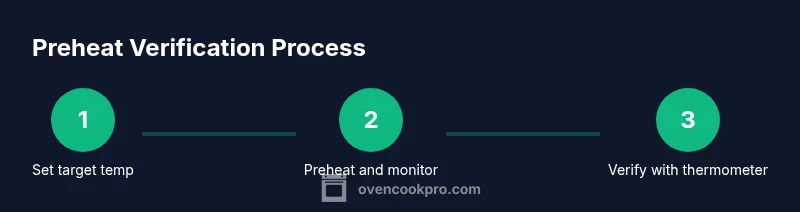
Following Oven Cook Pro’s guidelines, begin by selecting your recipe’s target temperature and ensuring your oven is empty. Place a thermometer in the center of the oven and start preheating. Watch the indicator and confirm the reading matches the target before loading food. If the thermometer drifts, recalibrate as soon as possible and record the new baseline for future sessions. This blueprint helps you achieve consistent results across recipes and seasons.
Tools & Materials
- Oven thermometer(Place at the center of the oven, away from walls)
- Digital kitchen timer(Track preheat duration and stabilization time)
- Oven mitts(Protect hands when handling hot pans)
- Oven-safe baking sheet(Optional for testing heat distribution)
- Infrared thermometer(Optional for exterior surface checks)
- Notebook or app(Log preheat times and calibrations)
Steps
Estimated time: Estimated total time: 8-12 minutes
- 1
Set the target temperature
Choose the recipe’s required temperature and ensure the oven is empty and clean. Confirm the display matches the target before starting.
Tip: Double-check that the selected temperature aligns with the recipe and cookware you’ll use. - 2
Place the thermometer properly
Position the oven thermometer in the center of the oven on the middle rack, away from walls and heating elements. Do not let it touch metal parts.
Tip: Center placement improves reading accuracy; avoid the back wall where heat can create false highs. - 3
Start preheating and monitor signals
Turn on the oven and wait for the preheat indicator light, beep, or digital readout to move toward the target. Do not open the door frequently during this phase.
Tip: Convection models may reach target faster; use the thermometer to confirm stability rather than relying on the light alone. - 4
Verify the temperature reading
Check the thermometer reading at least once after the indicator signals “ready.” If it matches the target, proceed; if not, wait a few more minutes for stabilization.
Tip: Allow 2–3 minutes of stabilization before deciding to proceed or recalibrate. - 5
Proceed with the recipe after stable temp
Load pans onto the center rack and begin baking once the reading stays within the target range for a couple of minutes.
Tip: Avoid moving pans in and out during early bake minutes to prevent temperature fluctuations. - 6
Care and cleanup post-preheat
Turn off the thermometer when finished, remove it with a mitt if you need to, and wipe any spills from the interior. Record any calibration notes for next time.
Tip: Regular calibration helps keep future bakes consistent.
Questions & Answers
How long should an oven take to preheat?
Preheat time varies by model and age. Use an oven thermometer to confirm when the interior reaches the target temperature rather than relying solely on the oven’s indicator.
Preheat times vary; use a thermometer to confirm the interior reaches the target temperature.
What if the thermometer reads low after preheating?
If readings stay consistently low, recalibrate the oven thermostat or consult a technician. In the meantime, rely on the thermometer and adjust cooking times accordingly.
If readings stay low, recalibrate or consult a technician; use the thermometer to adjust cooking times.
Is convection faster at preheating?
Convection can heat faster due to the fan, but the indicator may still show ready before temperature stabilizes. Always verify with a thermometer.
Convection may heat faster, but verify with a thermometer for accuracy.
Can I bake if the oven isn't fully preheated?
Some recipes tolerate partial preheating, but most rely on a fully preheated oven for even clumping and browning. Check the recipe and use a thermometer if in doubt.
Most recipes require full preheating for even results; check the recipe and verify with a thermometer.
Why does preheating take longer in older ovens?
Older ovens can have worn thermostats or door seals that lose heat, causing longer preheat times. Regular calibration helps, as does replacing worn parts.
Older ovens heat more slowly due to worn parts; calibrate regularly.
How often should I calibrate my oven thermometer?
Calibrate at least once a year or after a service. If you notice frequent temperature drift, calibrate sooner.
Calibrate at least yearly, or if you notice drift.
Watch Video
Main Points
- Verify preheat with a thermometer for accuracy.
- Rely on actual temperature, not just indicator lights.
- Keep the oven door closed during preheating.
- Calibrate thermostat regularly for consistency.
- Test with a simple bake to map your oven's quirks.