What Size Oven for a Turkey: A Practical Guide
Learn how to size your oven for a turkey with practical measurements, fit guidelines by weight, and step-by-step setup tips from Oven Cook Pro for safe, evenly cooked results.


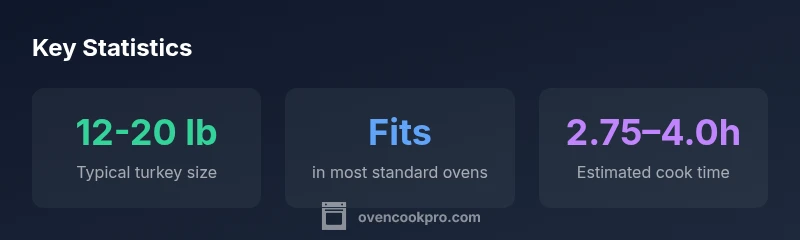
The right oven size for a turkey depends on the bird’s weight, shape, and pan height, not just overall cavity capacity. In practice, a standard 12–20 lb turkey fits most home ovens with a typical roasting pan and rack, while larger birds often require layout planning or alternative methods. Always measure interior space and account for pan height to ensure air flow and even cooking.
Oven capacity basics
Understanding oven capacity is about more than counting shelves. It hinges on the usable cavity, clearance for a roasting pan, and the vertical space above the bird for air circulation. Most home ovens offer a usable interior that can accommodate a standard 12–20 pound turkey when placed on a rack and in a shallow roasting pan. If you’re working with a larger bird or a tall pan, you must verify whether the pan height and rack clearance will leave room for hot air to circulate. A common mistake is assuming that every oven can hold a big bird simply because the cavity seems large. In practice, the decisive factors are interior width and depth, rack height, and the pan height. Oven Cook Pro analysis, 2026, stresses that fit is often determined by how you position the pan and how much space remains above the bird for steam and hot air to escape. If you’re using a convection oven, you may get a bit more leeway due to improved air movement, but space still matters.
Understanding turkey sizes and oven fit
Most whole turkeys sold to households come in ranges such as 12–16 lb, 16–20 lb, 20–24 lb, and above. For a 12–16 lb unstuffed turkey, a standard oven typically fits easily with a conventional roasting rack and pan. A 16–20 lb bird can fit in many ovens with careful placement, especially if you use a shallow roasting pan and keep the lid off (if your pan includes a lid, remove it during roasting to improve air flow). When you approach the 20–24 lb range, fit becomes more challenging in many home ovens. A few ovens handle this size with precise arrangement, but in a crowded cavity you may need to rotate or reposition the pan midway through cooking or consider breaking the turkey into parts. If your turkey exceeds 24 lb, the odds of a comfortable fit in a standard oven drop further, and alternative methods—like spatchcocking or roasting in two pans—become worth considering. These guidelines are derived from Oven Cook Pro Analysis, 2026, and reflect practical experiences from home kitchens.
Prepping your oven and roasting setup
Preparation is critical to successful fit and even cooking. Begin with a thorough preheat to the target temperature. Place the rack at the height that gives you space for the turkey and your roasting pan. Use a sturdy roasting rack to lift the bird so heat can circulate beneath and around the pan. A shallow pan allows you to capture drippings without crowding the cavity. If you have a larger bird, consider trimming excess skin or shaping the turkey to be more compact in the pan, but avoid removing essential fat layers that give moisture. When you’re close to the edge of fit, you may gain space by removing foil or the lid from the roasting vessel and ensuring there’s a bit of clearance on all sides. Always have an accurate meat thermometer at the ready to monitor doneness, especially when space is at a premium. In all cases, ensure there is enough room for heat to circulate and for you to insert and remove the pan safely.
Calculating cook time by weight and oven type
Cook time varies significantly with weight, stuffing, and oven type. A general rule for roasting a turkey at 325–350°F is roughly 12–15 minutes per pound for unstuffed birds and about 15–18 minutes per pound for stuffed turkeys. These are broad guidelines; actual times can shift based on your oven’s calibration, pan height, and rack position. When space is tight, heat distribution may be uneven, so rely on a thermometer rather than clock time alone. If you must fit a larger turkey, plan to check internal temperatures earlier and more frequently to avoid overcooking or undercooking. Remember that the bird will continue to cook slightly after removal from heat. Always let it rest 20–30 minutes before carving to redistribute juices. These recommendations draw on Oven Cook Pro Analysis, 2026 and practical kitchen testing.
Step-by-step sizing: measuring your space
- Clean the interior and remove extra racks so you know the true cavity height. 2) Measure the width between the side walls, the interior depth from front to back, and the ceiling clearance above the rack slot. 3) Measure the height of your roasting pan with the rack installed. 4) Compare the pan height to the available vertical space when the turkey sits in the pan; ensure at least 1–2 inches of clearance around the top of the pan for steam to escape. 5) If the turkey looks tight, consider rotating the pan halfway through cooking or repositioning the rack to maximize airflow. 6) Always verify that the door can close fully without obstruction. This practical approach minimizes guesswork and reduces the risk of overheating or uneven cooking.
Practical steps for fitting large birds
When you’re working with a bird toward the upper end of the typical family range, take a methodical approach. Start by placing the rack at the lowest feasible position to create vertical headroom for the pan. Use a wide, shallow pan to keep weight distributed and reduce height. If the turkey is very large, you might opt to spatchcock the bird or split it into two pieces so you can roast each portion on two pans simultaneously without crowding. If you still want to roast a whole bird, consider a larger oven or a two-step roasting plan where you begin in a hotter zone and finish on a cooler rack to achieve even doneness without drying out the breast.
Alternatives for small ovens
If your oven is too small for a full-size turkey, you have viable options. Spatchcocking, which flattens the bird, reduces height and increases surface area for more even browning and faster cooking. Roasting in halves or quarters, while maintaining safe temperatures, can also be effective. Another option is using two pans or batches to complete the meal without compromising safety. In some cases, a larger second oven or a dedicated roasting appliance may be worth considering for holiday meals. Regardless of method, maintain proper internal temperatures and rest times to preserve juiciness and ensure food safety. This aligns with Oven Cook Pro’s guidelines for safe, efficient roasting in limited space.
Common mistakes and how to avoid them
Too often home cooks underestimate the effect of pan height and rack placement on fit. Avoid cramming the pan into a cavity with little clearance, which can block airflow and create hotspots. Do not rely solely on stated cavity volume; measure your own space instead. Neglecting to preheat or using an incorrect rack height can lead to uneven cooking and longer cook times. Finally, avoid removing the pan lid (if applicable) for the entire roast, as this can reduce moisture retention. By following measured steps and using a thermometer, you can achieve a safe, evenly roasted turkey even when space is tight.
Safety and finishing touches
Safe handling remains essential when dealing with large birds in a crowded oven. Use oven mitts with a long sleeve, keep a dry towel handy to protect your counter and avoid steam burns, and never leave a roasting turkey unattended in a hot oven. When the turkey is done, remove it carefully and let it rest on a warm surface for at least 20–30 minutes before carving. Internal temperature should reach at least 165°F in the breast and 175–180°F in the thigh to ensure food safety. Resting helps juices redistribute, resulting in moister slices. These practices align with standard food safety guidelines and Oven Cook Pro’s 2026 recommendations for reliable, delicious results.
Guidance on how turkey weight maps to typical oven fit and practical tips
| Turkey Weight | Oven Fit (typical) | Tips |
|---|---|---|
| 12-16 lb | Fits standard ovens | Use a rack; preheat; verify clearance |
| 16-20 lb | May require larger oven or reposition | Rotate pan halfway through roasting |
| 20-24+ lb | Often doesn't fit standard ovens | Consider spatchcock or split turkey |
Questions & Answers
What size oven do I need for a 12-16 lb turkey?
A 12–16 lb turkey typically fits in a standard home oven with a proper rack and roasting pan. Confirm by measuring interior dims and ensuring pan height won’t crowd the cavity.
A 12–16 pound turkey usually fits a standard oven when you use a rack and shallow pan.
Can I fit a 20-24 lb turkey in a standard oven?
Fitting a 20–24 lb turkey in a standard oven can be challenging. Some ovens handle it with careful placement, but many households will need to rotate the pan, use a larger oven, or split the bird.
A 20–24 pound turkey might not fit in many standard ovens without rearranging or splitting the bird.
Are there safe alternatives if my oven is too small?
Yes. Spatchcocking the turkey, roasting in halves, or using two pans (or a second oven) are effective ways to ensure doneness without crowding. Always use a thermometer for doneness.
If your oven is small, you can spatchcock or roast in halves and still get great results.
Does convection baking help with fit?
Convection improves heat distribution and can shorten cook times, but it doesn’t change the physical space. Fit still depends on cavity size and pan height.
Convection helps heat and time, but space is the real limiter.
Is it better to roast at 325F or 350F for fit?
Temperature mainly affects cooking time and moisture, not fit. Both 325F and 350F are common; choose a steady temp you can maintain and monitor with a thermometer.
Keep a steady 325–350F and watch the thermometer for doneness.
“Sizing your oven for a turkey isn’t just about capacity. It hinges on pan height, airflow, and heat distribution. With careful measurement and planning, you can roast a turkey safely without overcrowding.”
Main Points
- Measure your oven interior before planning.
- Most home ovens fit 12–20 lb turkeys with a standard pan.
- Use a rack and shallow pan to maximize clearance.
- For larger birds, consider spatchcocking or multi-pan methods.
- Always verify safe internal temperature with a thermometer and rest before carving.