How to Place an Oven Near a Fridge: A Safe, Practical Guide
A step-by-step guide to evaluating and implementing an oven near your fridge, covering clearance, ventilation, electrical safety, and layout options for a safe, efficient kitchen.


Learn how to evaluate the safety and practicality of placing an oven near a fridge. This guide covers clearance, heat exposure, ventilation, electrical load, and cabinet configurations, then walks you through a step-by-step planning process to decide whether to keep the arrangement or relocate components. By the end, you'll have a compliant, kitchen-friendly layout.
Why placement matters for ovens and fridges
In most kitchens, placing an oven near a fridge is common, but it requires careful planning to prevent heat from the oven from affecting the fridge's compressor and to maintain safe operation. According to Oven Cook Pro, safe placement hinges on heat dissipation, airflow, and electrical planning. When heat from the oven encroaches on the fridge, the fridge may work harder, potentially reducing efficiency and increasing energy use over time. In addition, poor layout can hinder door clearance and storage, making daily cooking tasks more tedious.
Heat exposure and airflow are the invisible drivers of safe appliance placement. An oven radiates substantial heat during cooking and self-cleaning cycles. If vents, coils, or radiant surfaces are too close to a fridge, the appliance can experience longer cycling times or higher ambient temperatures inside the unit. This not only raises energy use but can shorten the fridge's lifespan if cooling coils are consistently stressed. A well-designed kitchen uses strategic barriers, such as tall cabinetry, a thermal wall, or a dedicated ventilation path to keep heat where it belongs.
Ventilation and cabinet design matter just as much as distance. Kitchens with robust range hoods, dedicated exhaust, or passive cooling routes help maintain stable temperatures around both appliances. If you cannot separate the fridge and oven, consider installing shields or a narrow cabinet between them, ensuring the oven's venting remains unobstructed. Always verify that doors can swing fully without colliding with any cabinet or appliance, and keep clutter away from the door seals. Finally, consult the installation manuals for both appliances and follow local electrical rules to avoid shared circuits or overloaded outlets.
Tools & Materials
- Tape measure(For measuring distances, door clearance, and clearances between appliances)
- Graph paper or kitchen layout software(To sketch multiple layouts and compare spacing)
- Notebook or digital notes app(Record measurements, constraints, and final plan)
- Appliance installation manuals (digital copies)(Keep manufacturer guidelines handy for clearances and venting)
- Stud finder and level(If making cabinet modifications, locate studs and ensure level mounting)
- Electrical tester or multimeter(Optional for confirming outlet status and load suitability)
Steps
Estimated time: 3-6 hours
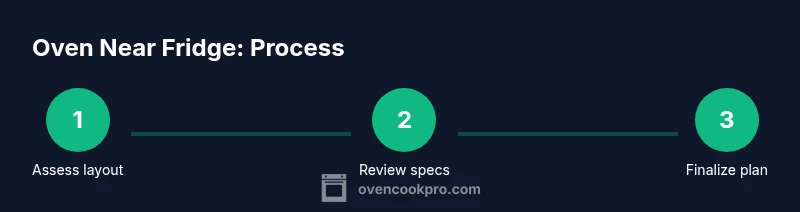
- 1
Assess current layout
Begin by mapping the positions of the oven, fridge, sinks, and range hood. Note doors that swing into walkways and any existing heat sources. Create a rough sketch to visualize sightlines, accessibility, and potential heat paths.
Tip: Start with a simple sketch on graph paper before moving any appliances. - 2
Review clearances and venting
Consult both appliance manuals to identify required clearances, venting needs, and installation constraints. Ensure that vents won’t be blocked by cabinetry and that heat dissipation routes remain unobstructed for both devices.
Tip: Do not rely on memory—document the official clearances for each model. - 3
Model alternate layouts
Draft two to three layout options on paper or with software. Compare heat exposure, airflow, door swing, and routine work flow for cooking and refrigeration tasks.
Tip: Label each option with pros and cons to compare quickly. - 4
Consult professionals
Engage a licensed electrician to verify circuits and outlets, and a carpenter or contractor for cabinet modifications or barriers. Obtain any required permits before making changes.
Tip: Get written confirmations of code compliance before proceeding. - 5
Finalize plan and schedule installation
Choose the safest, most practical layout, document measurements, and create a project timeline. Prepare a materials list and a budget, then coordinate installation with all professionals involved.
Tip: Keep manuals and photos of the final plan for future servicing.
Questions & Answers
Is it safe to place an oven near a fridge?
Yes, it can be safe if you meet clearances, provide adequate ventilation, and ensure dedicated electrical circuits. Avoid blocking vents and maintain proper door clearance.
Yes, with proper clearances, ventilation, and dedicated electrical circuits.
What layouts minimize heat exposure between the two appliances?
Opposite walls or a barrier-separated arrangement helps minimize heat exposure and enables better airflow for both devices.
Keep them on opposite walls or separated by a barrier.
Do I need permits for remodeling to separate appliances?
Permit requirements vary by location. Check with local building authorities and, if needed, obtain electrical and structural permits.
It depends on your area; consult local authorities.
Can I place an oven above a fridge?
Not recommended due to heat rising toward the fridge and potential clearance issues. Consider alternative layouts.
Usually not recommended; look for a different configuration.
What should I do if space is very tight?
Use barriers, selective insulation, and ensure good venting. Consider reconfiguring cabinets or moving one appliance to a separate wall.
If space is tight, add barriers and consider moving one appliance.
Does a convection oven change placement considerations?
Convection cooking changes nothing about the basic need for heat management and venting; follow the same guidelines.
Convection or not, you still need proper venting and heat boundaries.
Watch Video
Main Points
- Plan layout before purchasing appliances
- Ensure heat barriers between oven and fridge
- Verify ventilation and electrical requirements with professionals
- Follow manufacturer guidelines and local codes