Can You Put an Oven Next to a Wall? A Home Cook's Safety Guide
Learn whether you can place an oven next to a wall and how to do it safely. This comprehensive guide covers clearances, shielding, ventilation, and professional help to protect your kitchen and family.


Yes, you can place an oven next to a wall, but you must follow manufacturer clearances and local safety codes. Ensure proper ventilation, heat shielding on the adjacent wall, and sufficient space for door swing and service access. Always check installation instructions and use appropriate backing, mounting, or corner protection as recommended by the brand.
Why placement matters
Placement of an oven next to a wall is a safety and performance decision, not a decorative constraint. The oven radiates heat during every cycle, and sustained heat exposure can affect nearby cabinets, wall coverings, and finishes. Improper spacing can also compromise door clearance, control accessibility, and service access for maintenance. According to Oven Cook Pro, proper positioning reduces heat exposure to cabinetry and ensures safe door swing, which protects both your kitchen aesthetics and your family. In practical terms, this means planning around the appliance’s door arc, any adjacent drawers or panels, and the hood or ventilation system that serves the cooking area. By starting with the installation manual and your kitchen layout, you create a foundation that supports reliable performance, safer operation, and easier future upgrades.
Why placement matters
Placement of an oven next to a wall is a safety and performance decision, not a decorative constraint. The oven radiates heat during every cycle, and sustained heat exposure can affect nearby cabinets, wall coverings, and finishes. Improper spacing can also compromise door clearance, control accessibility, and service access for maintenance. According to Oven Cook Pro, proper positioning reduces heat exposure to cabinetry and ensures safe door swing, which protects both your kitchen aesthetics and your family. In practical terms, this means planning around the appliance’s door arc, any adjacent drawers or panels, and the hood or ventilation system that serves the cooking area. By starting with the installation manual and your kitchen layout, you create a foundation that supports reliable performance, safer operation, and easier future upgrades.
Tools & Materials
- Measuring tape(Long enough to measure from wall to oven front and assess door swing clearance)
- Owner's installation manual(Keep the exact model manual handy for model-specific clearances)
- Heat shield/back panel (heat-resistant material)(Install when wall surface is combustible or within recommended distance)
- Stud finder(Locate mounting points or to ensure a stable base if required by the model)
- Level(Ensure the oven sits perfectly level to avoid uneven heating or door misalignment)
- Safety goggles(Protect eyes during measurement and installation steps)
- Screwdriver set and appliance-grade screws(Use fasteners specified in the installation manual)
- Masking tape or layout markers(Helpful for marking positions before drilling or mounting)
Steps
Estimated time: 1-3 hours
- 1
Read the installation manual
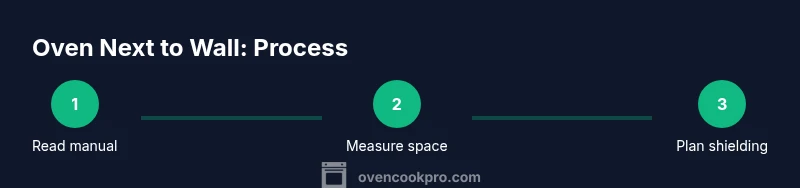
Begin by locating the manufacturer’s minimum clearances and any wall-material requirements. Note whether the model is freestanding, built-in, or wall-mounted, and verify electrical or gas connections. This initial reading sets the baseline for every subsequent step.
Tip: Have the model number handy and mark the references in the manual with a highlighter. - 2
Measure your space and door swing
Use a measuring tape to document the width of the cabinet face, the side clearance to the wall, and the full range of door swing. Check if nearby drawers or appliances would obstruct opening the oven door. If any door hits the wall, rethink the placement or add a spacer.
Tip: Mark the measured points on the floor or cabinet with masking tape for accuracy. - 3
Assess wall material and shielding needs
Identify whether the adjacent wall is drywall, plaster, tile, or a combustible surface. Plan to install a heat shield or noncombustible backing if required by the manual. This protects finishes and reduces heat transfer to framing.
Tip: If the wall is tiled or faced with a combustible veneer, a dedicated shield behind the oven is especially important. - 4
Plan ventilation and electrical provisions
Confirm that the oven’s venting path aligns with the kitchen hood or exhaust system and that electrical or gas connections are safely routed without creating heat pockets. Ensure a dedicated circuit as specified by the manual.
Tip: Avoid sharing circuits with high-draw appliances to reduce nuisance trips and heat buildup near the unit. - 5
Mark mounting or support points
With the oven position confirmed, mark anchor points and any required mounting brackets. If you are anchoring to cabinetry or a wall, verify stud locations and ensure there is clearance for screws and ventilation gaps.
Tip: Double-check alignment with a level before drilling or mounting. - 6
Install heat shielding and back panel
Attach the heat shield to the wall or cabinet face according to the manual. Make sure there is an air gap between the shield and any surface that could conduct heat. Re-check the oven’s position after shielding is in place.
Tip: Use nonflammable sealants or gaskets where the shield meets cabinetry to seal gaps without trapping heat. - 7
Verify clearance, ventilation, and service access
Re-measure all clearances, confirm door swing, and test the ventilation path. Ensure there is unobstructed access to service panels and that the unit can be pulled out for maintenance if needed.
Tip: Walk through a full door swing with the oven in the installed position to confirm no interference. - 8
Consult a professional if needed
If you encounter gas connections, complex electrical work, or unusual wall configurations, hire a licensed professional for final inspection and connection. A safety check from a pro can prevent costly mistakes.
Tip: Document all measurements and keep the installation manual handy for the technician.
Questions & Answers
Can I put an oven next to wallpaper or vinyl finishes?
Avoid placing an oven next to wallpaper, vinyl, or other heat-sensitive finishes. Use heat shielding and a noncombustible backing to protect wall coverings and ensure safe heat dissipation.
Avoid placing heat near wallpaper or vinyl; use shielding and backing to protect wall finishes.
Are there universal clearances or codes for oven placement?
There is no single universal clearance. Clearances depend on the model and local codes. Always refer to the appliance manual and local building requirements for the exact distances and materials allowed.
Clearances vary by model and code; consult the manual and local codes.
What is the difference between placing a gas oven and an electric oven near a wall?
Both types require proper clearances and shielding. Gas ovens may require venting and dedicated gas connections, while electric ovens focus on electrical supply and venting compatibility. Always follow the specific installation instructions for your model.
Gas and electric ovens both need proper clearance and venting; follow your model’s instructions.
How far should the oven be from cabinetry to allow door swing?
Leave enough space for the full door to open without contacting cabinets or walls. If space is tight, consider a shallower cabinet profile or a different layout to maintain safe operation.
Allow full door swing without hitting cabinets. Adjust layout if space is tight.
Should I install a professional for installation?
For gas hookups, electrical work, or complex wall configurations, a licensed professional is advised. They can ensure code compliance and correct venting and connections.
Consider hiring a pro for gas or complex electrical work.
What is a simple early-check I can perform before buying?
Review the model’s installation manual for required clearances, wall materials, and any shielding requirements. Align these with your kitchen layout to avoid costly moves later.
Check the manual for clearances and shielding before buying.
Watch Video
Main Points
- Verify model-specific clearances before moving forward
- Prioritize heat shielding for combustible walls
- Ensure door swing and service access are unobstructed
- Follow local codes and the installation manual
- Consult a professional when in doubt