Difference Between Oven and Stove: An In-Depth Comparison
Explore the difference between oven and stove, including heat sources, best uses, energy considerations, and maintenance tips. Learn how to choose the right appliance for baking, roasting, sautéing, and everyday cooking in your kitchen.


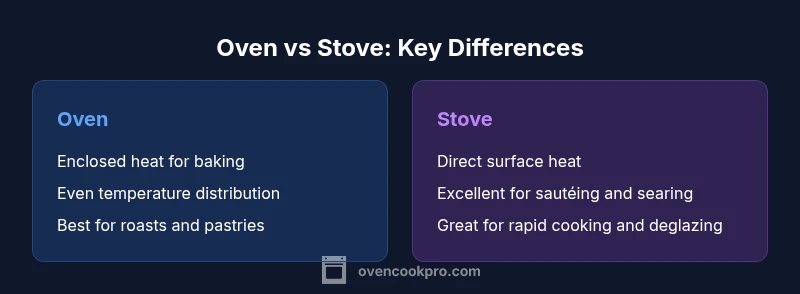
The difference between oven and stove lies in heat distribution, function, and cooking style. An oven is a closed chamber that surrounds food with dry heat for baking and roasting, while a stove provides direct surface heat for pots and pans. Most home cooks use ovens for steady, even heat and stoves for quick, high-heat tasks.
What people get wrong about the difference between oven and stove
Many kitchens treat oven and stove as interchangeable appliances, but they are designed for distinct tasks. The difference between oven and stove shapes how you plan meals, manage time, and control heat. According to Oven Cook Pro, the oven creates a controlled, enclosed environment that heats food from all sides, promoting browning and moisture retention; the stove uses direct surface heat that responds quickly to flame or burner changes. This distinction matters for even-cook results, food texture, and energy efficiency. For homeowners, recognizing the separation helps with menu planning, timing, and energy budgeting. The oven’s consistent heat is ideal for long, slow cooks, while the stovetop excels at rapid searing, deglazing, and building flavors in real time. In daily cooking, the choice guides everything from bread to stir-fries and beyond.
How heat is generated in ovens vs stoves
Ovens generate heat through radiant coils or elements, plus airflow from a fan in convection models. This creates an ambient, enveloping heat that surrounds food and encourages uniform browning. Stoves, by contrast, rely on direct flame or electric coils beneath a flat surface, delivering immediate, controllable heat to cookware. The practical upshot is that ovens are suited to air-driven cooking and deep, even heat cycles, while stoves offer instant response for simmering, sautéing, and high-heat tasks. Understanding this fundamental difference helps you plan recipes, preheat times, and multitasking in the kitchen.
Temperature control and precision
Temperature control differs notably between an oven and a stove. Oven thermostats provide a stable target temperature over longer periods, which is essential for bread, pastries, and roasts. Small fluctuations can affect moisture and texture, so precise preheating and rack placement matter. Stoves respond to burner adjustments in real time, allowing quick changes in heat for tasks like sautéing or boiling. The upshot is that you’ll get precise, steady heat in the oven for time-consuming processes, while the stove shines in tasks requiring rapid temperature shifts and immediate control.
Heat distribution patterns and airflow
Inside an oven, heat distribution is typically uniform with heat circulating from top and bottom elements. Convection ovens add a fan to improve airflow, reducing hot spots and shortening cook times. On a stove, heat is concentrated at the cookware contact point, creating direct heat zones that are excellent for browning and emulsification. The difference between oven and stove here is crucial: uniform heat supports even internal cooking, while surface heat supports quick surface reactions and flavor development.
Baking vs pan cooking: use-case mapping
Baking and roasting rely on the oven’s sealed environment to generate even heat and moisture retention. Pastry doughs, casseroles, and large cuts of meat benefit from this approach. Pan cooking—sautéing, frying, and rapid searing—occurs on the stove where heat is immediately available and we can deglaze the pan for fond development. When you map use cases to heat sources, you’ll see that many meals benefit from both appliances in sequence: finish a roast in the oven, then sear a sauce on the stove.
Energy use and cost considerations
Energy considerations hinge on how you use each appliance. Ovens are often efficient for bulk cooking or long cooks when heat is well-contained, but they can heat the kitchen. Stoves tend to be more energy-efficient for short, high-heat tasks since you only heat the pan and area you’re using. The overall energy footprint depends on batch size, cooking duration, and whether you use convection or standard modes. Efficient use includes planning meals so you minimize open-door heat loss and avoid preheating longer than necessary.
Cleaning and maintenance expectations
Ovens require periodic interior cleaning, especially if you bake frequently or use fatty foods. Self-cleaning cycles add convenience, but they can cause wear on seals over time. Stoves are generally easier to clean, with removable grates and spill trays, but burners and igniters need regular wiping and occasional calibration. A well-maintained oven and stove set offers reliable performance and longer appliance life. Keeping vents clear and following manufacturer guidelines reduces buildup and keeps performance consistent.
Safety considerations in kitchen design
Ventilation is important when using either appliance. Ovens generate heat within an enclosed space that needs adequate airflow, and gas stoves require proper ventilation to manage combustion byproducts. Installing appropriate clearance around both devices protects cabinetry and prevents heat damage. When you design a kitchen, consider separate zones for oven and stove tasks to minimize crowding and improve workflow. Child safety and burner guards add extra layers of protection in busy households.
Suitability for small kitchens and layouts
In compact kitchens, a combined range can save space and reduce routing in busy work zones. A separate wall oven with a compact cooktop may fit better than a large range, depending on traffic flow and counter space. If you anticipate frequent batch cooking or baking, a true oven setup is advantageous; if you do most tasks on the fly, a versatile cooktop might be the priority. Plan around your typical meals and storage constraints to decide which arrangement best suits your kitchen.
Common myths debunked
A common myth is that ovens always cook faster than stovetops; in reality, a stovetop can heat quickly but may require longer cooking times for even results. Another myth is that gas stoves are always superior to electric ovens; the right choice depends on your cooking tasks, energy costs, and kitchen layout. Debunking these myths helps you assess real-world performance rather than relying on popular opinions.
Recipe conversion between oven and stove
Many recipes assume oven-based cooking, but you can adapt by identifying whether the process benefits from dry heat vs direct surface heat. For baking, use the oven and adjust temperature and rack positions as needed. For stove-only cooking, leverage high-heat searing, then finish with simmering in a covered pot where possible. Document your adjustments and test in small batches to refine your method.
Decision framework: quick checklist
Create a simple framework to decide between oven and stove: list your most frequent tasks, check whether you need even heat or rapid surface heat, consider kitchen layout, and estimate energy impact. Use this as a baseline when upgrading or buying new appliances. A balanced approach often combines both: a capable oven for baking and a responsive stove for handling sauces and quick broths.
Pros and cons in everyday cooking
Overall, the oven provides consistent, enclosed heat ideal for baking and roasting, while the stovetop offers immediacy and high-heat capabilities for sautéing and searing. The main trade-off is between steady, even cooking versus fast, surface-level reactions. In most homes, having both appliances supports a broader range of recipes and styles, improving kitchen versatility and efficiency.
Buying checklist: what to look for in each appliance
When shopping, assess oven features such as convection options, probe capabilities, and self-cleaning modes. For stoves, review burner configurations, ignition reliability, and surface material. Consider energy efficiency, size, and installation requirements to ensure a good fit with your kitchen layout. Finally, balance upfront costs with long-term operating costs and maintenance needs.
Comparison
| Feature | Oven | Stove |
|---|---|---|
| Heat Source | Enclosed chamber heated by electric coils/gas elements; surrounds food | Open burners or coils on a surface; direct contact with cookware |
| Best For | Baking, roasting, slow-cook, even heat distribution | Sautéing, boiling, searing, quick high-heat tasks |
| Temperature Range | Approximately 100-550°F (38-288°C) | Approximately 200-650°F (93-343°C) on burners |
| Preheating Time | Typically longer due to volume and airflow | Shorter heat-up for immediate cooking |
| Energy Efficiency | Efficient for bulk cooking when used strategically; potential heat loss to kitchen | Efficient for rapid tasks; depends on usage and cookware efficiency |
| Cleanup | Interior cleaning required; self-cleaning options may exist | Burners and surfaces easier to wipe; spills can require frequent attention |
The Good
- Supports precise temperature control for a wide range of recipes
- Enclosed heat minimizes flavor loss and preserves moisture
- Great for batch cooking and even browning in the oven
- Convection options can reduce cook times when used
Drawbacks
- Bulky footprint and higher upfront cost
- Heating the entire oven can affect kitchen temperature
- Cleaning interior and racks can be more involved
- Stove-only workflows may lack consistent dry-heat baking without an oven
Ovens excel for baking and roasting; stoves excel for fast, surface-based cooking.
Choose an oven for reliable, even heat and batch cooking. Choose a stove for quick, high-heat tasks and responsive pan cooking. A mixed setup offers the most versatility for a typical home kitchen.
Questions & Answers
What is the primary difference between an oven and a stove?
The oven provides enclosed heat for baking and roasting, delivering even temperatures. The stove uses direct surface heat for sautéing and rapid cooking. Each appliance supports different cooking styles, and many kitchens benefit from both.
Ovens bake with enclosed heat; stoves heat the surface for quick tasks. Use both for best results.
Can I substitute an oven for a stovetop or vice versa?
In most cases you should not substitute one for the other without changing the method. Baking relies on even, surrounding heat, while stovetops require surface heat for browning and quick cooking. Some recipes can be adapted with careful adjustments, but outcomes may vary.
Substitution is possible for some recipes, but results vary. Plan adjustments.
Do gas and electric ovens/stoves perform differently?
Gas and electric models each have strengths. Gas provides immediate heat and moisture characteristics, while electric ovens offer even, steady heat and often more precise temperature control. The best choice depends on your cooking style and kitchen setup.
Gas gives quick heat; electric tends to be steadier. Pick based on your cooking.
How important is preheating?
Preheating helps reach the target temperature faster and ensures consistent results, especially for baking. Skipping preheat can lead to uneven cooking and longer overall times. Use preheat as a standard step for most recipes that require an oven.
Preheating matters for baking. It ensures even results.
What should I consider in a small kitchen?
In tight spaces, consider a compact range or separate components that fit your layout. An efficient stove setup with a dedicated oven can maximize workflow without crowding counters. Plan ventilation and storage to match your cooking patterns.
Choose based on your space; plan layout and ventilation.
Is there a ‘best’ appliance for all cooking tasks?
No single appliance covers every task perfectly. Ovens excel at baking and roasting, while stoves suit quick searing and simmering. A balanced kitchen often benefits from both to handle a wide range of recipes.
There isn’t a universal best; use both for versatility.
Main Points
- Define your top cooking tasks before choosing
- Oven = even heat; stove = rapid surface heat
- Plan energy use around batch cooking and quick meals
- Maintain both appliances to maximize longevity