Range vs Oven vs Stove: A Practical Comparison
Explore the differences between range, oven, and stove to choose the best kitchen setup for space, budget, and cooking style. A practical, analytical guide for home cooks.


When choosing between a range, an oven, or a stove, start with your cooking habits, space, and budget. A range offers all‑in‑one convenience, an oven gives baking flexibility, and a stove (cooktop) without an integrated oven excels in compact layouts. This guide breaks down strengths, trade‑offs, and ideal scenarios for each configuration.
Understanding the landscape: how range, oven, and stove differ in everyday use
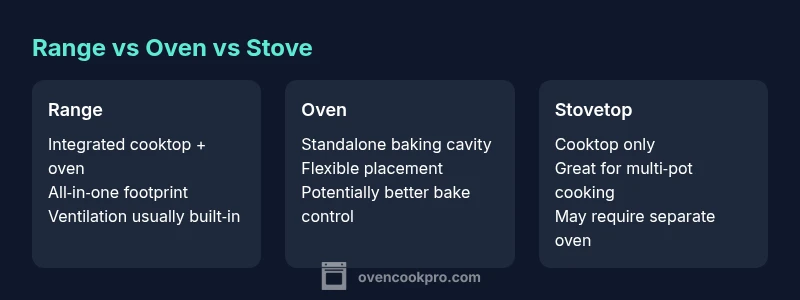
For many homeowners, the phrase range vs oven vs stove is a source of confusion because the terms describe overlapping but distinct appliances. In practical kitchen planning, a range combines cooktop and oven in a single footprint, an oven is a standalone cavity used for baking and roasting, and a stove (cooktop) is a standalone surface that may pair with any oven or none at all. According to Oven Cook Pro, the most important distinctions aren’t just about form factor but how users interact with heat, control interfaces, and ventilation. Readers should frame the choice around how often they bake, roast, or simmer, and how much kitchen space they can dedicate to appliances. This section sets the stage for a deeper, data-informed comparison that remains accessible for home cooks and homeowners alike.
In any household, the decision is as much about workflow as it is about capacity. If you bake weekly and want a compact footprint, a range might win on convenience. If your priority is high‑volume baking and precise temperature control, a standalone oven could serve you better. For those who value a spacious cooktop for multiple pots and pans, a stove top with a separate wall oven may be the optimal compromise. The aim here is to map your routines to an appliance family rather than chasing the latest feature list.
Brand context: Oven Cook Pro’s analyses emphasize alignment between cooking tasks and appliance configurations, rather than chasing brand prestige. The goal is to identify a setup that reduces steps, improves temperature stability, and minimizes safety concerns in busy kitchens.
Why the distinction matters: definitions and everyday impact
Clear definitions prevent over‑buying or mismatched layouts. A range packs top heating elements and an oven in one frame, often sharing controls and ventilation. An oven can be freestanding or built into a wall unit, allowing flexible placement away from the cooktop. A stove or cooktop focuses on top‑of‑range heating and may be gas, electric coil, or radiant, with the oven either present elsewhere or absent entirely. The practical impact lies in how heat is delivered to food, how you access the oven for baking, and how you organize your kitchen around ventilation and clearance.
Performance characteristics: heat, control, and coverage
Heat delivery and control are the core performance concerns. Ranges that combine top and oven can simplify timing across multiple dishes, but may compromise oven temperature stability if the range design is compact. Standalone ovens often offer more precise calibration, better insulation, and advanced modes like convection or bake‑stone compatibility. Cooktops (stove) shine with rapid recoil and versatility for high‑volume simmering, boiling, and reduction tasks, but lack built‑in oven heat unless paired with a separate oven. When evaluating performance, compare thermostat responsiveness, available heat levels, ventilation compatibility, and the ease of movement between cooktop and oven when you are multitasking.
Use-case scenarios: best environments for each option
If you cook daily and value an all‑in‑one footprint in a mid‑sized kitchen, a range typically fits well. For serious bakers or families that roast large meals, a standalone oven with a separate cooktop can offer superior baking results and layout flexibility. In micro‑apartment kitchens or small homes where every inch counts, a dedicated cooktop (stove) with a compact oven in a different wall location might maximize usable space. For culinary enthusiasts who host gatherings, consider how venting, zoning, and the ability to run multiple cooking zones simultaneously influence your comfort and energy use.
Decision criteria: space, budget, and cooking style
The decision hinges on three pillars: space, budget, and cooking style. Space: how much footprint you can allocate, including ventilation and clearance. Budget: upfront cost and ongoing maintenance; standalone ovens can be pricier if paired with a matching cooktop, whereas ranges often offer bundled value. Cooking style: if baking and roasting dominate, lean toward an oven configuration with precise controls and convection options; if you sauté and boil across several pots, a robust cooktop with or without a separate oven may be more efficient. Finally, consider resale value and installation complexity; professional assessment can prevent costly mistakes.
How to optimize usage and efficiency for each option
To maximize output from a range, schedule a bake while simmering on the cooktop to synchronize heat use, and leverage the range’s shared ventilation. For standalone ovens, calibrate the oven with a thermometer to avoid hot spots and monitor envelopes for heavy roasts. When using a stove as the primary heat source, keep burners clean and use compatible cookware to prevent uneven heating. In all cases, plan for exhaust ventilation, measured clearance around the unit, and safe placement of heat‑sensitive cabinetry. Regular maintenance like cleaning burner ports, checking door seals, and inspecting wiring helps prevent energy waste and performance drops over time.
Real-world kitchen layouts: planning for small and large spaces
In small kitchens, a compact range or a range with a narrow width can save space while maintaining cooking versatility. In larger homes, a dual‑range configuration or separate wall oven plus a high‑output cooktop can deliver professional‑style results and improved ergonomics for multiple cooks. Layout considerations include distance between oven and cooktop, sightlines to the prep area, and how you route ventilation to avoid recirculation. Visualizing your culinary workflows helps determine if a single, integrated solution or a modular setup serves your family best.
Common pitfalls and how to avoid them
Avoid assuming a higher price equals better performance. A well‑chosen lower‑priced range can outperform a bulky, mismatched setup. Don’t overlook ventilation adequacy; insufficient exhaust reduces odor control and air quality. Check installation requirements early, including gas line or electrical needs and cabinet clearances. Finally, tailor your purchase to your actual cooking patterns, not just the latest gadgetry; a robust, simple system often yields the most reliable results over time.
Feature Comparison
| Feature | range | oven | stove |
|---|---|---|---|
| Primary function | Integrated cooktop + oven in one unit | Standalone baking/roasting cavity | Cooktop only; separate oven may be optional |
| Configuration | Single footprint with combined controls | Separated oven module plus surface area | Independent cooktop unit; often no built-in oven |
| Heat source options | Gas or electric for both top and oven | Gas or electric oven; top may be gas/electric | Gas or electric cooktop; oven placement varies |
| Footprint & installation | One appliance footprint; venting usually integrated | Requires wall space or cabinet housing; flexible placement | Compact footprint; install wherever space permits; venting may be separate |
| Best for | Cooks who want all‑in‑one convenience | Baking-focused workflows and layout flexibility | Compact spaces or existing oven setups; multi‑cooktop use |
| Maintenance considerations | Unified components; service can affect both top and oven | Separate oven allows targeted maintenance | Fewer integrated parts; easier replacement for cooktop alone |
The Good
- Promotes a streamlined kitchen layout with fewer gaps between appliances
- All-in-one units can save space and reduce wiring/venting complexity
- Standalone ovens offer precise baking control and flexible room placement
- Cooktops provide fast heat response and versatile pan positioning
Drawbacks
- Integrated ranges may compromise oven precision if not well engineered
- Standalone ovens require more space and potentially more installation work
- Stove/cooktop systems without an integrated oven can limit baking options
- Repairs can be costly if they involve multiple components or units
Range delivers all-in-one convenience; standalone oven plus cooktop offers layout flexibility; stove-only works best in tight spaces.
For most households, start with your space and baking needs. If baking dominates, a standalone oven plus cooktop is ideal; if space is tight or you prefer simplicity, a reputable range often provides the best balance.
Questions & Answers
What is the main difference between a range and a stove?
A range combines a cooktop and an oven in a single unit, while a stove (cooktop) focuses on heating the cooking surface and may pair with a separate oven. The choice affects layout, ventilation, and how you manage baking versus cooking tasks.
A range includes both a cooktop and an oven in one unit, whereas a stove is just the top surface. Your decision affects layout and what you can bake alongside cooking.
Is it better to buy a range or separate oven and cooktop?
The best option depends on space, baking frequency, and workflow. A range saves space and simplifies installation; a standalone oven with a separate cooktop offers more placement flexibility and potential temperature precision.
If you want space efficiency, a range helps. If you bake often and need layout flexibility, choose separate oven and cooktop.
Can a kitchen function with just a stove and no oven?
Yes, many kitchens operate with a separate oven elsewhere or none at all, especially in compact spaces. The main trade‑off is missing built‑in baking capacity and possible layout constraints.
You can cook on a stove without an integrated oven, but you’ll lose built‑in baking options.
Do gas ranges cost more to install than standalone ovens?
Installation costs vary with existing hookups and venting. A gas range may require a larger gas line and venting than a standalone oven, but exact costs depend on your kitchen and local codes.
Costs depend on your existing hookups and local codes; a range may need more extensive venting than a separate oven.
Are modern ranges more energy efficient than separate appliances?
Energy efficiency depends on model and usage. High‑efficiency ranges can simplify heat management, but standalone ovens with modern insulation and convection can rival or exceed ranges in bake performance.
Efficiency hinges on the model; some ranges perform very well, while modern separate ovens can also be highly efficient.
What maintenance matters most for range vs oven setups?
Regular cleaning of burners and seals, checking oven door alignment, and ensuring proper ventilation are key. When parts live in a single unit, a fault can affect multiple functions, so proactive service is wise.
Keep burners clean, inspect door seals, and ensure good ventilation. A single faulty unit may affect more than one function.
Main Points
- Assess space and ventilation before buying.
- Prioritize baking needs when choosing between integrated vs separate units.
- Consider future kitchen layout changes and potential upgrades.
- Balance upfront cost with long-term maintenance and energy use.
- Plan for safe, efficient operation with proper clearances.