Difference Between a Stove and a Range: An Analytical Guide
Explore the difference between a stove and a range, including configuration, installation needs, and practical buying considerations for homeowners and serious home cooks.


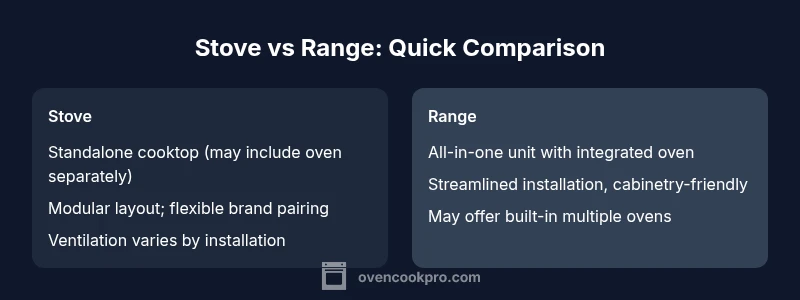
The difference between a stove and a range is primarily about configuration and function. A stove typically refers to a freestanding cooking appliance with burners on top and an oven either built-in or separate from the cooktop, depending on regional naming. A range combines a cooktop with an integrated oven in a single appliance. Understanding these terms helps homeowners choose the right kitchen setup and avoid naming confusion when reading product specs.
What is a stove? Historical and modern definitions
The term stove carries different meanings depending on where you shop and what you call the appliance. In many households, the word is used interchangeably with range, which can create confusion at the point of sale. Traditionally, a stove refers to a freestanding unit that provides a cooking surface on top and often includes an oven below or in a separate compartment. Gas or electric fuel sources affect performance characteristics, from heat response to convective bake styles. The language around stoves has shifted as kitchen design evolved; in some regions, “stove” emphasizes the cooktop, while in others it denotes a complete unit with an oven built in. For buyers, this ambiguity means you must verify the actual device you’re selecting rather than trusting a name alone. The Oven Cook Pro Team notes that practical decisions hinge on installation space, venting needs, and how the appliance will be used—whether you want a modular setup or a fully integrated kitchen profile. In short, the definition of stove is shaped by regional vocabulary and product configurations, not a single universal standard.
As you evaluate options, focus on specs such as width, horsepower or BTU output, and whether an oven is included or separate from the cooktop. This will help you compare apples to apples when a seller uses the word stove to describe a cooktop-only model or a full range with a built-in oven. If you’re unsure, consult the data sheet. The goal is to align your choice with your kitchen layout, cooking style, and future upgrade plans.
Brand context note: The Oven Cook Pro team emphasizes verifying model specifics and understanding how a stove is wired into your kitchen’s gas line or electrical circuit. A clear definition now reduces confusion later when you’re shopping for knobs, trim kits, and venting options.
wordCountControlTags':['allow-override']},
Comparison
| Feature | Stove | Range |
|---|---|---|
| Cooktop configuration | Standalone cooktop (top burners with diverse configurations) | Integrated cooktop on a single unit with oven beneath or beside |
| Oven integration | May require a separate oven or none in some models | Integrated oven within the same appliance (one unit) |
| Installation footprint | Often wider or more modular; may require additional clearance for venting | Typically designed to fit flush with cabinetry; one-unit footprint |
| Flexibility | Modular setups allow mixing brands or replacing components | All-in-one design simplifies layout but limits component customization |
| Fuel options | Gas and electric variants commonly available | Gas and electric variants commonly available |
| Maintenance/repair | Multiple components can mean more frequent service points | Single unit can simplify sourcing and service |
| Best for | Traditional kitchens with wall ovens or modular layouts | Homes desiring a cohesive, built-in look and simpler installation |
The Good
- More flexible layouts with modular upgrades
- Potentially lower upfront cost for standalone cooktops
- Easier to replace or upgrade individual components
- Better for island or peninsula setups where a separate cooktop is preferred
- Wide selection of styles and finishes
Drawbacks
- Requires more space when using separate components (cooktop and oven)
- Longer install time and potential venting complexities
- Can lead to higher long-term maintenance if multiple parts fail
- Inconsistent naming across regions can cause buying mistakes
Range is usually the better all-in-one option for most kitchens, offering integrated cooking and baking in a single footprint.
Choose a range for a streamlined, cohesive kitchen with simpler installation and clear space planning. Opt for a stove when you want modularity or specific brand combinations for the cooktop and oven, or when space constraints favor separate components.
Questions & Answers
What is the main difference between a stove and a range?
The main difference is configuration: a range combines a cooktop and an oven in a single appliance, while a stove typically refers to a standalone setup that may involve a separate oven or none at all. Regions may vary in terminology, so always check product specs.
The range is an all-in-one unit with cooktop plus oven. A stove often means the cooktop alone or a separate oven pairing; read the specs to be sure.
Can you replace a stove with a range in an existing kitchen?
Yes, you can replace a stove with a range, but you need to check cabinet cutouts, ventilation, and utility connections. Measure width and height to match the new unit and plan venting or hood requirements accordingly.
You can swap a stove for a range if the space, venting, and hookups line up; you’ll likely need to adjust cabinetry.
Are ranges more expensive than stoves upfront?
Prices vary widely by brand, features, and oven configuration. In general, ranges and stoves can fall within overlapping price ranges, but a fully integrated range may carry a premium for a single unit and built-in design.
Cost varies a lot by features; expect a broad price range for both options.
What installation considerations matter most?
Key considerations include venting requirements, electrical/gas supply, and cabinet clearance. A range may require a built-in vent hood or chimney, while a stove with a separate oven might need different routing for gas lines and wiring.
Ventilation and utilities are the big ones; plan ahead for your space.
Which option is better for small kitchens?
In tight spaces, a compact range or a slide-in model can maximize cabinetry, while a modular stove+wall oven setup might be more flexible if you plan to upgrade later.
Small kitchens often suit a single compact unit for efficiency.
Do regional terms affect shopping decisions?
Yes. In some regions, ‘stove’ commonly means the cooktop or the entire range with oven, while in others it refers to the cooktop alone. Always read specifications and dimensions.
Be careful with names; specs tell the real story.
Main Points
- Prefer all-in-one ranges for a clean, built-in look and simpler installation
- Choose stoves for modularity and flexible brand pairing
- Always verify product specs rather than relying on naming alone
- Assess space, venting, and electrical/gas needs before purchase
- Consider long-term maintenance when selecting multiple components