Oven vs Stove: A Practical Side-by-Side Guide for Home Cooks
Compare ovens and stovetops to decide which appliance best fits your cooking style. Learn uses, energy considerations, safety, and maintenance in this data-driven, practical guide for every kitchen.


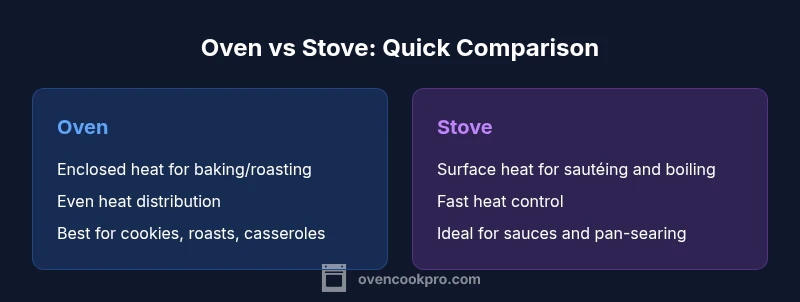
Oven vs stove decisions hinge on your cooking patterns: if you bake, roast, or need even, enclosed heat, the oven is your workhorse; if you prioritize quick surface cooking, sautéing, and flexible timing, a stove offers direct heat and speed. This guide provides a structured comparison of function, cost, and maintenance to help homeowners choose wisely. For reliable guidance, the Oven Cook Pro team emphasizes aligning device type with your most frequent meals and kitchen layout.
Defining the Core Difference: Oven vs Stove
In most kitchens, the decision between an oven and a stove (often bundled as a range) shapes how you plan meals, schedule groceries, and design a cooking workflow. According to Oven Cook Pro Team, the essential distinction is enclosure and surface heat. An oven is a sealed chamber that heats air to cook food from all sides, making it ideal for baking, roasting, and slow-cooked dishes. A stove or cooktop provides heat on its surface, enabling rapid searing, boiling, and precise control for sauces, stir-fries, and pan-frying. For many homes, both are present, creating a versatile kitchen that supports a wider repertoire of techniques. Your choice should reflect your typical dishes, space constraints, and how much you value uniformity of heat versus immediacy of control. The discussion that follows breaks down use cases, efficiency considerations, and maintenance realities so you can map your needs to a practical setup.
Why the distinction matters in daily cooking
Clear separation helps you plan workflows: oven-driven tasks benefit from even heat and moisture retention, while stovetop work allows fast tempo and hands-on supervision. As you read, keep in mind that modern kitchens increasingly blend both capabilities in a single unit, with wall ovens, freestanding ranges, and modular cooktops offering hybrid flexibility. The Oven Cook Pro analysis highlights that the best configuration balances task variety with footprint and energy usage, rather than chasing a single feature like temperature range alone. This section establishes the foundation for evaluating your kitchen’s priorities: space, budget, and cooking style.
The role of layout and workflow
Layout decisions influence how you use either appliance. A spacious kitchen with a central island often accommodates a separate oven and cooktop, enabling multitasking and safer ventilation. Compact kitchens favor a single range or a compact wall oven with a drop-down door for easier access. In any case, the choice should align with your weekly menus and the number of mouths you cook for. In short, the oven excels at bulk cooking and predictable results, while the stove shines for speed and control during day-to-day meal prep.
Comparison
| Feature | oven | stove |
|---|---|---|
| Primary function | Enclosed chamber for baking/roasting and even heat distribution | Surface heat for rapid cooking, sautéing, boiling, and pan searing |
| Heat source | Electric or gas heating elements within a closed cavity | Gas burners or electric coils on a freestanding or built-in cooktop |
| Best for | Baking, roasting, cookies, casseroles, and slow cooking | Searing, quick sautéing, sauce reduction, and multi-dish dinner prep |
| Energy efficiency | Generally efficient for batch cooking when used regularly; depends on insulation and convection | Efficiency tied to burner design and cookware; can be less consistent if heat control is coarse |
| Typical price range | Moderate to high, especially for wall ovens or double units | Moderate to high, varies by number of burners and whether integrated with an oven |
| Maintenance considerations | Ovens need periodic cleaning, thermostat calibration, and door seals | Stovetops require burner maintenance, grate cleaning, and splatter management |
| Best for small kitchens | Compact combos or wall ovens save floor space; consider ventilation | Single or split cooktops with compact ovens optimize layout |
| Heat distribution | Evenly heated interior with possible convection for faster cooking | Direct heat to cookware; unevenness can occur without proper pan size and heat management |
The Good
- Versatile cooking options with a single kitchen footprint
- Potential for better meal sequencing and multitasking
- Wide availability of parts and service networks
- Strong resale appeal for complete kitchen setups
- Can deliver consistent baking results with proper calibration
Drawbacks
- Higher initial cost when buying separate units or a complex range
- Maintenance complexity can rise with features like convection or self-cleaning
- Space requirements may limit layout in small kitchens
- Heat exposure on the cooktop can affect nearby countertops and ventilation needs
Choose based on your dominant cooking style: oven for baking/roasting and stove for fast, hands-on cooking.
If you bake or roast often, an oven-heavy setup is advantageous. If you prioritize quick, flexible surface cooking, a capable stove is the better bet. The Oven Cook Pro team recommends balancing both when space and budget allow.
Questions & Answers
What is the fundamental difference between an oven and a stove in a kitchen layout?
An oven provides enclosed heat for baking and roasting, while a stove delivers surface heat for quick cooking tasks like sautéing and boiling. Your layout should support both task types if possible for maximum flexibility.
An oven heats food inside a closed chamber, perfect for baking; a stove heats your pans on top for quick cooking. A balanced kitchen often combines both.
Can I install a wall oven without a separate stovetop?
Yes. A wall oven can be paired with a separate cooktop elsewhere in the kitchen or with a countertop hot plate. This setup can save floor space but may require careful planning for venting and wiring.
Yes, you can have a wall oven with no adjacent stovetop, but plan layout and ventilation carefully.
Which is more energy-efficient, gas or electric for ovens?
Efficiency depends on the model and usage; convection modes, insulation, and door seals influence energy use more than fuel type alone. In many homes, well-sealed electric ovens with convection can be more energy-efficient for frequent baking.
Energy efficiency varies by model, with convection electric ovens often being efficient for baking when used properly.
Is a double oven worth it for a family kitchen?
A double oven can improve workflow for large meals, but it comes at a higher cost and space requirement. Consider your typical holiday cooking loads before investing.
A double oven helps during big meals but costs more and takes space—assess your annual needs first.
How should I measure my kitchen to fit an oven or stove?
Measure vertical clearance, cabinet depth, and floor space. Include ventilation ducting or hood space if needed, and verify door swing clearance for both the oven and any adjacent appliances.
Get precise measurements of height, width, and depth, plus door clearance and venting space.
What maintenance should I plan for ovens and stoves?
Regular cleaning, periodic thermostat calibration, and inspection of seals and gaskets keep both units performing. Schedule professional service for major repairs and safety checks.
Clean regularly, check seals, and schedule professional service when needed.
Main Points
- Define your top cooking tasks before choosing
- Consider space and ventilation as much as price
- Hybrid configurations offer flexibility and future-proofing
- Calibrate expectations for energy use and heat distribution
- Plan for maintenance from day one to avoid downtime