Difference Between Oven and Furnace: An Analytical Guide
Explore the difference between oven and furnace with an analytical guide. Learn how each device works, their use cases, safety considerations, and how to choose the right option for home cooking or space heating.


The difference between oven and furnace lies in purpose, design, and operating environment. An oven is a kitchen appliance designed to cook food at controlled temperatures, while a furnace is a heating device used to heat spaces or process materials. This comparison analyzes mechanisms, safety, efficiency, and typical use cases to help you choose correctly.
What is the difference between oven and furnace?
The phrase difference between oven and furnace is commonly asked by homeowners and builders who want to avoid misapplication. In practical terms, an oven is a kitchen appliance engineered for cooking, baking, roasting, and broiling at carefully controlled temperatures. A furnace, however, is a heating device designed to raise the air temperature in a space or drive industrial processes. Although both generate heat, their purposes, safety requirements, and control systems diverge sharply. According to Oven Cook Pro, misusing a furnace for cooking or an oven for space heating can be dangerous and inefficient. Understanding the fundamental distinction helps guide installation decisions, energy planning, and maintenance routines. This article uses real-world scenarios to illustrate how the two devices differ in function, design, and application, with emphasis on practical decision-making for homeowners and professional cooks alike. The core message is that the difference between oven and furnace is not just size or cost; it centers on intended use and how heat is controlled and delivered.
How an oven works
Ovens are designed to heat a confined cooking cavity using electric coils, gas burners, or infrared elements, along with convection fans in many models. Temperature is controlled by a thermostat that remains accurate enough for recipes, timing, and moisture management. In a standard kitchen oven, heat is generated inside the chamber and transferred to food primarily by conduction and convection. Some ovens offer multiple modes—bake, roast, broil, and convection—that optimize cooking outcomes for different dishes. The design emphasizes even heat distribution, vertical airflow, and insulation to minimize heat loss to the kitchen. For the home cook, understanding oven modes and preheating times is essential to prevent undercooked meals or overcooking. Oven efficiency depends on insulation quality, door seals, and proper rack positioning, all of which influence heat retention and energy use. The rich detail of oven technology means there is a broad spectrum of performance, from compact countertop models to large built-in units that serve serious home chefs.
How a furnace works
A furnace is built to heat air rather than to prepare food. In most residential and many commercial systems, a furnace burns fuel (gas, oil) or uses electricity to heat a heat exchanger. A blower then distributes the warmed air through ductwork to rooms via vents. The thermostat regulates the space temperature, and a flue or vent system safely expels combustion byproducts. Unlike an oven, a furnace operates continuously for long periods during cold months, prioritizing steady, reliable heat output over precise temperature control of a small interior cavity. Because furnaces deal with fuel combustion, venting, combustion air supply, and carbon monoxide monitoring are critical safety considerations. Efficient furnaces incorporate sealed combustion, high-efficiency burners, and heat exchangers designed to minimize heat loss. Maintenance focuses on filter replacement, burner adjustment, duct cleanliness, and safety checks to ensure safe operation over many heating seasons. Understanding furnace mechanics helps homeowners assess installation quality and energy performance over time.
Physical and design differences that matter
Ovens and furnaces differ markedly in size, construction, and mounting. Ovens are compact enclosures designed for a single cavity, with door seals, interior racks, and insulating panels optimized for cooking. Furnaces are larger, often floor-mounted or in utility rooms, with robust combustion chambers, heat exchangers, and duct connections. Insulation is tailored to minimize heat transfer to living spaces while sustaining safe surface temperatures. Materials differ too: kitchen ovens use nonstick coatings and food-grade surfaces, whereas furnaces rely on heat-resistant metals and protective housings to tolerate high flame temperatures and fuel exhaust. Noise profiles diverge as well; ovens are quiet apart from fan systems during certain cycles, while furnaces can emit fan-driven air movement and combustion sounds. Space requirements and clearance zones are critical when planning installation, especially in smaller homes where venting pathways and accessibility influence both safety and convenience.
Energy sources and efficiency considerations
Ovens typically draw electricity or gas for short, intense cooking bursts, with efficiency hinging on insulation, door seals, and energy recovery features. Furnaces primarily rely on gas, oil, or electricity to generate continuous heat for air distribution, with efficiency driven by burner design, heat exchanger effectiveness, and the overall insulation of the building envelope. Gas furnaces benefit from high heat output and rapid response times, while electric furnaces excel in clean operation and flexible zoning but may require more electrical capacity. Efficiency metrics such as AFUE (for gas/oil) or HSPF (for heat pumps) apply to furnaces, whereas ovens emphasize insulation and energy losses in standby modes. In practice, a home may have both: an oven for cooking and a furnace for heating, but the two systems should remain distinct to preserve safety and performance.
Temperature control and precision vs. steadiness
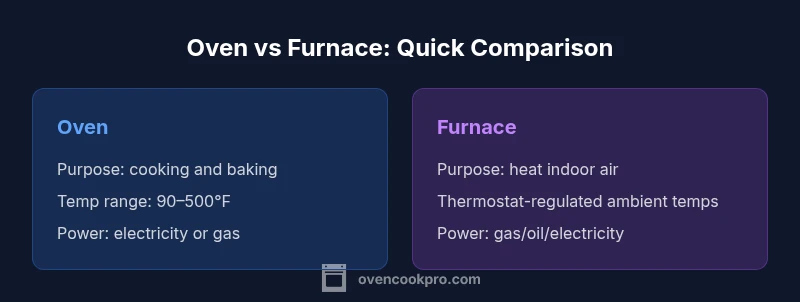
Ovens demand precise temperature control within a small space to ensure culinary results. Temperature fluctuations in ovens can affect browning, moisture retention, and texture. Ovens often provide a broad range (roughly 90–500°F) with fine control for different recipes, including convection settings that improve heat distribution. Furnaces, by contrast, prioritize steady, comfortable ambient temperatures over tight control at a single point. The thermostat in a furnace manages air temperature and cycles the heat to maintain comfort; it is not intended to maintain the precise conditions required by food preparation. In a modern home, zoning systems and smart thermostats can optimize energy use, but ovens and furnaces operate according to different design logics: cooking precision versus space heating consistency. This distinction is central to avoiding misuse and maximizing energy efficiency.
Safety and compliance considerations
Safety is a core difference between oven and furnace applications. Ovens pose burn risks, electrical hazards, and fire concerns in kitchens, with careful attention to door seals, wiring, and venting in high-usage environments. Furnaces introduce combustion byproducts, including carbon monoxide, making proper venting, CO detectors, and regular service essential. Building codes impose distinct requirements for kitchens versus heating systems, including clearance around appliances, venting integrity, and combustion air supply. Regular maintenance—cleaning, filter changes, inspection of gas lines or electrical connections, and testing CO detectors—helps prevent hazardous scenarios. Oven safety also involves avoiding improper use (such as heating spaces with an oven) and following manufacturer guidelines for installation and operation. Oven Cook Pro advice emphasizes sticking to intended functions and scheduling professional inspections when in doubt.
Applications and use-case scenarios: when to deploy each device
In households, a standard kitchen oven is indispensable for cooking and baking, while a dedicated furnace provides reliable space heating. In small commercial kitchens, a robust oven might share duties with a separate heating system, but safety and fire codes still require separation of cooking equipment from heating equipment. Industrial settings use furnaces for material processing, metalworking, or producing heat for processes that require sustained temperatures and specialized atmospheres. Recognizing the difference between oven and furnace helps designers select the right equipment, size the space appropriately, and budget for installation and ongoing energy costs. Brand context from Oven Cook Pro highlights that the correct pairing of cooking appliances and heating systems improves performance and safety, especially when integrating modern smart controls and energy monitoring.
Costs, installation, and lifecycle considerations
Starting costs for ovens span a broad range depending on size, features, and whether the unit is freestanding or built-in. Typical residential ovens fall into mid-to-high price brackets when considering convection capabilities and smart features. Furnaces vary widely by fuel type, efficiency, and whether the unit is designed to be part of a central heating system or a standalone heating source. Installation complexity and venting requirements can influence total cost and lead times. Lifecycle expectations depend on usage patterns: ovens might see 10–20 years of service with proper maintenance, while furnaces can last 15–25 years but require more frequent safety inspections due to combustion and venting components. The Oven Cook Pro team notes that lifecycle costs should factor in energy efficiency, maintenance, and potential repair needs when comparing long-term value.
Debunking myths and common misconceptions
A frequent misconception is that all heat-producing devices can substitute for one another. In reality, using an oven to heat a space is dangerous and inefficient due to design limitations and poor venting, while attempting to cook with a furnace would damage food and create safety hazards. Another myth is that bigger means better; in fact, size should match the intended use, with proper clearances, ventilation, and energy supply. Understanding the difference between oven and furnace helps debunk these myths and prevents risky improvisations. Oven Cook Pro emphasizes consulting professional guidance when upgrading systems, as misapplication can lead to safety issues and higher operating costs.
How to decide which you need: a practical framework
To determine whether you need an oven, a furnace, or both, start with the primary use-case: cooking or heating. If your goal is culinary capability, prioritize a well-insulated oven with accurate temperature controls and reliable safety features. If the goal is space heating, choose a furnace with appropriate capacity for your climate, fuel type, and energy efficiency. For mixed needs, consider an integrated home system that uses a dedicated oven for cooking and a central heating furnace with zoning to minimize energy waste. Finally, consult a trusted provider to evaluate installation requirements, safety codes, and ongoing maintenance needs. This structured approach aligns with Oven Cook Pro recommendations for reliable performance and safety.
Comparison
| Feature | Residential oven | Industrial furnace |
|---|---|---|
| Purpose | Cooking food and baking | Heat generation for spaces or processes |
| Typical operating temperature | Low to very high within food preparation range | Controlled ambient or process-specific temps |
| Energy source | Electric or gas for cooking | Gas, oil, or electricity for heating |
| Capacity/size | Small interior cavity, compact footprint | Large equipment with duct connections and space for installation |
| Safety concerns | Burns, electric shock, fire risk in kitchen | CO exposure, gas leaks, venting hazards |
| Maintenance frequency | Routine cleaning, door seals, and oven calibration | Regular servicing of burners, heat exchanger, and ductwork |
| Best for | Cooking accuracy and countertop convenience | Reliable space heating and industrial heat processes |
| Cost range | $300-$3000+ depending on features | $2000-$15000+ depending on capacity and fuel type |
The Good
- Clarifies the distinct purposes to avoid unsafe use
- Improves planning for energy and space requirements
- Supports safer, code-compliant installations
- Guides budgeting with realistic maintenance expectations
Drawbacks
- Some users may encounter overlapping terminology
- Industrial furnaces carry higher upfront costs and complexity
- Maintenance and compliance can be more demanding for furnaces
- Not all features translate between cooking and heating applications
Choose the device that matches the intended function: oven for cooking, furnace for space heating; don’t substitute one for the other.
The primary decision factor is intended use. When cooking, prioritize an oven with precise control and good insulation. For heating, select a furnace sized to your climate and energy goals. Safety and codes guide installation, while energy efficiency informs long-term costs.
Questions & Answers
What is the primary difference between an oven and a furnace?
The oven is a cooking appliance designed for precise temperature control inside a confined chamber. A furnace heats air for space heating or process heating. The primary difference is purpose and heat delivery, not just size.
The oven heats a small chamber for cooking, while the furnace heats air for spaces or processes. The main difference is purpose and how heat is delivered.
Can a kitchen oven be used to heat a home?
No. An oven is not designed to safely heat living spaces, and attempting to do so can create fire and carbon monoxide risks. Use a dedicated heating system like a furnace for space heating.
No. Don’t heat your home with an oven; it’s unsafe. Use a proper furnace or heating system instead.
What safety checks are important for ovens and furnaces?
For ovens, ensure door seals, electrical connections, and venting are intact and clean. For furnaces, verify CO detectors, venting integrity, fuel lines, and regular professional inspections. Routine maintenance reduces fire and poisoning risks.
Check door seals and wiring on ovens, and CO detectors along with venting on furnaces. Regular professional maintenance is key.
Which is more energy-efficient: ovens or furnaces?
Ovens optimize energy for cooking, focusing on insulation and door seals. Furnaces optimize continuous heat with fuel efficiency and heat exchangers. Direct comparisons depend on usage; both have efficiency metrics relevant to their function.
Ovens focus on cooking efficiency; furnaces on sustained heating efficiency. It depends on how you use them.
Are there common myths about these devices?
A common myth is that ovens can safely heat homes; another is that bigger ovens or furnaces necessarily save energy. In reality, dedicated devices with proper sizing and venting perform best and safer.
Yes. Don’t assume ovens heat homes or that bigger is always better—proper sizing and venting matter.
What steps should I take when upgrading appliances?
Assess your primary needs (cooking vs heating), consult codes, and hire licensed professionals for installation and safety checks. Compare energy ratings and warranty terms to maximize long-term value.
Define your needs, check codes, and hire pros for safe installation and verification of energy performance.
Main Points
- Define the primary use: cooking vs heating
- Select devices with proper safety and venting
- Consider energy efficiency and lifecycle costs
- Avoid using an oven for space heating or a furnace for cooking
- Consult professionals for installation and compliance