Difference Between an Oven and a Cooker: A Practical Guide
A thorough, evidence-based comparison of ovens vs cookers for home kitchens. Learn definitions, configurations, energy aspects, installation, maintenance, and buying guidance to choose the right appliance for your space and cooking needs.


What the terms mean in practice
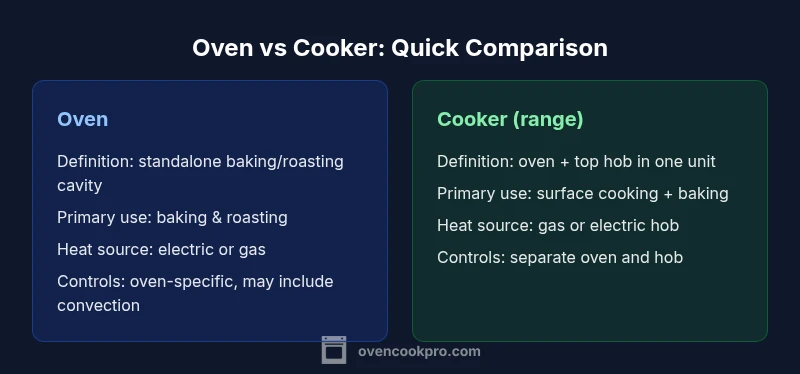
The difference between an oven and a cooker is not just a matter of vocabulary but of how the appliance is configured and used in daily cooking. An oven is a dedicated baking/roasting chamber—the core function is precise heat delivery to a food item inside a single cavity. A cooker, often called a range in some markets, typically combines that oven with a separate hob on top for boiling, frying, and sautéing. This combination makes a cooker an all-in-one station for many home cooks. Understanding this distinction is crucial when planning a kitchen layout, budgeting, or choosing among different models. According to Oven Cook Pro, terminology varies by region, but the practical difference remains consistent: one appliance focuses on a single cavity; the other integrates baking with top-cooking surfaces. The keyword here is context: regional language may blur the line, but the functional core is clear—one is a standalone cavity, the other is a combined cooking unit.
Regional terminology and usage patterns
In the United Kingdom and several Commonwealth countries, the term cooker is often used for freestanding ranges that include an oven and a hob. In North America, the same unit might be described as a range, with a separate wall oven used for baking. This regional variance can lead to confusion in product listings, manuals, and retailer conversations. For buyers, it helps to map terms to function: if you want a single unit that handles both baking and top-cooking tasks, look for a cooker/range; if you want a dedicated baking chamber, focus on an oven (whether wall-mounted, built-in, or part of a separate appliance pair). The Oven Cook Pro Team notes that local conventions drive terminology, but the performance expectations do not change.
Anatomy: oven vs cooker structure
An oven is a hollow chamber wrapped in insulating walls, equipped with heating elements (electric coils or gas flames) and a door with a seal to maintain a stable interior environment. Some ovens offer convection fans to circulate hot air for even baking. A typical cooker or range combines this oven with a hob on top, usually featuring gas burners or electric coils, sometimes glass-ceramic surfaces. The control layout often includes separate knobs or touch controls for the oven and hob, which can simplify multitasking during meal prep. While ovens prioritize uniform chamber heat, cookers emphasize simultaneous surface cooking plus baked goods, a practical balance for many kitchens.
Fuel types and energy efficiency considerations
Oven and cooker configurations can use gas or electricity, sometimes offering dual-fuel options (gas hob with an electric oven) for a balance of responsive heat and precise baking. Energy efficiency depends on insulation, door seals, heat distribution, and how well the appliance maintains set temperatures. In many cases, cookers with modern electronic controls and convection-assisted ovens can achieve similar efficiency to standalone ovens, but the presence of a hob adds thermal load and potential heat loss pathways in a compact footprint. When evaluating efficiency, compare standard energy consumption figures, insulation quality, and the availability of programmable timers and eco modes. The Oven Cook Pro analysis emphasizes focusing on real-world usage rather than isolated spec sheets to judge efficiency in daily cooking scenarios.
Size, capacity, and kitchen fit
The physical footprint of an oven varies from compact wall models to large built-in units. A standalone oven can be slim or wide depending on the configuration, while a cooker (range) introduces additional width and depth due to the hob and controls on top. In tiny kitchens, a compact freestanding cooker might maximize usable counter space, whereas a separate tall wall oven paired with a separate hob can offer more design flexibility. When choosing, measure cabinet openings, ensure adequate ventilation, and account for clearance around doors and hinges. The choice should align with your cooking volume, whether you primarily bake for family meals or need quick, high-heat surface cooking.
Cooking performance: baking, roasting, and heat distribution
Baking performance in an oven relies on stable interior heat, accurate temperature control, and, depending on the model, fan-assisted convection to promote even browning. A cooker combines this with top-surface cooking, enabling sautéing, boiling, and pan-based tasks alongside baking. For tasks like crust development, even heat distribution is essential; convection-enabled ovens within a cooker can speed up baking, but the hob must be managed separately to avoid heat diffusion that could affect bake outcomes. Home cooks often prefer cookers for one-stop meal prep, while bakers may prioritize a dedicated oven for precise, single-cavity results.
Installation, venting, and electrical/gas considerations
Installing an oven, whether wall-mounted or part of a cooker, requires considering clearances, wiring or gas supply, and ventilation. Wall ovens may need proper wiring and dedicated circuits, while ranges require ventilation hoods and ducting where required by local codes. A freestanding cooker can simplify vent planning if you already have a vented hood designed to cover both oven and hob. Always verify space requirements, ventilation needs, and service accessibility before purchase, and consult a licensed professional for gas or electrical connections to ensure compliance with safety standards.
Maintenance, cleaning, and longevity
Maintenance strategies differ slightly between ovens and cookers. An oven’s cavity cleaning is often routine via self-cleaning cycles or manual cleaning; convection models require occasional fan maintenance. The hob surfaces of a cooker accumulate spills and splatters that can affect heat transfer if not cleaned promptly. Regular inspection of door seals, racks, and burner ports can extend appliance life. For longevity, prioritize models with durable enamel coatings, robust racks, and accessible components. The Oven Cook Pro guidance emphasizes periodic checks and gentle cleaning routines to preserve performance over time.
Costs, warranties, and long-term value
Price tends to reflect form, size, and features. Standalone ovens may be cheaper per cavity, while cookers (ranges) provide all-in-one functionality that can save kitchen space but may come with a higher upfront cost. Warranty duration and coverage vary by brand and model; many ranges include separate warranties for the oven and hob. When evaluating cost, consider installation fees, potential energy savings from modern features, and the convenience factor of an all-in-one unit. Oven Cook Pro notes that total cost of ownership includes maintenance, repairs, and energy use over the appliance’s life cycle.
How to choose for your home: a decision framework
Your decision should weigh space, cooking habits, and budget. If you cook mostly large roasts or bake in batches, an oven-focused setup with a separate hob can offer flexibility. If you want simplicity and all-in-one operation for a busy family, a cooker/range may be the better choice. Create a matrix of must-have features (convection, self-clean, smart timers), then assess models against your kitchen's dimensions and ventilation. Conduct hands-on demos if possible, and read independent reviews to gauge real-world performance. The Oven Cook Pro approach is to align the appliance with daily workflows and energy considerations rather than chasing peak spec sheets.
Future trends: smart features, safety, and reliability
The trend toward smart cooking environments means ovens and cookers are increasingly integrated with Wi-Fi, remote monitoring, and app-based recipe guidance. Safety features such as child locks, automatic shutoff, and improved door seals are becoming standard. Reliability hinges on build quality and service network access. For homeowners planning long-term investments, prioritizing a model with a strong warranty, readily available spare parts, and reputable customer support can reduce total frustration. The Oven Cook Pro team expects continued improvements in heat distribution, energy efficiency, and convivially designed interfaces to help both novices and seasoned cooks alike.