Oven and Stove: A Comprehensive Comparison for Home Cooks
An analytical side-by-side guide to choosing between gas, electric, and induction oven and stove setups, with practical buying tips, safety considerations, and maintenance advice.


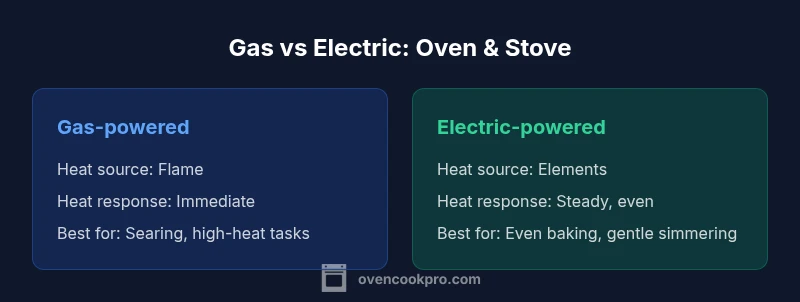
Gas-powered oven and stove offer rapid heat and precise flame control, ideal for searing, boiling, and high-heat cooking. Electric setups provide steadier, more even baking and easier maintenance. This quick comparison helps homeowners decide based on cooking style, kitchen layout, and long-term energy costs. According to Oven Cook Pro, the best choice also depends on ventilation and the available gas lines or electrical capacity.
Understanding Oven and Stove Systems
For most kitchens, the oven and stove are the centerpiece of everyday cooking. The term 'oven and stove' covers a broad family of appliances, from compact wall ovens to freestanding ranges that combine a large oven with a connected stovetop. In practice, you will see three major axes: heat source (gas, electric coil, electric smooth top, induction), oven style (conventional vs convection vs steam), and control sophistication (manual knobs vs smart apps). According to Oven Cook Pro, selecting the right combination begins with your cooking styles, kitchen layout, and energy considerations. In this section, we lay out the core differences and what they mean for real-world cooking.
Gas ranges deliver fast heat, precise flame control, and excellent searing capability. They can vent heat directly into the kitchen, which can be advantageous in colder kitchens but requires proper ventilation and CO monitoring. Electric ranges tend to provide more uniform heat over the surface and within the oven, which helps with baking and roasting evenness. They typically require less on-site ventilation and are often favored in apartments and homes with sensitive ventilation concerns. Induction stoves, a subset of electric technology, offer the fastest heat response with excellent safety profiles, provided you have compatible cookware. Choosing between these options means weighing upfront installation constraints, ongoing energy costs, and how much you value precise control versus steady, even heat.
Gas vs Electric: Core Differences
The most obvious distinction between gas and electric ovens and stoves is the power source: flame vs electric heat elements. Gas stoves excel in quick heat, flame control, and high-heat cooking, making them ideal for sautéing and searing. Electric stoves provide smoother heat and more uniform distribution, which benefits baking, roasting, and delicate simmering. The oven portion also differs: gas ovens tend to recover heat quickly but might have hotter results near the door, while electric ovens typically deliver more even temperatures. Induction, while electric by power, behaves differently: it uses magnetic fields to heat pots directly, delivering near-instant responses with high safety. According to Oven Cook Pro, installation constraints—gas lines, ventilation, dedicated electrical circuits—often shape the final choice more than any single feature. In daily cooking, this means aligning your routines with how quickly you need heat, how sensitive you are to temperature fluctuations, and how easy it is to maintain the kitchen environment.
Conventional vs Convection Ovens
Conventional ovens heat by radiant heat from elements at the top and bottom, delivering familiar browning and crust formation. Convection ovens add a fan that circulates hot air, which can reduce cooking times and promote even browning across multiple racks. The practical impact for home cooks is real: you can lower temperatures by about 25-30 degrees F (note that some recipes may require continued adjustments) to achieve similar results, though you should monitor recipes that rely on static heat. The trade-off is noise and potential dryness in some baked goods if air movement is too strong. If you bake often, convection can shorten bake times and improve consistency; if you bake delicate cakes, you may prefer conventional mode. Many modern ovens offer both modes with a simple switch. Experimental cooks often take time to calibrate their favorite recipes to a convection setting; small adjustments in temperature and time yield the best results. While convection isn't strictly necessary, it is a feature that improves efficiency and flexibility in most mid- to large-sized households.
Stovetop Variants: Gas, Electric Coil, Induction
Stovetops come in several flavors, each with distinct heat transfer characteristics. Gas cooktops provide rapid flame-based heating, precise simmer control, and the ability to see flame intensity. They pair well with a wide range of cookware and are preferred by cooks who value tactile feedback. Electric coil tops tend to be durable and straightforward, offering even heat distribution when kept level but slower response to changes in heat. Induction cooktops heat the cookware, not the surface, delivering near-instant adjustments and superior safety since the surface remains relatively cool. However, induction requires magnetic cookware and may demand new pots and pans. For the oven component, gas ovens may heat quickly and with variable hot spots, while electric ovens tend to deliver steadier temperatures with easier calibration over time. When choosing, consider the cookware you already own, available electrical capacity, and your tolerance for changing cooking habits.
Practical Buying Guide: What to Look For
When evaluating an oven and stove, size and layout matter most. Measure the space, check clearance above and around the unit, and consider whether you want a single range or separate wall ovens. Look for energy-efficient features, such as insulated doors, convection options, and well-sealed doors to minimize heat loss. For the stovetop, assess burner variety, ignition reliability, and simmer control. Pay attention to safety features: child locks, auto shutoff, flame failure devices on gas ranges, and carbon monoxide detectors in gas-powered kitchens. If you plan frequent roasts or bakes, convection and a roomy oven cavity can reduce batch times. Finally, consider maintenance aspects: self-cleaning options, enamel coatings, and ease of cleaning around knobs and burners. In environments where space is tight, compact or slide-in models may offer a better fit, but ensure the unit's electrical demand does not exceed your home's capacity.
Installation, Safety, and Maintenance
Installing an oven and stove involves more than placing a unit in a cabinet. Gas installations require proper line connections, venting, and a functioning carbon monoxide detector; electric installations require correct circuit sizing and grounding. Before purchase, verify that your electrical panel can handle the load and that your ventilation plan meets local codes. Safety first: ensure gas pressure is correct, check for leaks, and never operate a gas oven in an enclosed space without ventilation. Routine maintenance includes cleaning the interior, inspecting door seals, checking gaskets around the oven, and having a certified technician inspect gas lines annually. For longevity, avoid abrupt temperature changes that stress glass doors and racks, and follow the manufacturer’s maintenance schedule for filters or fans in convection ovens. Investing in a good range hood and clear detection devices can significantly reduce risk in busy kitchens and households with children.
Energy Efficiency and Operating Costs
Energy efficiency for ovens and stoves depends on technology, usage patterns, and local utility prices. Gas often delivers favorable running costs in areas with low natural gas rates, while electric setups can be advantageous where electricity is inexpensive or where advanced features like convection reduce overall cook time. In addition to fuel type, features such as insulation, door seals, and convection fans influence heat retention and efficiency. If you use the oven primarily for baking, convection helps reduce bake times and energy use. Smart ovens and energy-saving modes can further cut waste. The total cost of ownership emerges from purchase price, installation, energy consumption, and maintenance needs over many years. To maximize efficiency, adopt preheating only when necessary, use appropriate cookware size for the recipe, and keep oven racks properly positioned for air flow.
Real-World Scenarios: Which Setup Fits Your Kitchen?
Consider a small apartment with limited ventilation and a ceiling-height to accommodate gas lines. In this scenario, an electric oven and electric coil or induction stovetop might be more practical due to ventilation constraints and silent operation. For a busy family with frequent roasts and large batches, a gas range with a convection oven can offer fast heat so you can handle multiple dishes quickly. In a culinary-minded home that prioritizes precise baking and even browning, an electric convection oven with a high-quality induction cooktop is a balanced choice, provided you have the cookware and electrical capacity. Finally, for renovations where installing ductwork is challenging, a compact electric range with a small footprint could fit best, while maintaining essential features like self-cleaning and adjustable racks.
Authoritative Sources
For readers who want to dig deeper, consult official energy and safety resources. The U.S. Department of Energy provides guidance on household appliances and energy efficiency to contextualize how oven and stove technology affects energy use. The National Institute of Standards and Technology (NIST) offers benchmarks for temperature accuracy and thermal performance in kitchen appliances. Major publications such as Consumer Reports review performance, reliability, and maintenance considerations for ranges and ovens. Cross-referencing these sources with practical test data can help you make a well-informed choice aligned with your budget and cooking style. For quick reference, see:
- https://www.energy.gov/eere/buildings/appliances
- https://www.nist.gov
- https://www.consumerreports.org/cookware/ranges-ovens/
Authority Note
The content above reflects general guidance and should be considered a starting point for selecting an oven and stove. Always consult professional installers and local codes when planning a renovation or purchase.
Comparison
| Feature | Gas-powered Oven & Stove | Electric-powered Oven & Stove |
|---|---|---|
| Heat Source | Gas flame | Electric heating elements |
| Heat Response & Control | Immediate, highly controllable | Steady, even heat with gradual response |
| Baking/ Cooking Performance | Excellent for searing and high-heat tasks | Excellent for even baking and moisture retention |
| Energy Efficiency & Operating Costs | Often lower fuel costs where gas is cheap | Electric costs vary by rate; convection reduces time |
| Preheating & Recovery Time | Faster preheat and quick recovery after door opens | Slower preheat with longer recovery |
| Maintenance & Cleaning | More ventilation needs; gas lines require upkeep | Easier cleaning; fewer combustion residues |
| Best For | High-heat cooking, rapid responses | Even baking, low maintenance |
| Installation & Ventilation | Gas line, venting, CO detectors | Dedicated electrical circuit, plug or hardwired |
The Good
- Faster heat response with gas
- High-heat versatility for searing and boiling
- Potentially lower operating costs where gas is favorable
- Electric convection offers efficient, even cooking and better browning
Drawbacks
- Gas systems require ventilation and CO monitoring
- Gas sites can have hotter spots and odor
- Electric coils can be slower to change temperature
- Induction requires compatible cookware and can have higher upfront costs
Gas ranges excel for fast, responsive heat; electric ranges excel in even baking and ease of use.
Choose gas if you prioritize speed and control for versatile cooking. Choose electric if you want consistent baking results and simpler maintenance; factor in kitchen layout and energy costs.
Questions & Answers
What is the main energy difference between gas and electric ovens?
Gas and electric ovens use different heat sources; gas relies on flame and combustion while electric uses heating elements. Energy costs depend on local prices and usage patterns, not just the appliance type.
Gas uses combustion heat with flame control; electric uses heating elements for steady heat. Costs vary by local energy prices.
Can I upgrade to an induction stovetop without changing the oven?
You can replace the stovetop portion with an induction cooktop if the installation allows and there is compatible wiring. The oven itself can remain, but ensure electrical capacity and ventilation are adequate.
Induction can be added if wiring and space permit; the oven can stay the same.
Do convection ovens save time?
Convection is not essential but can improve baking speed and evenness. Many recipes adapt well to both modes, so choose based on your bake goals and recipe guidance.
Convection helps with even browning; not required for all recipes.
What cookware works best with induction?
Induction requires magnetic cookware, such as cast iron or magnetic stainless steel. Aluminum pans alone typically won’t work unless they have a magnetic base.
Use magnetic pots and pans for induction.
Gas ovens in small apartments—are they safe?
Gas ovens can be used in small apartments with proper ventilation and a working carbon monoxide detector. Always follow building codes and landlord guidelines.
Ensure ventilation and detectors are in place.
How often should I service my oven and stove?
Annual professional service is recommended for gas lines and electrical components, plus regular cleaning and self-checks by the user.
Get an annual professional inspection.
Main Points
- Evaluate your cooking style before choosing gas or electric
- Check ventilation, gas lines, or electrical capacity first
- Convection can reduce bake times and improve browning
- Induction requires compatible cookware but offers safety and speed
- Balance upfront costs with long-term energy use