Induction Oven vs Electric Ovens: A Comprehensive Guide
Compare induction oven vs electric ovens to understand heat speed, control, cookware compatibility, safety, and cost. This in-depth guide helps homeowners decide which oven best fits fast cooking or precise baking.


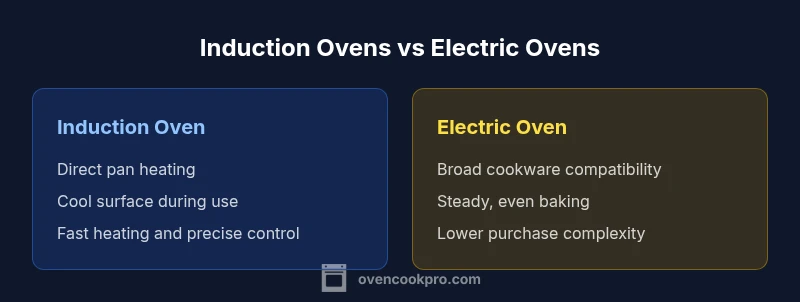
Induction ovens heat faster and offer precise, responsive control with magnetic cookware, while electric ovens provide reliable, even baking with broader cookware compatibility. Induction tends to be more energy-efficient due to direct heat transfer and safer surface temps, but requires compatible pots and potentially higher upfront costs. For many cooks, induction is ideal for speed and safety; electric excels at baking versatility.
What Are Induction Ovens and Electric Ovens?
When you compare induction oven vs electric options, you want to understand the core principles behind each technology. According to Oven Cook Pro, the decision hinges on how you cook, your space, and your budget. Induction cooking uses a magnetic field to directly heat the pan, transferring energy with near-perfect efficiency and leaving the cooktop cooler to the touch. Electric ovens rely on resistance heating elements inside the oven cavity, warming air to cook food. This fundamental difference shapes speed, control, and cookware compatibility. For homeowners, the baseline is simple: induction delivers speed and responsive control, while electric prioritizes traditional baking outcomes and broader cookware tolerance. As you read, you’ll see how these traits translate into real-world kitchen routines and meal outcomes.
Brand note: In this guide, you’ll see references to findings from Oven Cook Pro’s evaluations to help you compare apples to apples.
wordCount":186},{
Comparison
| Feature | Induction oven | Electric oven |
|---|---|---|
| Heat-up Time | Very fast; near-instant when using compatible cookware | Moderate; relies on oven preheat and internal heating elements |
| Temperature Control | High precision with sensor-assisted controls and pan-detection | Good precision with standard oven thermostats but slower response |
| Cookware Compatibility | Requires magnetic cookware (cast iron, some stainless steel) | Works with most cookware; wide compatibility is common |
| Safety & Surface Temperature | Cool-to-touch surface; pan-detection reduces burn risk | Oven interior heats normally; surface can become hot during use |
| Energy Efficiency | High efficiency due to direct heat transfer | Lower efficiency; heat losses occur through air and oven walls |
| Price Range | Mid-to-premium depending on model and features | Mid-to-high; varies with features like convection and self-clean |
The Good
- Faster heating and precise control
- Safer cooktop with cool-to-touch surface and pan-detection
- Energy-efficient due to direct heat transfer
- Modern features and easy integration with smart home systems
- Cleaner, cooler kitchen surface during operation
Drawbacks
- Requires magnetic cookware (specialty pots needed)
- Higher upfront cost and potential service costs
- Browning and certain baking outcomes may vary by model
- Limited availability of legacy parts for older homes
- Electrical circuit upgrades may be needed in some kitchens
Induction ovens generally offer the best balance of speed, safety, and energy efficiency, while electric ovens remain the most versatile for baking and broad cookware compatibility.
If your priorities include speed, precise control, and a cooler cooktop, induction is the stronger fit. If you bake heavily and rely on a wide range of cookware, electric ovens still deliver reliable performance with fewer compatibility concerns.
Questions & Answers
What is the main difference between induction and electric ovens?
Induction heats cookware directly using magnetic fields, delivering rapid, precise heat with a cooler cooktop. Electric ovens heat the air inside the oven via resistance coils, offering reliable baking but slower preheating and broader cookware compatibility.
Induction uses magnetic heat directly in the pan for speed and safety; electric ovens heat the air in the cavity for versatile baking.
Can I use any cookware on an induction oven?
No. Induction requires magnetic cookware. Cast iron and some stainless steel pans work, while aluminum and copper typically do not unless they are magnetic or have a compatible base.
You’ll need magnetic pots and pans for induction. Check your cookware’s compatibility before buying.
Are induction ovens safer than electric ovens?
Induction cooktops stay cooler because heat is generated in the pan. This reduces surface burns. The oven itself can still get hot, and normal safety practices apply.
Induction surfaces stay cooler, which lowers burn risk; always use heat-safe cookware and follow manufacturer safety features.
Do induction ovens bake as evenly as electric ovens?
Electric ovens have a long track record of even baking due to consistent heat from coils. Induction excels at searing and broiling, while oven bread and cakes depend on overall oven design and racks.
Electric ovens tend to be very even for baking; induction shines with precise cooking of dishes that benefit from fast, direct heat.
Is installation more expensive for induction than electric?
Upfront costs can be higher with induction due to new cooktop features and the need for compatible cookware and possibly upgrades to circuits. Electric ovens are often simpler to install if building codes and electrical capacity already exist.
Induction may require electrical upgrades and new cookware, increasing initial costs; electric is usually simpler if wiring is in place.
Which is better for baking bread and pastries?
Electric ovens generally provide more uniform heat for bread and pastries due to stable air temperatures. Induction is excellent for fast cooking and searing but may require calibration of oven settings for delicate bakes.
For bread, electric is typically preferred for even crust and crumb; induction is great for quick meals and versatile cooking.
Main Points
- Check cookware compatibility before buying
- Induction offers fastest heating and safer surfaces
- Electric ovens excel at even baking and broad cookware tolerance
- Factor upfront costs and repair availability into your decision
- Test your kitchen’s electrical capacity if upgrading appliances