Gas Oven vs Electric Oven: Practical Comparison Guide
A thorough, evidence-based comparison of gas vs electric ovens, covering heating, baking accuracy, energy costs, installation, safety, and maintenance to help homeowners decide.


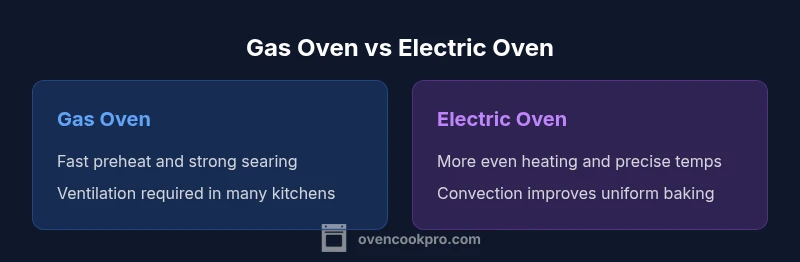
Gas ovens heat up quickly and excel at high-heat searing and broiling, while electric ovens offer steadier, more even baking and precise temperature control. This comparison weighs performance, installation, and cost to help you decide which option—gas or electric—is best for your kitchen and cooking style. Think about preheating speed, energy prices in your area, and whether you value range-style heating or uniform bake results.
Is Gas Oven Better or Electric? The Core Question
When homeowners ask, is gas oven better or electric, they’re weighing two different heat philosophies. Gas ovens heat with an open flame, producing rapid temperature changes and characteristic moisture that can affect browning. Electric ovens rely on heated elements or a fan to push hot air for more uniform coverage. The choice influences not just how you sear a steak or roast a chicken, but how reliably you bake cookies or pastries. According to Oven Cook Pro, the reality is not a single winner; the best option depends on your cooking style, your kitchen setup, and your energy costs. In this guide we unpack the differences, the trade-offs, and practical signals you can use to decide for your home. We’ll cover performance, efficiency, installation, and ongoing maintenance, with concrete scenarios that help translate theory into everyday cooking.
How Heating Works: Gas vs Electric
Gas ovens depend on a burner below the oven cavity that heats air and, for many models, a separate broiler element. The flame can heat quickly, and the oven’s air movement often creates a more humid environment that some cooks enjoy for roasting. Electric ovens use coil or ribbon elements to heat the cavity, with convection fans further distributing heat in some models. Without a fan, electric ovens can bake with a more direct, radiant heat pattern; with a fan, heat is circulated for evenness. Understanding these mechanics helps you predict outcomes: a gas oven may produce a faster preheat and a more assertive high-heat surface, while an electric oven tends to equalize hot spots and minimize hot zones, especially in standard bake mode. The difference isn’t just about flavor; it affects timing, temperatures, and how you interpret recipes.
Temperature Control and Heat Distribution
Temperature control in gas ovens can be variable because gas supply and venting influence how quickly the interior responds to the thermostat. Some users notice faster shifts when opening the door or changing wind conditions in the kitchen. Electric ovens generally offer tighter control; modern models with electronic thermostats and true-convection fans push more consistent heat across shelves. This means that a cake or a loaf can bake more evenly at a given setting, reducing the risk of under-browned bottoms or overcooked edges. Of course, performance depends on model quality and calibration. Regular calibration, rack positioning, and following the manufacturer’s preheating recommendations are essential to achieving reliable temperatures—especially if you’re balancing multiple trays or foods with different cooking times.
Baking and Roasting Performance
Cookies, pastries, and delicate desserts benefit from uniform heat, which many electric ovens deliver. For roasts and high-heat searing, gas ovens can provide quick browning and shorter preheat times for weeknight dinners. In practice, the best results come from understanding hot spots and how to adjust racks, pans, and preheat times. If you frequently bake bread or puff pastry, you may prefer an electric oven with good insulation and cooled edges, or a convection oven for even airflow. The Oven Cook Pro team notes that performance varies even within the same fuel category due to door seal integrity, oven calibration, and the presence of a convection option. A well-calibrated electric oven with convection can outperform a non-convection gas oven on many baking tasks.
Energy Efficiency and Operating Costs
Energy costs are highly dependent on local energy prices and usage patterns. Gas ovens may offer cheaper per-unit fuel in some regions, but electric ovens can be more efficient in heat transfer and insulation in others. The key is to compare annual energy consumption rather than unit price alone. If you bake often at moderate temperatures, electric ovens with true convection can reduce overall bake time and energy use. Conversely, gas ovens may deliver lower operating costs for high-heat searing and roasting when gas prices are favorable. Based on Oven Cook Pro research, regional price fluctuations are a major driver of the total cost of ownership, so your decision should account for your local price landscape and your typical cooking load.
Installation, Venting, and Wiring Considerations
Choosing between gas and electric is not just about the oven itself; installation matters. A gas oven typically requires a reliable gas line, an appropriate venting solution, and a safe clearance around cabinets and walls. In some jurisdictions, a gas oven installation must be performed by a licensed professional, and a vent hood may be required to meet local building codes. Electric ovens need a dedicated 240-volt circuit, proper outlet or hard-wiring, and adequate space for air flow. If you’re upgrading an older kitchen, plan for electrical service upgrades or possible relocation of outlets. The upfront work can add to the total project cost, but proper installation helps ensure consistent performance and safety.
Safety, Maintenance, and Cleaning
Gas ovens have an exposed flame and venting system that can accumulate grease and require periodic inspection of hoses and connections. Electric ovens—especially self-cleaning models—pose different maintenance considerations, including insulation wear and door seal integrity. Regular cleaning of racks, doors, and interior surfaces keeps heat distribution predictable. Be mindful of gas odor or yellow flame, which indicate problems; in such cases, shut off supply and call a professional. A well-maintained oven—gas or electric—will perform more reliably and last longer, reducing the risk of unexpected repairs. Oven Cook Pro’s guidance emphasizes routine checks on door seals and burner performance to preserve oven efficiency.
Convection: When It Helps or Hurts
Convection adds a fan and sometimes a secondary heater, which can dramatically improve evenness and shorten bake times. Gas convection ovens combine gas heat with airflow, which can lead to excellent roasting results and more even browning. Electric convection ovens often excel at cookies and cakes by distributing temperatures more evenly, reducing hot spots. The choice of setting matters—avoid opening the door during the first 10-15 minutes of baking to prevent heat loss. When you’re deciding, evaluate whether your kitchen’s layout and your typical recipes benefit more from rapid airflow or from stable, radiant heat. Your decision should reflect both your recipe types and your comfort with adjusting timing.
Real-World Scenarios: What Each Type Excels At
High-heat searing and quick weeknight meals often favor gas due to rapid heat-up and strong surface browning. Baking and pastry work—where even temperature and controlled browning matter—often benefits from electric ovens, particularly with convection. Families with diverse cooking needs may prefer electric for consistency and gas for speed. For homes with older wiring or limited ventilation, electric ovens can be easier to integrate, while gas ovens may require venting considerations. The Oven Cook Pro team recommends listing your most frequent dishes and simulating your current setup to see which fuel source delivers the best outcomes in practice.
Budgeting, Longevity, and Long-Term Costs
Buyers should consider upfront price and ongoing costs, including energy consumption, maintenance, and potential repairs. Gas ovens typically have lower upfront price tags but may incur higher maintenance costs if venting or gas lines fail. Electric ovens often cost more initially, but maintenance and repair costs can be lower due to simpler components and fewer safety concerns related to gas lines. In the long run, the total cost of ownership depends on how often you cook, the types of dishes you prepare, and energy prices in your region. Researching local incentives for efficient appliances can also affect the overall value proposition.
A Step-by-Step Decision Framework
- List your most frequent dishes and cooking methods. 2) Compare preheat times and heat-up reliability from your current appliances. 3) Check your kitchen’s wiring, gas lines, and venting. 4) Analyze local energy prices and define a monthly budget for operating costs. 5) Decide whether you want convection features and self-cleaning capabilities. 6) Factor in installation costs and warranty coverage. 7) Choose the model that best aligns with your cooking style and space.
Quick-Start Checklist for Your Kitchen Upgrade
- Confirm local gas venting and electrical codes before purchase
- Verify the oven size fits your cabinet space
- Prioritize even heating and reliable thermostats
- Consider convection options for more even browning
- Plan for professional installation if required
- Review warranty and maintenance requirements
- Decide on features like self-cleaning, smart controls, and energy efficiency
Practical Signals to Test in a Demo Kitchen
Before finalizing a purchase, request a live demonstration or in-store trial. Test preheating times, bake performance across multiple racks, and how the oven handles broiling and high-heat searing. For gas models, note any flame irregularities or venting noises, and for electric models, observe heat distribution with and without convection. Bring recipes you frequently use and compare outcomes side-by-side. This practical testing helps translate general guidance into real-world results you can trust.
Comparison
| Feature | Gas Oven | Electric Oven |
|---|---|---|
| Heat up speed | Faster preheat with gas | Slower initial heat with electric |
| Heat distribution | Direct flame heat; variable air flow | More even heat with coils/fan, true convection improves uniformity |
| Temperature accuracy | Can vary with venting and gas supply | Typically more consistent with electronic control |
| Energy cost context | Gas price dependent; regional variations matter | Electric costs depend on local electricity rates |
| Installation/venting | Requires gas line and venting; professional install often needed | Requires 240V circuit; venting usually not required |
| Best for | Searing, high-heat cooking, quick meals | Baking, pastries, and even browning with convection |
The Good
- Potentially lower operating costs in regions with cheap gas
- Faster preheat and strong searing for quick meals
- Familiar cooking experience for gas users
- Convection in either fuel type can improve results
Drawbacks
- Gas ovens may have uneven heat without proper calibration
- Ventilation and gas line requirements add installation complexity
- Gas odors or flame instability require immediate attention
- Electric ovens may require higher upfront electrical upgrades in older homes
Neither fuel is universally better; choose based on your cooking style and home setup
If you prioritize speed and broiling power, gas often wins. If you bake frequently or value even heat, electric—especially with convection—tends to excel. Balance your routine, energy prices, and installation realities to decide.
Questions & Answers
Is a gas oven better for baking than an electric one?
In most cases, electric ovens provide more even baking due to consistent heat distribution, especially with true convection. Gas ovens can bake well too, but results may vary with venting and calibration. If you bake a lot of delicate pastries, electric is usually the safer bet.
Electric ovens tend to provide more even baking, especially with convection. Gas can work, but results vary with venting and calibration.
Do gas ovens heat up faster than electric ovens?
Yes, gas ovens typically heat up faster to high temperatures because the flame provides rapid heat. Electric ovens may take longer to reach the target temperature but can maintain stable heat more consistently once hot.
Gas heats quickly; electric takes a bit longer but stays steady once hot.
Which is cheaper to operate, gas or electric?
Operating costs depend on local energy prices and usage patterns. Gas can be cheaper in regions with low gas prices, while electric ovens may be more economical where electricity is affordable and usage is efficient with convection.
Costs vary by region; check your local gas and electricity prices and your typical cooking load.
Can I convert a gas oven to electric or vice versa?
Conversion generally isn’t practical; it usually requires replacing the appliance and altering hookups. If you switch fuel types, you’ll need a different model designed for that fuel. Consult a licensed technician and consider the installation costs.
Conversions are usually not practical; you’ll likely replace the appliance.
Does convection matter for gas vs electric?
Convection improves heat distribution in both fuels, but electric convection ovens typically offer more uniform results for baking. Gas convection can enhance roasting and browning if properly vented and calibrated.
Convection helps both, with electric often giving more even baking.
Are electric ovens easier to maintain?
Electric ovens generally have fewer gas-related components to inspect, which can simplify maintenance. Self-cleaning modes, if present, are common on electric models and can ease routine cleaning.
Electric ovens are usually easier to maintain due to fewer gas-related parts.
Main Points
- Identify your top 5 recipes to guide fuel choice
- Consider convection if even heating is critical
- Factor installation and venting into the cost
- Test preheat and bake performance before buying
- Balance upfront costs with long-term operating expenses