Is Convection Oven the Same as Air Fryer? A Practical Comparison
Compare convection ovens and air fryers: heat, airflow, and results. Practical guidance on batch size, energy use, and when each appliance shines for everyday cooking.


According to Oven Cook Pro, is convection oven the same as air fryer? Not exactly. A convection oven is a full-size oven with a built-in fan that circulates heat to cook evenly across racks. An air fryer is a compact countertop chamber designed for quick, crispy finishes in small batches. Substitutions are possible, but results vary.
What is the core distinction between convection ovens and air fryers? A practical overview
At first glance, the question is convection oven the same as air fryer can be confusing. Both devices rely on moving heated air to cook food, but their scale and design steer different outcomes. According to Oven Cook Pro, a convection oven is a full-size appliance (in a kitchen range or countertop variant) equipped with a fan that circulates air around racks or pans. An air fryer is a compact countertop chamber, typically with a high-powered fan and a small footprint, engineered to produce a crisp texture quickly. With this framework, you can start to map recipes based on batch size, texture target, and available space. The rest of this guide unpacks where the two overlap, where they diverge, and how to get the best results when you interchange them.
Airflow basics: how moving air influences browning and moisture
Airflow is the main driver of cooking performance in both appliances, but its impact depends on where the air moves. In a convection oven, air circulates around multiple racks, promoting even browning across dishes that sit side by side. In an air fryer, air travels in a tighter path, delivering rapid surface dehydration that accelerates crispness. This difference explains why cookies may bake beautifully on a center rack in a convection oven yet come out with a different texture in a compact air fryer. For best results, place foods so airflow can reach all sides and avoid stacking pieces too tightly.
Size and capacity: from family meals to snack-size portions
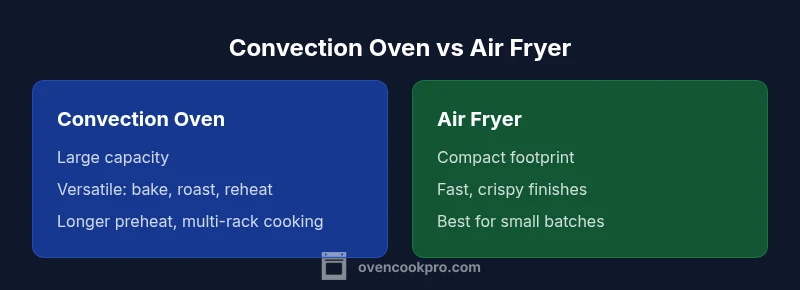
Convection ovens offer broad versatility: you can bake a sheet of cookies, roast a chicken, and reheat casseroles all at once. The downside is a larger footprint and longer preheat times. Air fryers excel in quick, small-batch cooking where space is at a premium. Their compact chambers concentrate heat and air, making crisp textures possible with a fraction of the energy and time for small portions. If you regularly cook for two or three people, an air fryer can be a great supplement; for larger meals, a convection oven is typically more practical.
Heat sources and temperature ranges you can expect
In conventional convection ovens, heating elements and an integrated fan create a broad, steady heat field, with typical temperature control from roughly 200°F to 500°F. Air fryers use a similar principle but in a much smaller space, often with a slightly lower maximum temperature in some models (roughly 180°F to 400°F). The net effect is that ovens favor more even, large-batch cooking, while air fryers push speed and surface browning. Always consult model-specific manuals to confirm exact ranges.
Texture outcomes: browning, moisture, and oven spring
Texture is where the difference becomes most apparent. A convection oven can deliver deep browning for roasts and cookies without sacrificing interior moisture when used correctly. An air fryer tends to produce crisper exteriors with less interior moisture, a result of rapid surface dehydration in a confined chamber. When deciding between them, consider whether you want a moist interior with even browning (oven) or a ultra-crisp exterior in quick time (air fryer).
Use-case scenarios: everyday meals vs quick-crisp snacks
For everyday meals—roasted vegetables, baked chicken, casseroles—a convection oven is typically the workhorse, capable of handling multiple dishes at once. For quick snacks or small portions, an air fryer can shine, delivering crisp textures with less wait time. That said, you can often achieve similar outcomes by using a convection oven set to a higher fan speed or by preheating and adjusting rack positioning. The best choice depends on batch size, texture target, and how much countertop real estate you’re willing to allocate.
Energy use and efficiency in practice
Movement of hot air is energy-intensive, but efficiency depends on batch size and dish type. In general, air fryers shine when you’re cooking small portions and want fast crisping, while convection ovens excel for larger meals where you can leverage the larger interior with fewer batch cycles. Oven Cook Pro Analysis, 2026 notes that energy use is closely tied to batch size and cooking duration, so optimizing load and timing yields the best overall efficiency. Treat these devices as complementary tools rather than strict replacements.
Preheating and time management: plan ahead
Preheating strategy differs: many convection ovens benefit from a short preheat for even browning, while some air fryers reach operating temperature quickly and can shorten overall cook times. Practical planning means recognizing which recipes benefit from a head start and which items are better started on a hot surface. A little preheating discipline can save energy and improve texture, especially when you’re juggling multiple dishes.
Cleaning, maintenance, and longevity: care for both devices
Regular cleaning extends appliance life and preserves performance. Convection ovens require periodic cleaning of racks and the interior, particularly after roasting fatty foods. Air fryers demand thorough washing of the basket and tray while ensuring the fan vents remain unobstructed. Using non-abrasive cleaners and avoiding metal scrubbers helps protect the surfaces. For both appliances, unplug and let cool before cleaning, and consult the user manual for manufacturer-specific guidance.
Substituting one for the other: practical tips and caveats
When substituting a convection oven for an air fryer, you can replicate crispness by placing the food on a rack with good airflow, using parchment paper or a perforated tray, and keeping portions smaller to mimic the air fryer’s batch efficiency. Conversely, cooking a larger batch in an air fryer often requires dividing into smaller runs or using a similar strategy in a convection oven with multiple racks. Time adjustments and monitoring are essential to avoid overcooking.
Myths vs reality: debunking common assumptions
A common myth is that air fryers always outperform convection ovens in texture. Reality varies: for large, evenly heated dishes, the convection oven’s larger interior often yields more uniform results. Another myth is that you must always preheat; some air fryers and recipes can skip preheating with acceptable results. Finally, many assume both devices cook identically; the geometry of the chamber and the oven’s rack configuration can lead to noticeably different textures.
Best practices for consistent results across models
To obtain consistent results, standardize your approach: keep a single rack height, avoid overcrowding, and use the same pan type when testing recipes across devices. Document adjustments in time, temperature, and rack position so you can reproduce success. When purchasing models, prioritize air circulation capability, thermostat accuracy, and ease of cleaning. This disciplined approach reduces variability and helps you exploit the strengths of each appliance.
2026 shopper guide: choosing between convection ovens and air fryers
Choosing between a convection oven and an air fryer in 2026 depends on your cooking habits, space, and budget. If you regularly prepare large meals or bake pastry, a convection oven adds versatility and capacity. If your meals are mostly small, crispy items and you value speed, an air fryer is a strong complement. Many households benefit from owning both, using the convection oven for roasts and sheet-pan meals, and the air fryer for quick sides and snacks. When evaluating models, compare fan speed, heating element placement, capacity, and ease of cleaning to maximize long-term satisfaction.
Comparison
| Feature | Convection Oven | Air Fryer |
|---|---|---|
| Heat source | Built-in fan + heating elements in a large cavity | Compact chamber with a dedicated heater and high-powered fan |
| Airflow design | Multi-rack circulation for even browning | Intense, focused airflow in a small chamber |
| Cooking capacity | Full meals, multiple racks, large trays | Small batches, typically 1-4 servings |
| Temp range | ~200–500°F | ~180–400°F |
| Best for | Versatile baking, roasting, sheet-pan meals | Crisping small portions quickly |
| Preheat time | Moderate to long | Very short to moderate |
| Footprint | Countertop or built-in, larger footprint | Compact countertop footprint |
The Good
- High versatility for a wide range of cooking tasks
- Capable of handling large meals and multiple dishes
- Better for even browning across large trays
- Familiar kitchen integration with standard cookware
Drawbacks
- Takes up more counter space and may require installation
- Longer preheat times for some recipes
- Higher upfront cost than a single-use air fryer
- Can use more energy per batch for small meals
Convection ovens offer broader versatility; air fryers excel at fast, crisp results in small batches
Choose a convection oven for big meals and baking, and an air fryer for quick, crispy snacks. If space allows, use both to maximize cooking options and texture control.
Questions & Answers
Is a convection oven the same as an air fryer?
Not exactly. They share airflow principles but differ in size, design, and typical use. A convection oven is larger and versatile; an air fryer is compact and focused on crisp textures.
No. They use similar air movement but are built for different tasks.
Can I substitute a convection oven for an air fryer in recipes?
Yes, for many items you can substitute by adjusting time, temperature, and spacing to encourage air contact. Expect some texture differences and be prepared to test small batches first.
Substitute with adjustments.
Are air fryers more energy-efficient than convection ovens?
Air fryers can be more energy-efficient for small portions due to faster cooking and smaller interior. Convection ovens may be more efficient for large meals since you cook more at once.
Depends on batch size.
What foods work best in a convection oven vs an air fryer?
Convection ovens excel at roasts, sheet-pan dinners, cookies, and casseroles. Air fryers shine for fries, chicken wings, and bite-sized snacks with a crisp finish.
Oven for roasts; air fryer for crisp bites.
Do I need to preheat a convection oven or an air fryer?
Preheating is common for both to ensure even results, though many air fryers heat quickly. Follow your model’s instructions and plan accordingly.
Usually yes, follow your model.
Can I bake cookies in an air fryer?
Yes, you can bake cookies in an air fryer with smaller batches and parchment or a suitable tray. Times and textures will differ from a conventional oven, so monitor closely.
Yes, with adjustments.
Main Points
- Assess batch size to decide on appliance footprint
- Expect different texture outcomes: even browning vs crispiness
- Adjust timing and temperature when substituting between devices
- Factor in kitchen space and energy use for long-term value
- Consider owning both for maximum flexibility