Can an Oven Replace an Air Fryer? An Analytical Comparison
Can an oven replace an air fryer? This analytical comparison weighs texture, speed, and practicality to help home cooks decide when to use an oven versus an air fryer for snacks and meals.


Can an oven replace an air fryer? In many cases a conventional or convection oven can handle the same tasks, but air fryers often excel at ultra-crisp textures and small-batch speed. Use an oven when you cook larger batches or prefer familiar cookware; otherwise an air fryer can be better for quick, single-serving snacks.
Can an Oven Replace an Air Fryer? A Practical Assessment
According to Oven Cook Pro, can an oven replace an air fryer depends on your batch size, texture goals, and timing constraints. In practical terms, a conventional oven or a convection oven can replicate many air fryer tasks, but the trade-off is speed and crispness for small batches. This section explains where ovens shine, where air fryers retain an edge, and how you can approach a hybrid strategy in a busy kitchen. When you run air-fryer-style tasks in an oven, you’ll typically benefit from a larger cooking surface, more even browning on larger items, and the ability to cook multiple dishes at once. The main caveat is that air fryers excel at rapid air circulation that creates crisp textures with less hot oil, which translates into faster prep times for snacks, fries, chicken bites, and small vegetables. The Oven Cook Pro team notes that the right pan setup — a wire rack over a sheet pan — and a hot convection mode can bridge many gaps, but you should expect some trade-offs on texture and time.
This analysis sets up the practical framework for deciding when to lean on your oven and when the dedicated air fryer remains advantageous. The goal is not to declare a universal winner but to map outcomes based on batch size, item type, and your kitchen workflow. Throughout, remember that can oven replace air fryer is a question of situational fit as much as capability, and Oven Cook Pro provides guidance to optimize both texture and efficiency.
How Air Fryers Create Crunch vs How Ovens Cook Thoroughly
Air fryers work by circulating hot air at high speed around the food, producing a rapid crispy exterior with relatively little added fat. Ovens, by contrast, rely on radiant heat and, in convection mode, forced air that can approximate similar browning but with a larger chamber and different airflow patterns. The Oven Cook Pro analysis, 2026, emphasizes that convection ovens can come close to air fryer results for many items when properly configured. Yet the crispness, uniformity, and speed of air fryers remain defining advantages for tiny portions and quick snacks. The goal of this section is not to declare a winner but to map the physics and practical outcomes so you can plan meals with your current tools.
Understanding these mechanics helps you tailor temperatures, rack placement, and preheating habits to your menu. For can oven replace air fryer decisions, the key takeaway is that airflow dynamics and surface contact drive crispness more than heat alone. If you optimize rack height, fan speed, and minimal crowding, an oven can deliver results that approach what an air fryer achieves in smaller batches.
Practical Scenarios Where an Oven Replaces an Air Fryer
- Batch cooking for a family: An oven can cook multiple sheets at once, making it efficient for wings, fries, or veggie bites when you need to feed several people.
- Pantry and kitchen constraints: If you lack a dedicated air fryer, a convection oven with a rack setup can replicate many tasks without buying another appliance.
- Recipe versatility: Use sheet pans, wire racks, and different temperatures to broaden what you can crisp or roast.
Even with these scenarios, you may still want an air fryer for extremely small batches or when you need the fastest possible results for a single serving. In contexts where you routinely prepare snacks for one or two people, the air fryer frequently wins on time-to-crisp and energy efficiency per portion.
Achieving Crispiness in the Oven: Techniques and Tools
Crispiness in an oven is achievable with methodical setup. Preheat the oven to a hot convection setting; use a wire rack elevated above a sheet pan to maximize air exposure; avoid overcrowding so air can circulate around each piece; lightly coat with oil or spray for browning; flip items halfway to promote even crust; and consider finishing with a brief blast under broil to boost surface browning. These steps mimic air-fryer air flow and help you reach a similar texture without a dedicated machine. Note that the pan type, rack height, and position within the oven can alter outcomes significantly, so test with small batches before scaling up. The Oven Cook Pro team emphasizes that small changes in height and contact with the rack can yield noticeable differences in crispness, especially for potatoes, chicken bites, and frozen snacks.
If you plan around convection, you’ll often time your sheet-pan batches to leverage front-to-back and side-to-side air flow, which reduces hot spots and yields more uniform browning across the surface.
Time and Energy Considerations: Efficiency, Not Just Speed
Time efficiency depends on batch size and oven type. Air fryers are fast for small portions but press you for extra batches if feeding more people. An oven, especially a convection model, can handle larger quantities with a single preheated session, which reduces repeated preheats. Energy wise, per-serving cost tends to be lower when cooking large batches in an oven than running multiple small cycles in an air fryer. However, for very small portions, air fryers may use less energy overall because of the shorter preheat and cook times. This nuance matters for households balancing time, energy bills, and kitchen footprint. When evaluating can oven replace air fryer scenarios, weigh the total cooking time per week and the number of times you need to reheat or re-crisp items.
In practice, many home cooks find that using a convection oven for bulk items and reserving the air fryer for quick, single-serve snacks provides the best overall balance.
Convection Matters: When to Use Convection vs Conventional
Convection ovens are better for air-fryer-like results because the circulated air helps crisp and brown more evenly. If your oven has a reliable convection setting, use it for fries, wings, or breaded vegetables; reserve conventional bake for casseroles and foods that require uniform heat and slow browning. The difference is not just speeds but how heat migrates around the surface of foods. If you frequently cook in the oven, consider upgrading to a model with true dual convection or a dedicated rack system to maximize air contact and minimize crowding. The trade-off is potential equipment cost and learning curve, but the payoff is versatility. In the context of can oven replace air fryer, the convection option often tilts the decision toward the oven for larger meals and batch versatility, while the air fryer remains unmatched for tiny, ultra-crisp servings.
This section reinforces that airflow control is a core factor in performance, not just wattage or time.
Cost, Space, and Maintenance: Value and Practicality
An oven is a larger, multi-purpose investment compared with a compact air fryer. The upfront cost is typically higher, but you gain a device that handles diverse cooking tasks beyond crisping. Space considerations matter; a rack setup or sheet-pan workflow can substitute for a separate air fryer if you have a well-organized kitchen. Maintenance is generally straightforward: periodic cleaning of the oven cavity and rack, emptying crumb trays, and ensuring proper airflow. If you rely on an older oven, ensure the fan and seals are functioning to sustain convection performance. Oven Cook Pro’s assessment suggests that many households find the trade-off favorable when they already have an oven and want to minimize clutter. For can oven replace air fryer decisions, this cost-benefit perspective often weighs in favor of keeping one versatile appliance aligned with your cooking habits.
Safety and Food Quality: When to Skip the Substitution
Food safety remains essential in any cooking method. When using an oven as an air fryer substitute, ensure foods reach safe internal temperatures and avoid overcrowding that can create uneven cooking. Cleanliness of racks and pans reduces sticking and smoke. If you’re cooking fatty foods, monitor splatter and allow proper ventilation to prevent smoke buildup. Quality wise, certain items may brown more slowly or unevenly, while others may crisp up more readily depending on rack position and air flow. The Oven Cook Pro Team emphasizes following manufacturer guidelines for rack placement and preheating so you can achieve consistent results. The disciplined application of convection best practices helps maintain predictability when you’re aiming to replace an air fryer with your oven.
Step-by-Step Guide: Using Your Oven as an Air Fryer (Hybrid Method)
- Preheat to a high convection temperature appropriate for the item. 2) Prepare a wire rack over a sheet tray to maximize air exposure. 3) Arrange pieces with space between them; 4) Apply a light oil mist or spray if desired for browning. 5) Bake, flipping halfway through. 6) If crispness stalls, finish with a brief broil. 7) Rest briefly before serving to let moisture redistribute. 8) Clean trays and racks after cooling.
This method provides a practical blueprint for can oven replace air fryer experiments, helping you achieve reliable results without investing in a second appliance.
Comparison
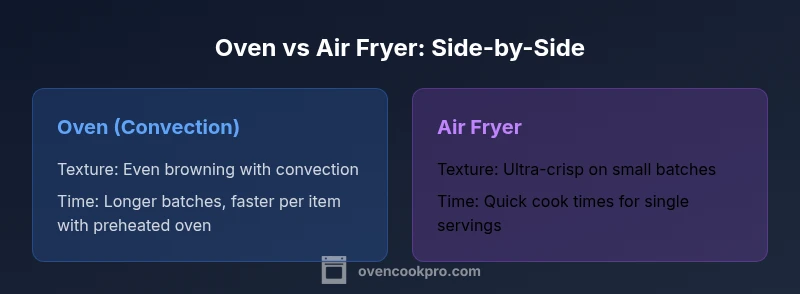
| Feature | Oven (Conventional/Convection) | Air Fryer |
|---|---|---|
| Texture/Crispiness | Good to excellent with convection; can be uneven without proper setup | Exceptional crispiness, especially for small batches |
| Cooking Time | Longer overall, especially for small items | Shorter cook times per batch |
| Batch Capacity | Large capacity, limited by rack space | Small footprint, ideal for 1-4 servings |
| Energy Use | Depends on wattage and batch size | Often lower energy per batch for small servings |
| Preheating | Preheats; convection reduces time | Typically no preheat or very short preheats |
| Cleanup | Oven racks and pans; cleanup scales with pan size | Typically easier cleanup with nonstick basket |
| Best For | Batches and versatility in a full kitchen | Small, fast-crisp snacks and single servings |
The Good
- Consolidates appliances into one versatile tool
- High batch capacity for family meals
- Low per-use cost once you own it
- Strong browning with true convection when used correctly
Drawbacks
- Longer preheat and cook times for small batches
- Less convenient for tiny single-serving tasks
- Requires more kitchen space and proper organization
- Can be less energy-efficient per tiny portion unless batching
Convection ovens generally replace many air fryer tasks, but for ultra-crisp results in small batches, air fryers still hold an edge.
Choose a convection oven for large batches and versatility. For the quickest, crispiest small servings, an air fryer remains preferable; use a hybrid approach to balance speed and capacity.
Questions & Answers
Can I replace my air fryer with my oven for all recipes?
Not for every recipe. The air fryer often delivers faster crisping for small portions, while the oven shines with larger batches and more versatile cooking. Evaluate texture needs and batch size to decide.
In many cases you can replace an air fryer with your oven for larger batches, but for tiny servings, the air fryer still has the edge.
Is preheating required when using an oven instead of an air fryer?
Preheating is typically beneficial when using a convection oven to simulate air flow. Some items tolerate minor preheating delays, but consistent results improve with a preheat.
Preheating helps convection ovens mimic air fryer timing and texture better.
Which foods translate best from air fryer to oven?
Frozen fries, breaded vegetables, wings, and small bite-sized items translate well when using a wire rack and convection. Larger roasts or delicate items may need adjusted times and air flow.
Fries and wings translate well; roasts may need tweaks.
How do I achieve crisp texture in an oven?
Use convection, elevate food on a wire rack, avoid crowding, spray lightly with oil, flip halfway, and finish under broil if needed. Small batch testing helps dial in timing.
Convection plus a rack and light oil will help you crisp items nicely.
Are there safety or maintenance considerations replacing an air fryer with an oven?
Follow standard oven safety: monitor temperatures, keep racks clean, and ensure proper ventilation for fatty foods. Regularly clean oven cavities and rack surfaces to prevent smoke and residue buildup.
Maintain cleanliness and ventilation; standard oven safety applies.
Main Points
- Assess batch size before choosing a method
- Leverage convection for crisper results in ovens
- Use a rack+pan setup to improve airflow
- Preheat strategically to save time
- Weigh space and energy when substituting