Does Oven Work Like Air Fryer? A Thorough Comparison
Explore how a conventional oven stacks up against an air fryer. This analytically driven comparison covers speed, texture, energy use, and best-use scenarios to help you decide which appliance fits your cooking needs.


Does the Oven Work Like an Air Fryer? A Quick Diagnostic
For most home cooks, the question hinges on what you actually need: speed, texture, or capacity. A traditional oven can reproduce many air-fryer outcomes, especially when you leverage convection settings, proper preheating, and surface drying techniques. The Oven Cook Pro team notes that you can achieve crisp exterior and tender interior with the right pan setup and airflow management. However, it’s important to acknowledge that certain crisping tasks, particularly in very small batches, tend to be more efficient in a dedicated air fryer. The key takeaway is that the two appliances share methods but differ in how quickly heat moves and how much space is heated. If your goal is to minimize oil while still getting a crackly exterior, both tools can help; the choice comes down to batch size, texture target, and kitchen layout.
Key Differences You Should Know: Air Fryer vs Oven
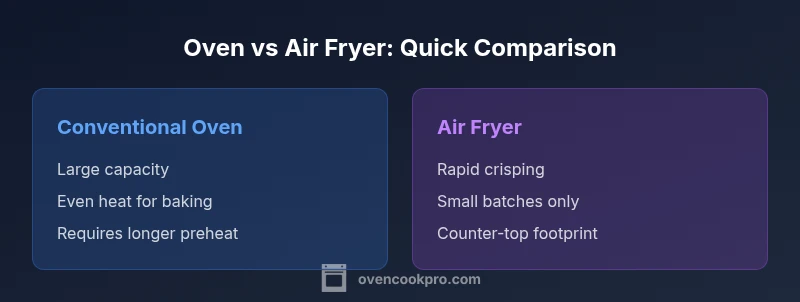
The essential distinction lies in airflow and heat density. An air fryer uses a compact chamber with a powerful fan that circulates hot air at high velocity around small portions of food. This rapid air movement reduces moisture on the surface and creates a quick, crisp exterior. An oven, by contrast, heats a larger cavity, often relying on radiant heat and, in many models, a convection fan. While convection can mimic some crisping effects, the surface area-to-volume ratio is different, and preheating a full oven takes longer. For the question does oven work like air fryer, the practical answer is that both can deliver crisp textures, but air fryers do it more efficiently for small items while ovens excel when you’re cooking larger quantities or baking items that require even browning.
Practical Results: Texture, Moisture, and Flavor
Texture is where the air fryer often shines. Foods like French fries, chicken nuggets, and vegetables can achieve a uniform, pale-gold crisp with noticeably less oil in an air fryer. An oven can replicate this with convection, but achieving the same level of crisp without over-browning on the edges may require adjustments—such as patting items dry, using a wire rack, or flipping halfway through cooking. Flavor-wise, both appliances deliver similar outcomes, but the oven has a wider envelope of sweet spots for browning curves, roast flavors, and more complex baking tasks. Thus, whether you should replace an air fryer with an oven depends on your priority: speed and crispness in small batches, or capacity and versatility for larger meals.
Preheating, Temperature, and Batch Size: The Real-World Balancing Act
Preheating time and how you load the cavity can dramatically affect results. Air fryers typically require little to no preheat for most tasks and heat rapidly due to their compact, hot chamber. Ovens generally demand longer preheat times, and the way you arrange food matters more there to avoid hot spots. For does oven work like air fryer, you’ll find best results by using a convection setting, a shallow pan, and a wire rack when appropriate. If you are cooking a single batch of small items, an air fryer may win on speed. For larger batches or multi-dish meals, the oven offers better scalability and consistent browning across more food pieces. Remember to monitor internal temperatures and adjust times by 5–10 minutes to compensate for larger volumes.
Tricks to Maximize Oven Crisp Without an Air Fryer
Even without a dedicated air fryer, you can coax crisper results from a traditional oven. Begin with a hot oven and a preheated tray or a wire rack elevated on a sheet pan. Pat food dry to reduce surface moisture, and consider a light coat of oil or a spray to encourage browning. Use convection mode if your oven has it, but beware of over-crisping thinner items. Space items evenly to avoid steaming and rotate halfway through cooking. For many weeknight fry-like tasks, these adjustments bring you near-air fryer crisp without purchasing a second appliance. The Oven Cook Pro methodology emphasizes airflow optimization and surface dehydration as the primary levers.
Real-World Scenarios: When to Reach for Each Appliance
If you routinely cook small batches of crispy snacks, an air fryer often saves time and oil, delivering predictable results. If you prepare large roasts, sheet-pan dinners, casseroles, or multiple dishes at once, the oven’s capacity makes it the more practical choice. For does oven work like air fryer in this context, consider your typical meal size and whether you value speed over volume. A hybrid approach—using air fryer for a few quick sides and the oven for main courses—can balance efficiency with versatility. In short, both tools have a place in a modern kitchen; your decision should reflect your weekly cooking patterns and space constraints.
Safety, Maintenance, and Longevity Considerations
Both appliances require routine cleaning to maintain performance. Air fryers are generally easier to clean due to their limited interior space, but they still accumulate grease and food particles in the basket components. Ovens require periodic cleaning plans, especially if you roast fatty foods or bake sugary items. The convection fan in many ovens should be kept clear of debris to maintain airflow. Adhering to manufacturer guidelines for heat limits and cleaning intervals extends the life of either device. Oven Cook Pro highlights that a well-maintained convection oven can deliver consistent results comparable to an air fryer when used correctly.
Authoritative Sources and What the Experts Say
For readers seeking additional guidance, consult trusted sources on cooking methods and appliance efficiency. Consumer Reports discusses the practical differences between air fryers and ovens and helps shoppers assess value. Government and university extension resources offer general safety and cooking best practices. While no single source will lock in every outcome for every recipe, understanding airflow, heat transfer, and batch dynamics provides a solid framework for choosing the right tool in your kitchen. Visit credible sources to supplement these recommendations and tailor them to your cooking style.
Conclusion: Practical Takeaways for the Home Cook
The overarching answer to does oven work like air fryer is nuanced. Air fryers excel at rapid crisping for small portions with minimal oil, while ovens shine when you need larger volumes, diverse cooking techniques, and baking versatility. Your decision should hinge on batch size, texture preference, and how much space you’re willing to dedicate to the task. Oven Cook Pro’s guidance is to optimize airflow and leverage convection when you want outcomes close to air-fryer results, while recognizing the inherent strengths of each appliance.