Air Fryer vs Oven: Which Should You Choose?
Compare air fryer vs oven to decide which appliance best fits your kitchen: speed, texture, capacity, and energy use—backed by Oven Cook Pro analysis for 2026.


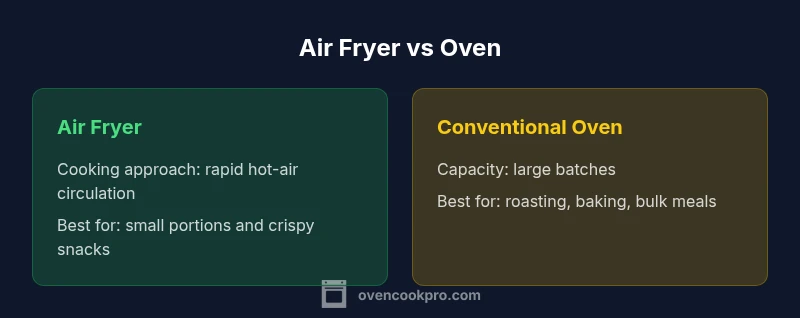
Air fryer vs oven: for small portions and weeknight crispy snacks, the air fryer typically wins on speed and energy use. But for large batches, even browning, and high-heat roasting, the traditional oven remains more versatile. If you prioritize quick, portable results, choose the air fryer; if you cook for families or rely on sheet-pan meals, the oven is the better all‑round workhorse.
How an air fryer works
Air fryer vs oven is a common comparison for home cooks. An air fryer uses rapid hot-air circulation to crisp foods with little to no oil, leveraging a compact cooking chamber and a built-in convection fan. A heating element heats air to high temperatures, while the fan forces that air to move around a perforated basket. This design accelerates surface browning and moisture loss, producing a crispy exterior with a tender interior for many foods. Because the chamber is small, heat transfer happens quickly, and preheating is often shorter than a full-size oven. The basket, racks, and nonstick coatings matter: choose dishwasher-safe accessories when possible, and avoid overcrowding, which can smother airflow.
In practice, most foods prepared in an air fryer require far less added oil than traditional frying, which can translate to lower fat content and fewer calories per serving. The reduced oil and fast airflow also make it easier to achieve crisp textures without deep-frying. For best results, pat foods dry, cut into uniform pieces, and shake or flip midway to ensure even browning. According to Oven Cook Pro, the core principle is hot-air circulation that mimics frying with minimal oil, not magic. With the right setup, an air fryer can produce restaurant-like crusts on small portions without heating a large oven.
How a conventional oven works
A conventional oven relies on radiant heat from heating elements and circulating air when you enable a convection setting. The core idea is to transfer heat from metal walls into food, with the air moving passively or via a fan to improve consistency. In a standard bake mode, bottom heating elements primarily drive cooking, while top heat browns the surface toward the end of the cycle. Convection models push air more aggressively, which can reduce cooking times somewhat and promote even browning across a sheet pan. Unlike a countertop air fryer, a full-size oven has a much larger cavity, allowing you to cook bigger batches at once or multiple dishes in the same run. Preheating is usually longer, especially at higher temperatures, and success often depends on proper rack placement and air circulation. For many foods, you can use cookware you already own: metal pans, glass dishes, and silicone mats. In chef-level practice, sheet-pan meals demonstrate the oven’s strength for efficiency and uniformity, particularly when temperatures climb toward roasting levels. The true convection feature can help even out hot spots if you don’t overcrowd the rack.
Air fryer vs oven: Speed, energy, and batch size—a head-to-head
When you compare air fryer vs oven, the most noticeable differences are how quickly foods cook, how much energy they consume for small portions, and how much you can cook at once. Air fryers shine with tiny batches: wings, fries, and vegetables crisp up in minutes with little oil. Ovens excel when you need to feed a crowd or bake multiple dishes at once. In terms of energy, air fryers typically use less energy per serving for single-serve meals, while ovens can be more efficient for large sheets or roasts due to batch scalability. Preheating differences also matter: air fryers generally heat faster, but ovens may deliver more stable results across a broader range of dishes. Climate considerations, kitchen size, and maintenance all factor in. Based on Oven Cook Pro Analysis, 2026, choose the tool that matches your usual load: quick, crisp snacks or a larger, more flexible cooking workflow. Remember to monitor rack space, airflow, and the dishware you own, since these influence results as much as the appliance you pick.
Texture and taste: why it matters
Texture and taste are the heart of the air fryer vs oven decision. The air fryer can create a crisp exterior quickly, often without deep-frying, which appeals to crave-for-crisp foods with less oil. However, some items may dry out if overcooked due to the concentrated hot-air flow. The oven, by contrast, offers more consistent browning across large surfaces and can better manage moisture for baking bread, casseroles, and roasted vegetables. Because of its size, the oven allows you to use sheet pans or roasters to spread food evenly, reducing overlap that can lead to soggy edges. The key is to monitor temperature and time and to flip or rotate items to avoid hotspots. For items like chicken thighs or fish fillets, you may observe that the air fryer yields a crisp skin but slightly less even interior texture than the oven; this is a trade-off between speed and uniformity. In real-world cooking, most users report satisfying results with both when used within their strengths, aligning with general expert guidance.
Best use cases for air fryer
The air fryer is a natural fit for meals where speed and texture matter more than volume. Crisping frozen snacks, reheating leftovers to reclaim crunch, and cooking small portions of chicken, fish, or vegetables are ideal. It also shines for day-to-day tasks like toasting nuts or making quick bites with minimal oil. When space is tight, the compact unit on a countertop can become a convenient second kitchen station. For apartment dwellers or busy households, the air fryer reduces heat load and keeps kitchens cooler on hot days. Keep in mind capacity: most air fryers handle 1-4 servings per load, so for families or batch cooking you’ll likely opt for the oven for larger tasks.
Best use cases for oven
The traditional oven remains unbeatable for sheet-pan meals, large roasts, baked goods, and casseroles. From roasted vegetables to brisket and holiday cookies, the oven supports full dinners where timing and even heat matters across multiple items. When you need uniform browning on a wide surface, or you’re cooking with pans that won’t fit in an air fryer basket, the oven is the better choice. In addition, true convection ovens distribute heat more evenly, reducing hot spots and enabling consistent results across trays. If you bake bread, cakes, or layered desserts, the oven’s even heat is often essential, and you can leverage multiple racks to maximize capacity. Finally, for soups and stews that require simmering, the oven’s braising mode or low-temperature roasting can be a valuable feature in a single appliance.
Cleaning, maintenance, and space planning
Both appliances require regular care, but the specifics differ. Air fryers are generally easier to clean: remove the basket and tray, wash with warm soap, and wipe the interior with a damp cloth after use. Avoid using abrasive scrubbers that could scratch nonstick coatings. Oven maintenance involves more components: racks, pans, door seals, and interior walls, which means more time spent on cleaning, rust prevention, and periodic calibration checks for temperature accuracy. For spaces with limited counter real estate, an air fryer can be a space-saving option; however, if you already own a large oven, adding a countertop oven or using the oven's convection setting may eliminate the need for a separate appliance. Consider your kitchen layout, storage options, and how often you cook multiple dishes at once when deciding how to arrange these tools.
Costs and long-term value
Price is a practical factor in the air fryer vs oven decision, but long-term value also matters. Air fryers come in a wide price range depending on capacity, features, and build quality; basic models are affordable, while higher-end units offer more presets and larger baskets. Conventional ovens range from modest countertop units to built-in wall ovens or freestanding ranges, with price reflecting size, insulation, and features like true convection, smart controls, and precise temperature control. In terms of energy and maintenance, air fryers typically use less energy for small meals and are easier to maintain, while ovens deliver greater flexibility at the cost of longer cooking times and more intensive cleaning. The right choice depends on how you plan to cook: if your daily routine involves quick, crisp snacks and small meals, an air fryer may deliver better per-minute value; for weekend meals and frequent batch cooking, the oven’s versatility often justifies the investment. Analysts emphasize balancing upfront costs with expected usage to determine the true value.
Decision guide: how to choose
To decide between air fryer vs oven, start with your typical meals, space, and budget. Step 1: List your most frequent foods and consider whether crisp texture or bulk capacity matters more. Step 2: Evaluate counter space and whether you can dedicate a separate appliance. Step 3: Consider cleaning effort and maintenance tolerance. Step 4: If possible, test a few common dishes in both devices and compare results. The air fryer is excellent for quick, crisp items and smaller households; the oven wins for family dinners, bulk roasts, and baking. If your budget allows, both can coexist: use the air fryer for quick-bite tasks and the oven for larger feasts, sheet-pan meals, and baking. A staged approach—start with the air fryer if time and space are tight, then add an oven later if your cooking needs expand—helps align with your kitchen workflow.
Using both appliances effectively
In many kitchens, owners adopt a hybrid approach: air fryer for crisping and quick wins, and the oven for everything else. Plan meals so that you benefit from the oven's capacity while the air fryer finishes components to crispness. For example, you can roast vegetables in the oven while finishing chicken wings in the air fryer, coordinating timings to serve hot, crisp results together. Consider preheating strategies, rack placement, and batch rotation to optimize results. With thoughtful planning, you maximize texture, time, and energy efficiency across both devices.
Comparison
| Feature | Air Fryer | Conventional Oven |
|---|---|---|
| Cooking approach | Rapid hot-air circulation; basket-based design | Radiant heat with convection options; larger cavity |
| Capacity | Typically 1-4 servings | Large batches; multi-dish versatility |
| Typical cook time (small portions) | Quicker crisping; minutes for snacks | Longer overall, but efficient for batches |
| Texture results | Crispy exterior, moist interior (when done right) | Even browning with broad heat distribution |
| Versatility | Best for crispy foods; some baking possible | Broadest range: roasting, baking, broiling, toasting |
| Cleanup | Basket trays; often easier to clean | Racks and pans; more components to clean |
| Energy usage | Lower per small batch | Higher for bulk when cooking many items |
| Best use case | Quick snacks, small households | Family meals, batch cooking, baking |
The Good
- Faster readiness for small portions and crispy results
- Uses less oil for many recipes, supporting healthier options
- Compact footprint makes it ideal for apartments
- Easier cleanup with basket/tray design
Drawbacks
- Limited capacity for large families or bulk cooking
- Some foods don’t crisp evenly and may dry out if overstressed
- Requires extra countertop space if you already own a full-size oven
- Not every dish translates perfectly from oven to air fryer
Air fryer for small portions; oven for bulk cooking and versatility
Choose the air fryer when speed and crisp texture on small batches matter most. For family meals, large roasts, and baking, the oven is the more practical all-round choice.
Questions & Answers
What is the primary difference between an air fryer and a conventional oven?
The air fryer relies on rapid hot-air convection in a compact chamber to crisp foods with little oil, while a conventional oven uses radiant heat in a larger cavity for broad cooking tasks. The two appliances excel in different contexts.
Air fryers use hot air for crisp textures; ovens use radiant heat for larger, versatile meals.
Can I bake in an air fryer and in an oven?
Yes, many foods can be baked in both, but results differ. Air fryers bake faster with crisp surfaces and limited capacity, while ovens handle larger items and more delicate baked goods with even heat.
Yes, you can bake in both; expect differences in texture and size.
Is an air fryer more energy-efficient than an oven?
Air fryers often use less energy per small batch due to shorter cooking times, but for large meals the oven can be more efficient because of its larger capacity and batch cooking potential.
Air fryers save energy on small jobs; ovens win for big batches.
What should I consider when choosing between them?
Consider batch size, typical foods, kitchen space, and how much you value speed versus versatility. If you mostly cook small items, an air fryer makes sense; for family meals, the oven is usually the smarter long-term choice.
Think about what you cook most and your space.
Can I use both appliances to save time?
Yes. You can use the air fryer for crispy components while the oven handles roasting or baking, coordinating timing to serve hot, fresh results for the whole meal.
Yes—use both to multitask and save time.
Main Points
- Choose air fryer for quick, crispy small dishes
- Opt for oven for large batches and baking versatility
- Balance upfront cost with intended usage and space
- Consider using both to maximize efficiency and texture