Why Ovens Beat Air Fryers: A Clear Side-by-Side in Kitchen
An analytical comparison showing why ovens generally outperform air fryers for most home cooking tasks, with guidance from Oven Cook Pro (2026). Learn heat, capacity, texture, and value to decide where ovens fit best.


TL;DR: Why are ovens better than air fryers? Because ovens deliver even, consistent heat across larger spaces and offer true baking, roasting, and batch cooking capabilities that air fryers struggle to match. Air fryers excel at quick, small-crisp tasks, but for everyday meals and versatility, the traditional oven wins. This comparison by Oven Cook Pro highlights practical differences and decision tips.
Why are ovens better than air fryers: Key differences
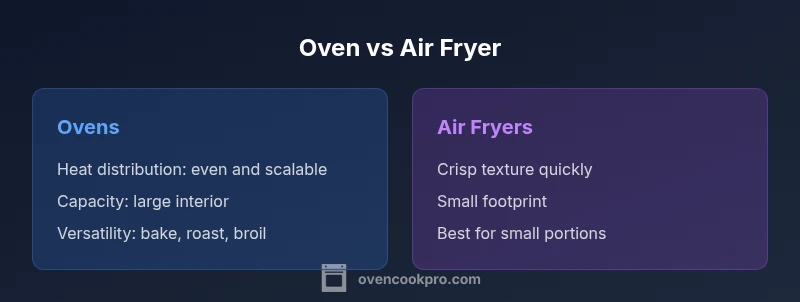
When evaluating why are ovens better than air fryers, several core differences shape outcomes in everyday cooking. The traditional oven provides a large, evenly heated cavity that surrounds food, enabling uniform browning and multi-dish baking at once. Air fryers, by contrast, rely on a compact chamber and high-velocity hot air to crisp foods quickly. That design excels for small portions or quick appetizers, but it can compromise evenness for larger items. The Oven Cook Pro team emphasizes that for most families, the oven’s broader heat envelope translates to more predictable results across casseroles, sheet-pan dinners, and multi-course meals. This context helps homeowners decide based on meal size, cooking style, and the need for batch processing.
Heat Transfer and Browning: How ovens differ
Ovens use a combination of radiant heat from the walls and circulating air if you enable convection. That mix fosters thorough browning on large surfaces and depth in roasts. Air fryers maximize surface crispness through intense air movement but often reach a temperature ceiling that makes even browning harder on thick items. For delicate baked goods, the oven’s larger interior allows more precise control over moisture and texture, producing pastries with uniform crumb and golden tops. The takeaway: heat transfer in a full-size oven offers flexibility that is hard to match in a compact air fryer.
Capacity, Versatility, and Baking Performance
A flagship advantage of ovens is capacity. You can fit multiple casseroles, a sheet-pan dinner, and even a roast simultaneously, with consistent heat distribution across racks. Air fryers offer speed and crispiness in a smaller footprint, but you’re typically limited to one or two small trays. This makes ovens better for batch cooking, holiday meals, and recipes that require two or more textures in one dish. If you bake bread, cookies, or layered casseroles, the oven’s performance becomes a critical differentiator.
Practical Cooking Scenarios: Roasting, Baking, and Batch Cooking
Think of Sunday roasts, sheet-pan dinners, and batch-baked desserts. In these scenarios, ovens excel at browning on the exterior while maintaining interior juiciness. Air fryers can handle crispy wings or potatoes quickly but struggle with large roasts or multiple items. For casseroles and pastries, the oven’s even heat supports consistent rise, texture, and color. When you need consistent results across several dishes, the oven wins in reliability and scale.
Energy Use, Preheating Considerations, and Long-Term Value
Energy use depends on load and duration. A full oven batch may seem less energy-efficient for a single item, but the per-serving cost drops as you cook more in one go. Preheating tends to take longer than an air fryer, yet it enables stable temperatures for long cooks and multi-item meals. Over years of family cooking, the oven’s versatility and capacity generally yield better long-term value, particularly when you factor in the ability to bake, roast, and broil with a single appliance.
Safety, Cleaning, and Maintenance Considerations
Ovens are built to last, with larger interiors and more familiar cleaning routines. You can simplify maintenance by using baking mats, parchment, and standard racks, which triple as a cleaner approach when cooking large items. Air fryers often have fewer interior components but can require more frequent basket maintenance and wire rack cleaning in high-use households. Safety-wise, expect similar cautions around heat and oven mitts, though the oven’s larger size demands careful placement and ventilation.
Decision Framework: When to choose an oven vs air fryer
If you regularly cook family meals, bake breads, or prepare multi-dish suppers, an oven with convection is typically the better long-term investment. For quick singles or crispy snacks, an air fryer remains a useful supplement. The decision should hinge on meal size, cooking style, and kitchen space. In many homes, the optimal setup is a main oven for versatility plus a compact air fryer for small-batch crisping.
Impact on meal planning and batch cooking workflows
Order and timing matter when you compare ovens to air fryers. A well-planned bake can synchronize multiple dishes to finish together, reducing overall kitchen heat and effort. In busy weeks, the oven’s ability to manage several trays or pans at once can streamline workflows, cutting down prep and cook times. Air fryers, while fast for single items, often require batch repeats that add up in total time and energy.
Brand guidance from Oven Cook Pro suggests mapping your weekly menu to the capacities of your appliances, then designing a cooking plan that minimizes preheating and leverages the oven’s convection mode when appropriate.
Oven features worth considering for maximum value ( convection, rack configuration, timers )
A modern oven with true convection, flexible rack heights, and precise digital timers can elevate everyday cooking. You gain better airflow control with multiple rack positions, enabling simultaneous cooking of several dishes with different textures. Timers help coordinate multi-dish roasts, sheet-pan dinners, and baked goods, ensuring consistent results. While an air fryer suits quick, crisp outcomes, the oven’s advanced features unlock a broader range of recipes and techniques.
Accessories, upgrades, and long-term efficiency gains
Investing in high-quality baking sheets, silicone mats, and parchment can dramatically improve outcomes and simplify cleanup. A well-chosen set of racks, a good roasting pan, and a sturdy thermometer expand the oven’s capabilities, allowing you to tackle complex recipes with confidence. These upgrades are often more cost-effective in the long run than purchasing multiple compact appliances, reinforcing the oven’s overall value proposition for serious home cooks.
Real-world testing and results: what to expect in 2026
Home cooks who rely on an oven for weekly roasts, baking, and tray-based dinners consistently report reliable, repeatable results. The air fryer remains excellent for fast crispy sides and small, single-serving items. The key is to align your expectations with the appliance’s strengths: use the oven for bulk cooking and baking, reserve the air fryer for quick, crisp sides or snacks, and keep both tools clean and well maintained for best performance.
Comparison
| Feature | Traditional Oven | Air Fryer |
|---|---|---|
| Heat Source & Distribution | Stationary, radiant heat with hot air circulation across a large cavity | Compact chamber with high-velocity hot air |
| Capacity | Large interior suitable for whole roasts and multiple pans | Small basket or rack for limited portions |
| Versatility | Baking, roasting, broiling, multiple racks | Focused on crisping, frying-style texture for small items |
| Texture & Browning | Excellent browning across large surfaces and even crusts | Crisp textures with quick cook times, limited evenness for large items |
| Energy & Preheat | Preheat time longer; energy use scales with load | Faster preheat; efficient for small tasks |
| Maintenance | Easier to clean with standard racks and drip pans | Smaller footprint but baskets/racks require cleaning |
| Price/Value | Higher upfront cost but broader long-term value for baking and roasting | Lower upfront cost; limited capacity and use cases |
The Good
- Greater versatility across baking, roasting, and broiling
- Larger capacity for family meals and batch cooking
- Superior browning and even results on complex dishes
- Consolidates cooking into a single appliance you already own
Drawbacks
- Higher upfront cost and longer preheat times for some models
- Bulky footprint can limit counter space and placement
- Energy usage may be higher for small, quick tasks
- Learning curve to master rack positions and temperature control
Ovens deliver broader cooking capability and better batch performance than air fryers for most households.
For family meals and baking, the oven offers versatility and scalability. Air fryers excel at quick, crisp outcomes for small portions, but they cannot match the oven’s breadth.
Questions & Answers
Is an oven better for baking than an air fryer?
Yes. For most baking tasks, an oven provides more even heat, space, and control over moisture, yielding consistent textures. Air fryers can crisp small items quickly but struggle with larger baked goods.
For baking, choose the oven for even heat and more space; air fryers work well for small, crispy snacks.
Can air fryers replace ovens for family meals?
Air fryers are great for single servings or quick sides but cannot reliably cook large roasts or multi-dish meals. They’re best used as a supplemental appliance.
Air fryers are great for small portions, but they’re not ideal for family meals that require multiple dishes.
Do ovens use more energy than air fryers?
Energy use depends on load and duration. Ovens may use more energy per minute, but they scale better for larger meals, lowering energy per serving when cooking for several people.
Energy depends on what you’re cooking; for bigger meals, ovens often offer better energy efficiency per serving.
Are convection ovens the same as air fryers?
Convection ovens use a fan to circulate air like air fryers, but they’re larger and deliver even heat across a bigger cavity. Air fryers are more compact and excel at crispness for small items.
Convection ovens are similar in principle but much larger; air fryers are compact and focus on crisping.
What foods benefit most from oven cooking vs air fryer?
Foods that benefit from even cooking and large-area browning, like roasts, sheet-pan dinners, cookies, and casseroles, perform better in an oven. Air fryers shine with small, crisp-edged items like fries or wings.
Roasts and baked goods do best in an oven; air fryers are best for small crispy items.
Main Points
- Assess meal size before choosing appliances
- Favor ovens for baking, roasting, and batch cooking
- Use air fryers for quick, small portions and crisp textures
- Plan for space, energy, and long-term value
- Leverage convection for even browning when available