Gas Oven vs Convection Oven: An Analytical Comparison
Explore the key differences between gas ovens and convection ovens, focusing on heat delivery, baking quality, energy use, and practical kitchen guidance for homeowners.


Convection ovens generally deliver more even cooking and faster bake times due to a fan, while gas ovens excel at quick preheating and high-heat searing. Your choice depends on baking needs, kitchen setup, and energy considerations.
Gas Ovens vs Convection Ovens: A Practical Lens
According to Oven Cook Pro, the decision between a gas oven and a convection oven hinges on how you cook most often in your kitchen. The Oven Cook Pro team found that both technologies have distinct strengths and trade-offs, which become especially clear when you consider typical meals, favorite bakeware, and space constraints. This article uses an analytical lens to map out when a gas oven might serve you well and when a convection option offers better outcomes for even browning, shorter bake times, and consistent results across multiple racks. By the end, homeowners will have a clear framework for choosing based on cooking style, energy context, and maintenance considerations.
How Heat Is Delivered: What Each Oven Does Differently
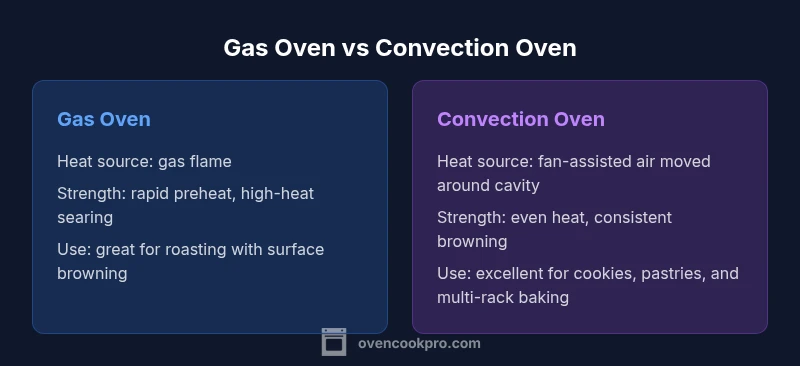
Gas ovens rely on a flame to heat the interior, with heat rising naturally and circulating through natural convection. This can create intense, direct heat that’s ideal for searing roasts or delivering a strong crust on certain dishes. Convection ovens, by contrast, incorporate a fan and often an additional heating element that actively moves hot air around the cavity. That circulation tends to produce more uniform temperatures at all racks, reduce hot spots, and promote even browning on cookies, pastries, and casseroles. For homeowners, the practical implication is straightforward: gas ovens often excel when you want quick, high-heat results, while convection ovens shine when you need precision and even cooking across the whole oven. The Oven Cook Pro analysis emphasizes how a simple switch from standard bake to convection can alter outcomes across multiple recipes, making it easier to achieve consistent results without constant monitoring.
Energy Use, Preheating, and Cooking Speed
Energy use and preheating behavior differ noticeably between these two technologies. Gas ovens typically preheat quickly to allow fast entry into cooking, especially for high-heat tasks like roasting. However, because heat can be less evenly distributed without forced air, you may encounter longer per-surface monitoring times to prevent scorching. Convection ovens may take a little longer to preheat because of the fan and ducting, but once up to temperature they distribute heat more evenly, reducing the need for rotating pans and often shortening overall bake times. In practice, this means a busy household might gain efficiency with convection for most tasks, while a dedicated meat lover might prefer the urgency of gas for searing and finishing at high heat.
Baking Performance: Browning, Evenness, and Time
One of the most tangible differences between gas and convection arises in baking performance. Convection helps cookie sheets and sheet pans achieve uniform browning on all sides because the circulating air reduces stagnant pockets. Pastry bakers often prefer convection for even color and texture. Gas ovens can produce exceptional crusts when used with proper rack placement and temperature control, but you may notice slight differences between the top and bottom racks in some models. The key takeaway is that convection reduces hot spots, making recipes that rely on stable, even heat—like soufflés, tart shells, and layered cakes—more dependable. For roasts and braises, gas heat can deliver robust surface browning, with convection then finishing the dish more evenly inside.
When to Choose Gas and When to Choose Convection
If your cooking repertoire features frequent high-heat searing, rapid preheating for weeknight meals, or if you value a traditional oven experience, a gas oven remains compelling. Conversely, if you bake frequently, stack multiple trays, or want uniform browning without rotating pans, a convection oven is typically the better choice. Many households find value in a hybrid approach: a gas oven for certain dishes and a convection setting for others. The decision should consider your cooking style, typical dish types, and the size of your kitchen. Oven Cook Pro’s guidance suggests evaluating how often you bake desserts that rely on air circulation and how important even crusting is to your everyday menus, then choosing the model that aligns with those priorities.
Installation, Safety, and Maintenance Considerations
Gas ovens require proper installation, venting, and routine safety checks to ensure safe operation. In some regions, a licensed professional is needed to verify gas lines and ventilation. Convection ovens, typically electric, involve different maintenance tasks such as checking the fan and ensuring proper ducting. Regardless of choice, regular cleaning and descaling—especially around the baking elements and the fan housing—help maintain performance. The Oven Cook Pro team emphasizes planning for service access, ensuring that the oven is installed in a location with adequate clearance and ventilation, and scheduling periodic inspections to prevent heat imbalances and noise that can occur with aging convection fans.
Practical Cooking Scenarios: Recipes and Techniques
A practical way to compare these ovens is to consider common kitchen tasks. For roasting vegetables, gas’s quick heat can produce a nice crust on outside edges, while convection may yield uniform browning on large sheets without rotating pans. For baking, convection generally offers more predictable results for cookies, pastries, and pies, as consistent air movement promotes even color and texture. If you’re cooking delicate items like meringues or custards, monitor temperatures carefully since air circulation can influence moisture retention. In both cases, starting with manufacturer guidelines, reducing standard temperatures by about 25 degrees Fahrenheit (14 degrees Celsius) when using convection, and testing with a two-rack setup can help you dial in recipes more effectively. The goal is reliable outcomes across a variety of dishes, with minimal guesswork.
Cost, Availability, and Long-Term Value
Price and availability for gas and convection ovens vary by region, model year, and features. Gas ovens may come with lower purchase costs in some markets where natural gas is inexpensive, while convection models can be pricier due to added fans and advanced controls. When evaluating long-term value, consider energy efficiency, maintenance needs, and potential resale value. It’s also wise to compare warranties and service coverage, since gas line components and convection fans can be subject to wear over time. The Oven Cook Pro team notes that regional energy prices and maintenance costs should factor into the total cost of ownership, not just the upfront price tag. A careful total-cost assessment helps homeowners avoid surprises down the line.
How to Convert Recipes Between Gas and Convection: Practical Tips
Converting a recipe from gas to convection (or vice versa) is not merely a matter of adjusting temperature. Atmospheric changes alter heat transfer rates and moisture loss, so you should also adjust bake times and rack placement. A practical approach is to start by reducing the baking temperature by about 25 degrees Fahrenheit (14 degrees Celsius) when using convection, then checking for doneness early and often. Use multiple racks with adequate space between pans to promote even air flow, and rotate pans mid-way through baking for particularly dense items. For gas ovens, you may need to account for stronger radiant heat on the top surface; if you notice excessive browning on top, cover with foil to prevent scorching while the inside finishes cooking. The overarching rule is to monitor closely, record your adjustments, and refine the method for your specific oven model. The Oven Cook Pro guidance emphasizes starting with tested recipes and gradually adapting them to your appliance while keeping a log of temperatures, times, and outcomes.
Comparison
| Feature | Gas Oven | Convection Oven |
|---|---|---|
| Heat distribution | Direct radiant heat with natural convection | Active air circulation with a fan and rear/bottom heat source |
| Preheating time | Often quick to reach cooking temperature | Can take slightly longer to reach target temperature due to fan startup |
| Browning and crusts | Strong surface searing potential | More uniform browning across multiple racks |
| Evenness across racks | Potential hot spots on some models | Consistent results across all racks |
| Best-used scenarios | High-heat searing, quick roasts, and traditional dishes | Baking cookies, pastries, and layered desserts with even texture |
| Installation & maintenance | Requires gas line and venting; safety checks essential | Electric; fan and ducting require periodic cleaning |
| Energy considerations | Energy use varies by model and gas price in your area | Typically efficient for even heat but may incur higher upfront costs |
The Good
- Gas ovens offer quick preheat and strong high-heat performance
- Convection ovens provide even heat and consistent results across racks
- Convection can reduce bake times for many baked goods
- Each type can be more cost-effective depending on regional energy prices
- Convection improves browning and sauce-free surface texture
Drawbacks
- Gas ovens may have uneven heat without proper calibration
- Convection ovens can cause overbrowning if not monitored and may dry delicate items
- Gas installation requires venting and professional setup
- Convection fans add a potential maintenance need over time
Convection is generally the more versatile choice for even baking and consistent results; gas excels for quick heat and high-heat searing.
Choose convection when you bake frequently or need even results across multiple racks. Choose gas when you prioritize rapid preheating and strong surface searing, especially for roasts. For mixed kitchens, a hybrid approach or models offering both modes can provide maximum flexibility.
Questions & Answers
Is a gas oven better than a convection oven for most home cooks?
It depends on what you bake most. Convection generally provides more even heat and faster bake times, which benefits cookies and pastries. Gas ovens excel in high-heat searing and certain roasts. A mixed kitchen approach can offer the best of both worlds.
It depends on what you bake most. Convection gives even heat and faster bakes, while gas shines for searing and high heat.
Can I convert a standard gas oven recipe to convection without trials?
Yes, but you should adjust temperatures and times. Start by lowering the temperature by about 25 degrees Fahrenheit (14 degrees Celsius) and monitor doneness closely. Rotating pans and using multiple racks helps if your convection oven is very powerful.
Yes—lower the temperature by about 25 degrees and watch doneness closely as you bake.
Are convection ovens energy-efficient?
Convection ovens can be energy-efficient because the fan circulation allows you to bake at lower temperatures for shorter times. Actual energy use varies by model and cooking load, so compare energy ratings and local energy costs.
Convection can save energy overall, but it depends on your model and how you cook.
What recipes benefit most from convection?
Cookies, pastries, pies, and casseroles with even browning benefit most from convection. Roasts and vegetables can also cook more evenly and quickly with airflow that reduces hot spots.
Great for cookies and pies, where even browning matters.
Do I need professional installation for gas ovens?
Yes. Gas ovens require proper gas lines and venting, and many regions require a licensed professional for safe installation. Electric convection ovens typically have different installation considerations.
Gas ovens usually need a licensed installer for safe setup.
What’s the main risk of using convection too often?
Over-drying delicate foods or over-browning if settings aren’t adjusted can occur. Always monitor, especially when you’re new to convection, and adjust times for each recipe.
Watch for over-browning and drying if you don’t adjust temperatures.
Main Points
- Choose convection for even baking and fast, uniform browning
- Opt for gas when you need rapid preheat and high-heat searing
- Account for maintenance needs and venting with gas installations
- Use temperature adjustments when converting recipes between modes
- Test and log your results to tailor settings to your oven