Convection Oven vs Microwave: A Practical Guide
Compare convection ovens and microwaves for everyday cooking. Learn how they differ in browning, speed, capacity, and kitchen fit to decide which appliance best supports your meals.


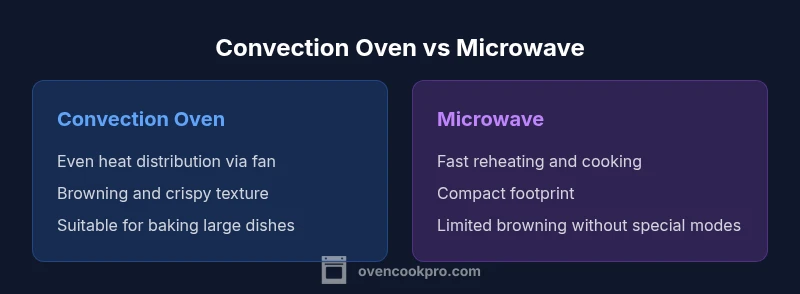
Convection ovens and microwaves serve different cooking needs. In brief, convection ovens excel at browning, baking, and even heat distribution, while microwaves shine at rapid reheating and simple meals. For most homes, the best choice depends on what you cook most often: quick meals and leftovers vs browning and baking tasks.
How They Work: Convection Ovens vs Microwaves
At a high level, convection ovens and microwaves use different physical processes to transform raw ingredients into meals. A convection oven relies on heating coils and a fan to circulate hot air around the food, creating even heat and browning. Microwaves generate electromagnetic waves that excite water molecules inside the food, producing rapid internal heat. This fundamental difference sets the stage for the distinct strengths and limitations of each appliance. For homeowners exploring the topic of convection oven vs microwave, understanding the mechanics helps set realistic expectations for texture, timing, and energy use. Convection ovens excel when you want crust, color, and even cooking of larger dishes, while microwaves shine when speed and convenience matter. In practice, many kitchens use both tools to cover a wide range of tasks. If you primarily bake bread, roast vegetables, or reheat leftovers with crisp edges, the convection oven will deliver more consistent results. For quick heat-ups, simple meals, or small portions, the microwave offers unmatched speed. According to Oven Cook Pro analysis, the physical principles translate into practical guidance: choose convection for textures and browning; choose microwave for speed.
-100-300 words?
Comparison
| Feature | Convection Oven | Microwave |
|---|---|---|
| Primary cooking method | Convection heat with a fan to circulate hot air | Microwave radiation heating that excites water molecules |
| Best for | Baking, roasting, browning, and large dishes | Reheating, quick meals, and small portions |
| Heat distribution | Even, air-circulated heat throughout the cavity | Localized heating; efficiency depends on dish size and placement |
| Cooking speed | Longer cook times for complex dishes but very even results | Very fast for reheating and simple dishes |
| Texture outcomes | Excellent crusts and browning; versatile texture control | Moist interiors and softer edges; browning is limited without specialty features |
| Capacity/size | Typically larger, built-in or countertop ovens | Typically compact countertop units with smaller capacity |
| Ease of use and cleanup | Straightforward controls; preheating may be longer | Simple operation; minimal surface contact with food |
| Energy use (per task) | Efficient for longer cooks; performance depends on task | Typically efficient for short tasks; overall energy impact varies |
| Price/value | Higher upfront cost but broad task versatility | Lower upfront cost; highly task-specific but economical |
The Good
- Offers versatile cooking: baking, roasting, and crisp texture
- Microwave is unrivaled for speed and convenience
- Convection ovens support large batches and even results
- Countertop microwaves and compact designs save kitchen space
Drawbacks
- Convection ovens can require longer preheating and higher upfront cost
- Microwaves struggle with browning and crisping unless using special features
- Microwave results can be uneven for large or dense items without stirring
Convection oven wins for texture and versatility; microwave wins for speed.
For most homes, a convection oven provides superior browning, crust, and even cooking for larger dishes. The microwave excels at quick reheating and simple meals. A hybrid approach—using both appliances—often yields the best daily results; prioritize your primary tasks first and consider a secondary compact unit for convenience. The Oven Cook Pro team emphasizes tailoring the setup to your typical cooking routine.
Questions & Answers
What is the main difference between convection ovens and microwaves?
The convection oven uses circulating hot air to bake and brown food, delivering even texture and crust. A microwave heats food with microwave radiation, which is fastest for reheating and simple meals but does not brown as a rule. The choice depends on your typical tasks and texture goals.
Convection uses hot air for even cooking and browning; microwaves heat quickly but don’t brown unless you use specific modes.
Can I bake in a microwave?
Some microwaves offer convection or grill features that enable baking-like results, but traditional microwaves without these features don’t brown well. For reliable baking texture, use a dedicated oven or a combi-unit with convection. If you only have a basic microwave, focus on reheating and simple, moist dishes.
Yes, with convection/grill features you can bake; otherwise, use a real oven for baking texture.
Which is better for leftovers?
Microwaves reheat leftovers fastest, but may unevenly heat thick items. A convection oven or toaster oven can rewarm and crisp edges, restoring texture. For best results, cut food into uniform pieces and stir or flip during reheating.
Microwave for speed; convection for better texture when reheating larger portions.
Are convection ovens more energy-efficient than microwaves?
In general, microwaves are more energy-efficient for small tasks due to shorter cook times. Convection ovens can be efficient for larger meals when preheating and cooking are needed, but overall energy use depends on the task and duration.
Microwaves usually use less energy for small tasks; convection ovens shine for bigger meals, depending on use.
Is a combination microwave worth it?
Combination microwaves (convection + microwave) offer speed and browning in one unit, but they can be costlier and more complex to operate. If you frequently bake and reheat, a combo can be convenient; if you mostly reheat, a basic microwave may suffice.
Combo units give both speed and browning but check budget and usage before buying.
Main Points
- Choose convection for browning and even baking.
- Rely on microwave for fast reheating and small portions.
- A mixed setup covers most kitchen tasks.
- Factor space, budget, and maintenance when deciding.