Convection Oven for Baking: Master Even, Consistent Results
Discover how to use convection baking to achieve even browning, faster results, and consistent texture. This guide explains temperature adjustments, rack placement, timing, and safety for home bakers.


With a convection oven for baking, you will bake more evenly, reduce prep time, and achieve crisper edges. To get started, set the oven to convection bake, lower the temperature by 20-25°F, and rotate trays halfway through. Use parchment or silicone mats and avoid blocking vents. This guide covers setup, best practices, and troubleshooting.
What is a convection oven for baking and why it matters
A convection oven uses a built-in fan and exhaust to circulate hot air around food, delivering more even browning and faster cooking. When used for baking, this air movement helps reduce hot spots and produces consistent texture on cookies, breads, and pastries. According to Oven Cook Pro, the benefits are most noticeable when you bake multiple sheets at once because heat is distributed more evenly across racks. In practice, you’ll see crisper edges on cookies, tighter crumb on breads, and more uniform crusts on pies. However, convection can dry out delicate items if you push the heat too hard or bake too long. With the right settings, you’ll enjoy reliable, repeatable results in your home kitchen. This section lays the groundwork for understanding how convection changes the game for baking and why so many home bakers reach for it first.
How convection baking works: airflow and heat distribution
Convection ovens circulate hot air with a fan and exhaust system. The moving air transfers heat more efficiently to the surface of baked goods, which accelerates crust formation and encourages even dryness around the crumb. The result is cookies with uniform edges, bread with even color, and pastries that brown consistently on all sides. There are two common configurations: true convection, which uses an additional heating element near the fan to boost airflow, and standard convection, which relies mainly on the fan for circulation. For most home bakers, true convection offers the most noticeable improvements, but any convection setting will outperform a non-convection bake when used correctly. Understanding airflow helps you decide where to place racks and how to orient pans for even exposure to heat.
Features to look for in a convection oven for baking
Look for a dedicated convection bake mode that maintains stable airflow even at lower temperatures. Key features include multiple rack support (at least two levels), even heat distribution across the oven cavity, and a reliable temperature control that tracks target settings without large swings. Some models offer true convection with a third heating element near the fan and adjustable fan speeds, which can give you more control for delicate items. A built-in oven thermometer or temperature probe helps you verify that the oven reaches and stays at the set temperature. Practical extras include separate timer settings for each rack, a crumb tray that is easy to clean, and sturdy racks that slide smoothly. If you bake on multiple racks, an interior light and simple rack-maneuvering system help you monitor progress without opening the door too often.
Converting recipes for convection: temperature and time adjustments
Convection baking is not just “hotter; faster.” When you move from conventional baking to convection, adjust temperature and time to exploit the improved heat transfer. A common starting rule is to reduce the recipe temperature by about 25°F (14°C) and start checking for doneness earlier by 5-10 minutes, depending on the item. For cookies and quick breads, you may also want to place a sheet pan on the rack above or below to balance heat if your oven shows hot spots. Cakes and muffins can benefit from using lighter pans or placing the batter on the center rack to prevent over-browning. Thin crusts benefit from the airflow that dries the surface a bit faster, while high-moisture fillings may need shorter bake times or lower fan speed. Always use a timer and rely on visual cues rather than time alone.
Practical setup: getting your oven ready and calibrating temperature
Before you bake, verify that your oven’s convection mode is functioning and that heat is distributed evenly. Place an oven thermometer inside to confirm accurate temperatures and preheat to the target setting. Position racks so that baked goods aren’t touching and have room for air to circulate. Line baking sheets with parchment paper or silicone mats rather than greasing heavily, which can promote uneven browning in a convection oven. When possible, rotate racks halfway through baking to counteract hotspot effects. After baking, let items rest briefly on a cooling rack to finish setting the crust while air continues to circulate.
Baking with convection: best practices by food type
Cookies: space cookies evenly and one sheet per rack if possible; rotate mid-bake for even edges. Bread: use a preheated baking stone or heavy sheet pan to maintain bottom heat and support a strong oven spring. Cakes and muffins: use light-colored pans and place them on the center rack to prevent over-browning. Pastries: keep the fan at a moderate setting and monitor carefully to avoid drying the surface. Pies: bake with a vented crust and consider shielding exposed edges to prevent scorching. In all cases, use parchment or silicone mats to prevent sticking and ensure easy cleanup.
Safety, maintenance, and cleaning for convection ovens
Keep the oven cavity clean to maintain airflow; food residue can block vents and alter heat distribution. Clean spills after each bake and use a mild detergent with a non-abrasive sponge. Inspect seals and gaskets for wear and replace if needed to maintain efficiency. Avoid placing foil on the oven floor or blocking the fan, which can disrupt air circulation and create hot spots. When self-cleaning is available, follow the manufacturer’s instructions, but be mindful of heat and potential odors. Finally, keep the exterior clean, dry, and free from moisture near the control panel to prevent electrical issues.
Troubleshooting common convection baking issues and how to fix
Uneven browning: rotate racks and consider reflowing air with a second rack. Hot spots: map your oven with a few trials, then rotate duties so that sensitive items aren’t placed over the same hot area. Dry or leathery crusts: reduce bake time slightly and check moisture from ingredients or fillings. Soggy bottoms: ensure pans are on racks with air circulating underneath and avoid excessive moisture in batters. Excess browning on edges: lower temperature a bit earlier or shield with parchment. If results remain inconsistent, calibrate temperature with a separate oven thermometer and revisit rack placement.
Tools & Materials
- Oven(Convection/bake mode available)
- Oven thermometer(Place in center of oven to verify temperature)
- Baking sheets (rimmed)(Use for even air exposure)
- Parchment paper or silicone baking mats(Prevents sticking and promotes even browning)
- Cooling rack(For air circulation after baking)
- Timer or smart clock(Track doneness with visuals)
- Oven-safe gloves(Handle hot trays safely)
- Mixing bowls and measuring tools(Accurate prep for consistent results)
Steps
Estimated time: 60-90 minutes
- 1
Gather gear and preheat
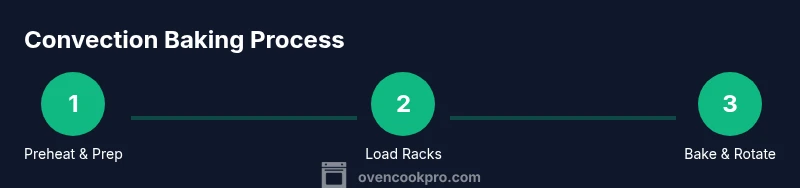
Collect all baking tools, pans, and ingredients. Select convection bake if available and preheat to the target temperature. Use the oven thermometer to confirm the set point before loading anything.
Tip: Preheating ensures the oven’s airflow is stable from the first moment of contact with the batter or dough. - 2
Set temperature and rack positions
Choose the correct rack level for the item being baked. Avoid stacking racks tightly; leave space for air to circulate. If your oven has multiple convection options, start with the standard convection setting.
Tip: Place heavier items on lower racks to promote even heat distribution and oven spring. - 3
Prepare pans and liners
Line sheets with parchment or silicone mats. Lightly grease only if specified by the recipe, but typically these surfaces reduce sticking in convection.
Tip: Parchment mats dramatically improve release and cleanup times with high-airflow baking. - 4
Load trays with space
Arrange items with space between them and avoid overcrowding. If baking on multiple sheets, stagger positions so air reaches all trays.
Tip: Keep a consistent distance from the oven walls to minimize edge scorching. - 5
Bake and rotate trays
Start checking doneness a little earlier than conventional recipes. Rotate trays halfway through to even out exposure to hot spots.
Tip: Rotation is typically enough to correct most uneven browning or crust formation. - 6
Check for doneness and adjust
Use visual cues and a toothpick or thermometer as appropriate. If browning is ahead of interior doneness, reduce temperature slightly or shorten bake time.
Tip: Trust appearance and internal temperature rather than time alone. - 7
Cool and finish
Let baked goods rest on a rack to finish setting. Airflow continues to help moisture redistribute, improving texture.
Tip: Avoid covering immediately; air circulation prevents soggy bottoms. - 8
Clean and maintain
Allow the oven to cool before wiping down. Clean spills promptly to preserve airflow and efficiency.
Tip: Regular maintenance prevents hot spots and improves long-term performance.
Questions & Answers
What is convection baking and how does it differ from traditional baking?
Convection baking uses a fan and exhaust to circulate hot air, promoting even heat and faster cooking. Traditional baking relies mostly on radiant heat from the elements with still air. The fan can cause faster browning and different moisture behavior, so recipes sometimes need adaptation.
Convection uses a fan to move hot air for even cooking, unlike standard ovens that rely on still air. Adjust recipes accordingly.
Can I convert all recipes to convection?
Most recipes can be adapted for convection, but delicate batters and high-moisture fillings may require different times or avoiding the fan entirely. Start with a temperature reduction and shorter bake, then monitor closely.
Most recipes can be adapted, but watch for delicate items that may overbrown.
Should I preheat when using convection?
Yes. Preheating ensures the cooking environment is stable from the first moment you load the food, which helps prevent uneven results.
Preheat the oven so the convection air is ready when you start baking.
How can I prevent cookies from spreading unevenly in convection?
Ensure even dough size, use parchment, and avoid overcrowding. If you notice hot spots, rotate trays and consider using a second rack to balance air flow.
Spread can be minimized by even dough sizes and rotating trays during bake.
Is convection baking more energy efficient?
Convection can be more efficient in practice due to faster preheats and shorter bake times, but total energy use depends on settings and dish size.
It can be more efficient thanks to faster cooking; energy use varies by recipe.
What foods benefit most from convection?
Cookies, crackers, roasted vegetables, pies with crumb toppings, and breads typically see improved browning and crust formation with convection.
Cookies and breads usually benefit the most from convection.
Watch Video
Main Points
- Master convection for most bakes to improve uniform browning.
- Reduce temperature by ~25°F and check doneness early.
- Space racks and rotate trays for even heat exposure.
- Calibrate your oven with an independent thermometer.
- Keep the oven clean to maintain airflow and performance.