Why Your Oven Turns Off by Itself: Urgent Troubleshooting Guide
Urgent, step-by-step troubleshooting for why your oven turns off by itself. Learn common causes, safe tests, and fixes to restore reliable baking and prevent future shutdowns.


According to Oven Cook Pro, an oven that turns off by itself is most often caused by power issues, an overheating safety cutoff, or a faulty sensor. Start with the power supply and basic settings, then test the sensor and cooling cycle. If unresolved, contact a professional. The deeper diagnostics follow below.
Understanding the symptom: why oven turns off by itself
When an oven turns off by itself, it interrupts dinner and raises safety concerns. This symptom is not always dangerous, but it should not be ignored. The question why oven turns off by itself typically points to one of several protective or fault-driven triggers. In many homes, the likely culprits fall into three categories: power issues, sensor or control faults, and thermal overload protections. A calm, systematic approach helps you separate easy fixes from problems that require professional service. Start with the simplest checks (power, door latch, and basic settings), then move to diagnostic tests of components that directly control heat and monitoring. By outlining a clear flow, you can restore reliable operation or know when to seek help. Common power problems include loose outlets, tripped breakers, and undervoltage. If the appliance is hard-wired or on a specialty circuit, the issue may be at the panel or within the cord. In any case, document symptoms and timings to aid future troubleshooting.
Quick checks you can do safely
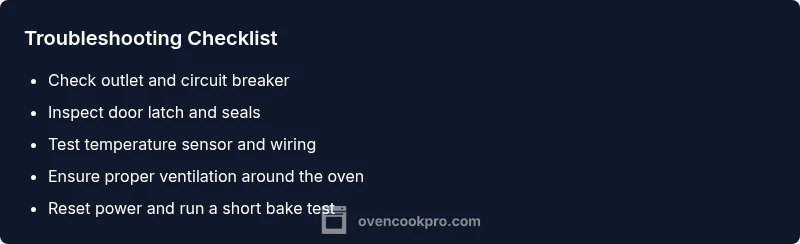
- Power basics: verify the outlet is live, unplug and re-plug, and confirm the circuit breaker hasn’t tripped.
- Door latch and seal: ensure the door is fully closed and the latch engages correctly; a loose latch can trigger safety interlocks.
- Settings sanity check: confirm clock, timer, and any child-lock features are off unless intentionally active.
- Ventilation: make sure vents aren’t blocked and the oven has adequate clearance for heat dissipation.
- Heat cycle observation: note if the shutdown coincides with preheat, bake, or broil modes to map timing to a subsystem.
If you see the oven lose power at startup, or it shuts off within minutes of heating, stop troubleshooting and consider professional service to avoid electrical hazards.
Common causes mapped to symptoms
- Power supply issues (high likelihood): a loose outlet, worn cord, or an overloaded circuit can cause intermittent shutdowns. If the outlet is unstable or the circuit shows repeated trips, the oven will lose power mid-cycle.
- Thermal overload / overheating safety (high likelihood): if internal sensors or vents fail to regulate heat, a built-in thermostat or safety cutoff triggers a shutdown to prevent damage or fire.
- Faulty temperature sensor or control board (medium likelihood): incorrect readings can cause the oven to think it has reached target heat and shut down or refuse to restart.
- Door latch/wiring problems (low likelihood): a faulty latch or damaged wiring can trigger safety interlocks that halt operation.
Understanding these mappings helps you decide which area to test first and what kind of professional may be needed.
How to test the power supply safely
- Visual inspection: check the power cord for nicks or fraying. If you see damage, discontinue use and replace the cord or call for service.
- Outlet test: plug another appliance into the same outlet to confirm voltage stability. If the other device behaves oddly, the outlet may be the culprit.
- Circuit assessment: inspect the breaker panel for signs of wear, corrosion, or frequent trips. If you suspect a faulty breaker, switch off power and call a licensed electrician.
- Reset protocol: disconnect the oven from power for 60 seconds, then reconnect and resume a low-power test bake to observe any immediate shutdowns.
- Ventilation check: ensure there’s no obstruction around the oven that traps heat, which could trigger thermal protection.
Always keep a fire extinguisher within reach when performing power-related checks, and if you’re unsure about wiring, stop and call a pro.
Diagnosing the control board and sensors
- Sensor readings: use the oven’s diagnostic mode if available to compare actual temperature against the displayed setpoint. Large discrepancies suggest a faulty sensor.
- Control board signals: listen for abnormal beeps, err code flashes, or lag in control responses, which can indicate a failing board.
- Wiring integrity: inspect visible wiring for loose connections or discoloration. A loose connector can cause intermittent shutdowns.
- Sensor replacement: if testing reveals erratic readings or persistent drift, replacing the sensor is often effective, but this should be done by a qualified technician.
- Board replacement: in many cases, a control board failure requires professional service due to the risk of further damage or safety concerns.
Most common fix: sensor or wiring check
In most residential troubleshooting, the quickest path back to reliable operation is addressing the sensor and wiring harness. Start by: (1) cooling the unit completely, (2) disconnecting power, (3) inspecting the sensor probe for signs of damage, corrosion, or misalignment, and (4) reseating or replacing any loose connectors. If readings then stabilize but drift over time, consider replacing the sensor. For wiring, ensure all harnesses are seated firmly and that there is no pinched or frayed insulation. If you’re not comfortable with this level of inspection, hire a licensed technician to avoid electric shock or fire risk.
Note: never operate the oven with damaged wires or exposed conductors. A failed sensor or loose wire is a common but addressable cause of unexpected shutdowns.
Safety precautions and when to stop
- Power down before any inspection: always unplug or switch off at the circuit breaker before touching internal components.
- Heat hazard: ovens retain high temperatures after use; allow complete cooling before handling components.
- Record-keeping: document symptoms, times, and any codes to aid diagnosis and future prevention.
- When to stop: if you smell burning, notice sparking, or see melted insulation, stop immediately and call professional service.
- Professional boundary: complex control board or gas valve issues should only be handled by licensed technicians to ensure safety and code compliance.
Prevention and maintenance tips
- Regular cleaning: remove grease and food debris that can affect sensors and ventilation. A clean oven reduces erratic sensor readings.
- Routine checks: inspect the power cord and plug every 6–12 months; replace damaged components promptly.
- Ventilation and clearance: ensure proper space around the oven to avoid overheating and support heat dissipation.
- Temperature calibration: periodically verify accurate temperature using an external thermometer; recalibrate if readings deviate.
- Schedule maintenance: annual professional service can catch worn components before failure, keeping your oven reliable and safe.
When to call a pro and what to expect
- Tripped circuits or frequent power issues: seek an electrician for a panel and outlet check.
- Sensor/control board concerns: a trained technician will test, replace, and safely power the unit; expect a diagnostic report and a parts estimate.
- Safety-first approach: never bypass safety interlocks or perform high-voltage tests without proper training. Prepare the model number, purchase date, and a list of observed codes for the technician to speed up service.
Steps
Estimated time: 60-90 minutes
- 1
Power check and outlet test
Start by confirming the oven is receiving stable power. Test the outlet with another appliance, check the cord for damage, and reset the circuit breaker if it tripped. A healthy power supply often resolves mid-bake shutdowns.
Tip: Always unplug before inspecting cords and outlets. - 2
Cool-down and reset
If the oven was recently in use, allow it to cool completely. Unplug for 60 seconds, then plug back in and run a low-power test bake on a non-critical setting to observe stability.
Tip: A full reset can clear transient faults that trigger false shutdowns. - 3
Sensor and wiring inspection
Inspect the temperature sensor for corrosion or misalignment. Reseat any loose connectors and look for frayed wires near the back panel. Replace damaged components only if you have the proper training.
Tip: Do not force connectors or bend sensor cables. - 4
Ventilation and clearance check
Ensure there’s adequate space around the oven and that exhaust vents aren’t blocked. Restricted airflow can trigger overheating protections even at moderate temperatures.
Tip: Keep at least a few inches of clearance on all sides. - 5
Software/board status check
If your model offers internal diagnostics, run them to check for error codes related to the control board or sensor. Record any codes for reference when contacting support.
Tip: Some codes correspond to known issues with specific boards. - 6
Professional assessment
If the issue persists after basic checks, schedule a service visit. A technician can test the control board, sensors, and wiring with specialized equipment and safely replace faulty parts.
Tip: Request a written estimate and expected turnaround time.
Diagnosis: Mid-bake oven shuts off unexpectedly
Possible Causes
- highPower supply issues (outlet or circuit)
- highThermal overload or overheating safety cutoff
- mediumFaulty oven temperature sensor or control board
- lowDoor latch or wiring problems
Fixes
- easyTest outlet and circuit breaker; reset if needed
- easyAllow oven to cool completely and check for proper ventilation
- mediumInspect sensor and wiring; replace sensor if readings are erratic (professionals only)
- hardConsult a technician for control board assessment/replacement
Questions & Answers
Why does my oven turn off in the middle of baking?
Most likely causes are power issues, a thermal cutoff, or a faulty sensor. Check the outlet and circuit first, then test the sensor readings and cooling cycle. If it persists, seek professional service.
Most ovens shut off mid-bake due to power, heat protection, or sensor faults. Start with power checks and then test the sensor; if unresolved, get a professional.
Can a faulty temperature sensor cause the oven to shut down?
Yes. A bad temperature sensor can send incorrect heat readings, prompting the oven to shut off for safety. Replacement by a technician is often straightforward.
A faulty sensor can cause shutdown by misreporting temperature, so replacement by a pro is common.
Is it dangerous when an oven turns off by itself?
It can be safety-related if power surges, wiring, or gas components are involved. If you notice burning smells or sparking, stop using the appliance and call for professional help.
If you smell something burning or see sparks, stop and call a professional—safety first.
Should I reset the oven or breaker to fix the issue?
Resetting can clear minor faults. Try unplugging for 60 seconds and checking the breaker. If problems persist, avoid repeated resets and contact a technician.
Try a quick reset, but if it keeps happening, don’t DIY further.
When should I call a professional for an oven that keeps turning off?
If power checks, sensor tests, and resets don’t resolve the issue, or if you detect heat or electrical hazards, schedule a service visit.
If simple checks don’t fix it or you notice heat/electrical risks, call a pro.
Watch Video
Main Points
- Start with power and settings checks
- Thermal overload is a common trigger
- Sensor or control board faults require professional help
- Never bypass safety interlocks
- Regular maintenance reduces shutdown risk