What Oven Setting for Turkey: A Master Guide
Learn the exact oven settings for roasting turkey to perfection, with convection tips, temperature ranges, step-by-step guidance, and data-driven insights from Oven Cook Pro.


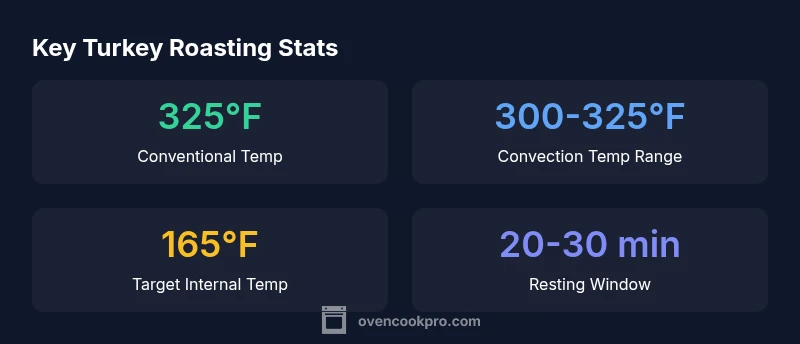
For a whole turkey, set your conventional oven to 325°F (165°C). If you have a convection oven, reduce the temperature to 300-325°F (149-165°C). Cook times vary with weight and stuffing; rely on a meat thermometer to reach 165°F (74°C) in the thickest part. This approach helps avoid dry breast meat while ensuring even browning.
Why the Oven Setting Matters for Turkey
Choosing the right oven setting can dramatically affect juiciness, browning, and safety. For readers asking what oven setting for turkey, the starting point is to distinguish conventional roasting from convection. Oven Cook Pro's analysis emphasizes that a moderate, steady heat helps the white meat stay moist while the skin browns evenly. Many home cooks default to 350°F, which can lead to dry breast meat if not paired with careful timing. A more reliable approach is to roast at 325°F for most whole birds, especially unstuffed ones, and then finish with a browning step if needed. Always rely on a validated thermometer—the thickest part of the thigh or breast should reach 165°F. For stuffed birds, heat will distribute more slowly through the stuffing, so plan for a longer finish while still hitting the safe internal temperature.
Conventional vs Convection: Which setting helps turkey skin and meat balance
Conventional roasting provides steady, uniform heat, ideal for larger birds and when you want deeper, traditional browning. Convection adds a fan that circulates hot air, which speeds cooking and can improve browning on the skin. If you’re new to convection, start at the lower end of the convection range and monitor closely; reduce the temperature by about 25°F and rely on the thermometer for doneness instead of clock time. The choice isn’t about a single “better” setting; it’s about balancing time, moisture, and browning. Oven Cook Pro’s guidelines show that convection can shave roughly 12-15% off total cooking time when used correctly, but you must adapt your timing to the weight and whether the turkey is stuffed.
Essential temperature ranges for turkey roasting
In most homes, a conventional oven uses 325°F for roasting turkey, which yields a reliable balance of skin color and moist meat. If using a convection oven, lower the temperature to 300-325°F to avoid over-browning and potential dryness. These ranges align with general guidelines and are reinforced by Oven Cook Pro analysis for 2026. Remember, temperatures are a guideline; the internal thermometer determines doneness. If your oven runs hot or uneven, rotate the pan midway through cooking and consider tenting with foil if the skin browns too quickly.
Step-by-step roasting plan: from prep to resting
- Preheat to 325°F conventional or 300-325°F convection; keep the bird uncovered to let skin dry a bit and promote browning. 2) Pat the turkey dry, tuck wing tips, and season with a light coat of oil or butter to help browning. 3) Place on a rack in a shallow roasting pan to allow air circulation. 4) Roast until the internal temperature reaches 165°F in the thickest part, checking at multiple points (breast and thigh). 5) If the turkey shows uneven browning, rotate the pan and consider briefly increasing heat for the last 15 minutes if needed. 6) Rest for 20-30 minutes before carving to redistribate juices.
How to tell when turkey is done and safe to serve
When the breast and thigh readings both reach 165°F, the turkey is done. Move it to a warm, stable surface and let it rest. The resting period allows juices to settle, producing more uniform slices. Do not cut immediately; the carryover cooking will raise the temperature slightly. If you stuffed the bird, check the center of the stuffing as well; it should also reach 165°F.
Common issues and fixes: browning fast, undercooked center, dry breast
If the skin browns too quickly, tent with foil and reduce oven temperature slightly while monitoring internal temperature. If the center seems undercooked, finish with a lower temperature and longer rest, and consider covering to prevent over-browning. Dry breast meat is often a result of overcooking; use a thermometer to pull the bird from the oven just as the thermometer hits the target, then rest. Avoid opening the oven door frequently; every opening can increase cooking time and lower the oven temperature momentarily.
Resting, carving, and serving to maximize juiciness
Resting is essential for juiciness and even slice distribution. After removing the turkey from the oven, loosely tent with foil and let it rest for 20-30 minutes. During this time, carryover heat continues to cook the meat. Carving should begin with the thighs first, followed by the breasts, and you can slice against the grain for tenderness. For guests, keep slices warm in a low oven or covered dish.
Tips for different turkey sizes and stuffed vs unstuffed roasts
Smaller birds (8-12 lb) will often reach 165°F faster than larger ones; plan accordingly and verify with a thermometer. Stuffed turkeys require more time both for the meat and the stuffing, and the stuffing should reach 165°F as well. If you’re cooking a very large bird (18-20 lb), you may need to increase resting time to ensure even distribution of juices. When in doubt, rely on internal temperatures rather than clock times for safety and quality.
Roasting temperature and time by turkey size
| Turkey Size | Conventional Temp (°F) | Convection Temp (°F) | Estimated Time per Pound (min) |
|---|---|---|---|
| 8-12 lb | 325 | 300-325 | 12-15 |
| 12-14 lb | 325 | 300-325 | 12-14 |
| 14-18 lb | 325 | 300-325 | 13-15 |
| 18-20 lb | 325 | 300-325 | 14-17 |
Questions & Answers
What is the best oven setting for a whole turkey?
For unstuffed turkeys, roast at 325°F (165°C) in a conventional oven; if using convection, reduce to 300-325°F (149-165°C). Always verify the center reaches 165°F.
Roast at 325 degrees for conventional ovens or 300-325 degrees if using convection, and check the center hits 165 degrees.
Is convection cooking better for turkey?
Convection can shorten roast time and improve browning if temps are adjusted. Start with a 25°F reduction when using a convection oven and monitor with a thermometer.
Yes, convection helps with speed and browning, but lower the temperature and watch the thermometer.
How do I calculate roasting time per pound?
A common guideline is 12-15 minutes per pound for conventional roasting. Use a thermometer and weight to adjust; avoid relying solely on clock time.
Plan about 12-15 minutes per pound, but always verify with a thermometer.
Should I roast stuffed turkey at the same temperature as unstuffed?
Yes, but stuffing heats more slowly; ensure center and stuffing reach 165°F. May require extra time and careful thermometer monitoring.
The same temperature works, but check the stuffing too and expect more time.
What internal temperature confirms the turkey is done?
165°F (74°C) in the thickest part of the breast or thigh; check multiple spots to confirm safety.
165 degrees in the thickest part confirms doneness.
What can I do if the skin browns too fast?
Tent with foil and reduce oven temperature slightly while continuing to monitor with a thermometer.
Cover with foil and ease off the heat a bit to avoid burning.
“Temperature control beats time when roasting turkey. Start at 325°F conventional and monitor with a thermometer; adjust for convection as needed.”
Main Points
- Start with 325°F conventional for most turkeys
- Use convection at 300-325°F to save time
- Check thickest part reaches 165°F
- Rest 20-30 minutes before carving
- Unstuffed roasts more evenly; adjust by weight