Oven Roast Chicken Temperature: Doneness Guide for Home Cooks
Learn how to roast chicken to safe, juicy perfection by dialing in oven temperatures, weight-based timings, and proven techniques. This guide from Oven Cook Pro covers temperatures, carryover, convection, and essential tips for roast chicken.


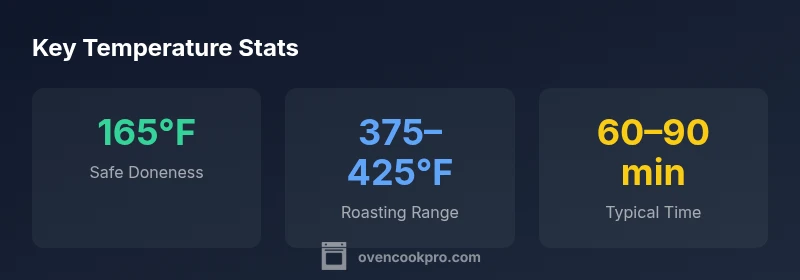
Target an internal temperature of 165°F (74°C) in the thickest part of the chicken for safety, then rest before carving. For most home ovens, roasting at 375–425°F (190–220°C) produces juicy meat with crisp skin. Use a digital thermometer and account for carryover heat after removing from the oven, before serving.
Why Temperature Matters in Oven Roasting
Temperature control is the foundation of roast chicken quality. Too low and the meat remains pale and undercooked; too high and the skin may burn before the interior reaches safety. Temperature also affects juiciness: carryover heat continues cooking after you remove the roast, so the actual pull temperature should be slightly below target. According to Oven Cook Pro, committing to a precise doneness target and using a reliable thermometer dramatically reduces guesswork. This section explains the science behind oven temperature, how to measure it, and practical considerations for both conventional and convection ovens. You will learn how your oven’s performance, pan choice, and starting temperature influence the final result, and how to adjust heat without sacrificing safety or texture.
Safe Doneness Targets: 165°F and Beyond
For safety and consistent results, aim for an internal temperature of 165°F (74°C) in the thickest part of the chicken. Keep in mind that carryover cooking will raise the temperature by about 5–10°F after you remove the roast from the oven, so you can pull slightly below the target and rely on resting to finish the job. Use an instant-read thermometer inserted into the thigh or the thickest part of the breast to verify; do not rely on the color of the meat alone. This target balances safety with juicy, tender meat, and it aligns with Oven Cook Pro guidance for home cooks who want reliable results.
How to Choose the Right Roast Temperature Range
Most home cooks roast whole chickens in the 375–425°F (190–220°C) range. A lower end around 375°F yields gentle browning and more even texture, while higher settings around 425°F promote crisp skin and faster searing. If you start from a fridge-chilled bird, a brief drop in temperature at the start can help prevent the breast from drying before the thigh reaches safe doneness. For ovens with uneven heat, use a rack to promote air circulation and rotate the pan halfway through roasting. In practice, choosing 375–425°F gives a reliable balance between browning, moisture retention, and predictable timing across standard home ovens.
Step-by-Step: Roasting a Whole Chicken in a Conventional Oven
- Preheat your oven to your target range (e.g., 425°F for crisp skin or 375°F for a gentler browning). 2) Pat the chicken dry inside and out; rub with oil and season generously with salt, pepper, and aromatics like garlic and herbs. 3) Tuck wing tips under the body and tie the legs (truss) for even cooking and to prevent flaring. 4) Place breast-side up on a rack in a roasting pan to promote air circulation and even browning. 5) Roast until the thermometer reads 165°F in the thickest part; estimate 60–90 minutes for a 4–5 lb bird in typical conditions. 6) Remove from the oven and rest 10–15 minutes before carving to allow juices to redistribute.
Convection vs Conventional: Does It Change the Temperature?
Convection ovens circulate hot air, which generally reduces cooking time and promotes browning at lower surface temperatures. If you use convection, you can start at 400–425°F and expect the same doneness in less time, but monitor closely to avoid overcooking. If you stick with conventional heat, stay in the 375–425°F range and rely on a thermometer rather than time alone to judge doneness. Convection can shave 5–15 minutes off typical cook times depending on bird size and pan setup.
Timing Guidelines by Weight: Quick Reference
- 3–4 lb whole chicken: roughly 60–85 minutes at 375–425°F.
- 4–5 lb: roughly 70–95 minutes.
- 5–6 lb: roughly 90–105 minutes.
- 6–8 lb: roughly 95–120 minutes. Note that pan size, bone-in vs boneless, and starting temperature can shift these numbers by ±10–15 minutes. Always verify with a thermometer rather than relying solely on time.
Temperature Tips for Skin and Juiciness
Crispy skin starts with moisture control. Pat the skin dry, then rub with a light coat of oil or melted butter to conduct heat and seal pores. Salt the skin generously to draw out moisture slightly before roasting. If the skin browns too quickly, briefly tent the chicken with foil while the interior catches up. For a consistently juicy finish, aim to finish the roast when the internal temperature is near the target and let carryover heat carry you into safe doneness during a 10–15 minute rest.
Safety Tools and Best Practices
Always rely on a quality digital thermometer to verify doneness instead of time alone. Calibrate your thermometer periodically and check the thermocouple at the thickest part of the meat (thigh or breast). Maintain kitchen hygiene by allowing the chicken to rest on a clean cutting board and store leftovers promptly at or below 40°F. By combining precise temperature, appropriate resting, and careful handling, you’ll consistently achieve safe, delicious roast chicken.
Common Mistakes and Fixes
Common mistakes include using an inaccurate oven temperature, cooking from frozen, and carving immediately after roasting. Fixes are straightforward: calibrate the oven, thaw fully before roasting, and rest the chicken for 10–15 minutes to let juices redistribute. Also avoid slicing into the bird too early, which causes a dramatic loss of moisture. With a thermometer in hand and a reliable resting period, you’ll reduce guesswork and improve texture across every roast.
Roasting methods: temp, time, and outcomes
| Technique | Target Temp (°F) | Estimated Time | Notes |
|---|---|---|---|
| Conventional, bone-in, skin-on | 350-375 | 90-110 | More even cook; longer skin-browning time |
| Conventional, bone-in, skin-on (high heat) | 425 | 60-75 | Crispy skin; watch doneness closely |
| Convection, bone-in, skin-on | 400-425 | 50-70 | Faster browning and full cook |
Questions & Answers
What is the safe internal temperature for roast chicken?
165°F (74°C) in the thickest part is the recommended target. Verify with a reliable instant-read thermometer.
Aim for 165 degrees in the thickest part with a thermometer.
Convection or conventional oven for roasting a whole chicken?
Convection speeds cook and promotes browning; if using conventional, adjust time and temperature accordingly.
Convection browns faster; adjust time if using a standard oven.
Does resting affect temperature?
Yes. Carryover cooking raises internal temp by about 5–10°F; rest 10–15 minutes.
Resting lets carryover heat finish the job.
What’s the best thermometer for roast chicken?
A digital instant-read or probe thermometer works best for accuracy.
Use a digital thermometer to check doneness.
Can I roast at lower temps to avoid dry skin?
Lower temps can lead to uneven doneness; finish at a higher temp to crisp the skin.
Lower temps may delay browning; finish hotter.
How long should I rest for a 4–5 lb chicken?
Rest 10–15 minutes after removing from the oven to let juices redistribute.
Rest 10–15 minutes before carving.
“Reliable doneness comes from measuring temperature, not time alone; a thermometer is your compass for roast chicken.”
Main Points
- Target 165°F doneness for safety
- Roast at 375–425°F for best skin/meat balance
- Use a digital thermometer for accuracy
- Rest 10–15 minutes to improve juiciness
- Convection speeds up cooking; adjust times
- Carryover heat finishes the job after removal