Is Oven and Microwave Safe the Same?A Practical Comparison
Explore whether oven-safe and microwave-safe materials are interchangeable. This in-depth comparison explains labeling, materials, and practical tips for safe cooking at home.


Is oven and microwave safe the same? Not always. Oven-safe items are designed to withstand high baking temperatures, while microwave-safe items are built to resist microwaves and avoid arcing. In practice, you should only use items labeled as both oven- and microwave-safe if you plan to move between appliances. This quick answer sets up a clearer, safer approach.
Is Oven and Microwave Safe the Same? Key Definitions
In everyday kitchen use, the question is not simply about heat but about the environment in which the heat is applied. The phrase is often misused, leading to risky substitutions. When people ask is oven and microwave safe the same, the correct distinction matters: oven-safe materials are designed to endure prolonged, dry heat at high temperatures, while microwave-safe materials are engineered to interact safely with microwave energy. The goal is to avoid conditions that could cause melting, cracking, smoke, or, in worst-case scenarios, fire. For home cooks who want reliable guidance, the safest assumption is that only items explicitly labeled as dual-safe should be used across both appliances. This means reading labels, manufacturer instructions, and care guides before attempting to move items between the oven and the microwave. The Oven Cook Pro team emphasizes that safety begins with clear labeling and cautious experimentation, especially with unfamiliar cookware.
How labeling informs safe use
Labels are not decorative; they exist to prevent accidents. Look for phrases like “oven-safe,” “microwave-safe,” and any dual labels indicating suitability for both appliances. Some materials may be oven-safe but not microwave-safe, and vice versa. For example, many ceramics and glassware can tolerate oven heat when marked as oven-safe, but unless the same item is explicitly labeled microwave-safe, it should not be used to heat foods in a microwave. Conversely, some plastics are designed for microwave use only and should never be placed in a hot oven. Understanding these distinctions helps reduce mishaps and extend the life of your dishes. Always cross-check the product’s packaging and the manufacturer’s website for definitive guidance.
Comparison
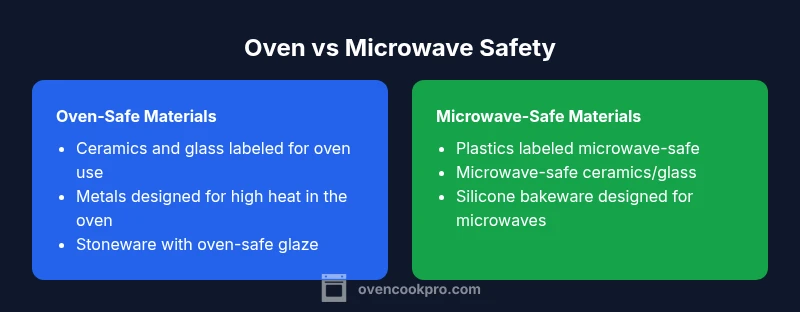
| Feature | Oven-safe Materials | Microwave-safe Materials |
|---|---|---|
| Primary environment | Baking/roasting with high dry heat | Microwave energy-based heating |
| Typical materials | Ceramics, glass, metals with explicit oven-safe labeling | Plastics labeled microwave-safe, certain silicone bakeware, some glass/ceramics designed for microwaves |
| Labeling cues | Look for oven-safe labels and temperature guidelines | Look for microwave-safe labels and, if dual-use, for dual-safe labeling |
| Care considerations | Check maximum temperatures; some items are dishwasher safe only if labeled | Follow microwave care guidelines; avoid overheating and scorching plastics |
| Best use cases | Baking, roasting, broiling with stable bakeware | Reheating, quick cooking, defrosting with microwave-safe vessels |
The Good
- Clarifies safety boundaries between appliances
- Reduces risk of fires and damaged cookware
- Improves decision-making for new cookware purchases
- Encourages better labeling and consumer awareness
- Promotes longer-lasting kitchenware by using correct environments
Drawbacks
- Labeling inconsistencies can still cause confusion
- Not all items clearly indicate dual-use availability
- Some older or generic kitchenware lack explicit guidance
- Over-reliance on labels may lead to unnecessary replacements
Not the same: rely on explicit dual-use labeling for cross-appliance use
Oven- and microwave-safe items serve different heating environments. Always verify labels before use; when in doubt, avoid cross-use unless a dual-safe designation is clearly stated by the manufacturer.
Questions & Answers
Are ceramic dishes always oven-safe?
Ceramic dishes can be oven-safe, but only if they carry an oven-safe label and have appropriate glaze that can withstand high heat. Not all ceramics are suitable for oven use, particularly if they are decorative or unglazed. When in doubt, avoid exposing unlabeled ceramics to oven temperatures.
Ceramics can be oven-safe, but only if labeled for oven use and glazed for heat. If unlabeled, don’t assume they’ll tolerate high oven temperatures.
Can I use glassware labeled microwave-safe in the oven?
Glasses labeled microwave-safe are not automatically oven-safe. Some glassware is designed to tolerate oven heat, but you must verify the label for oven use. If there is no oven-safe marking, do not place it in a hot oven.
Microwave-safe glass is not guaranteed to be oven-safe. Check the label for oven use before placing it in the oven.
Is metal allowed in the microwave?
Metal should generally be avoided in microwaves unless the cookware is specifically designed for microwave use and the manufacturer says it’s safe. Arcing and fires are risks with improper metal use in microwaves.
Avoid metal in microwaves unless it’s explicitly approved by the manufacturer.
What about plastics—can I use them in both appliances?
Only plastics labeled dual-use or explicitly for both oven and microwave should be used in either appliance. Many plastics warp or release chemicals in oven heat, while others may melt in a microwave if not designed for it.
Use plastics only if the label says they’re safe for both oven and microwave.
How can I verify a product’s dual-use safety?
Look for clear labeling on the product or packaging indicating oven-safe and microwave-safe compatibility. Consult the manufacturer’s care guide or website for exact temperature limits and use cases.
Check the labeling and manufacturer guidance to confirm dual-use safety.
What common mistakes should I avoid?
Avoid using unlabeled cookware in the oven or microwave, don't assume metals are safe in microwaves, and never heat takeaway containers that aren’t labeled for both appliances. Always follow care instructions and test cautiously with lower temperatures when in doubt.
Don’t assume; always check labels and follow care instructions.
Is parchment paper safe in both the oven and the microwave?
Parchment paper is commonly used in the oven, but its microwave safety depends on the product’s labeling. If the parchment is certified for microwave use, it can be used there; otherwise, use microwave-safe alternatives.
Parchment paper needs dual-use labeling to be safe in both appliances.
Should I replace cookware that isn’t clearly labeled?
If labeling is missing or unclear, it’s safer to replace with items that have explicit oven-safe and microwave-safe designations. This reduces the risk of damage or injury from unknown material limits.
Consider replacing uncertain items with clearly labeled dual-safe options.
Main Points
- Check labels before using cookware in a new appliance
- Don’t assume oven-safe means microwave-safe or vice versa
- Prefer items explicitly labeled for dual-use
- Avoid metal in microwaves unless specifically designed for it
- Follow manufacturer guidelines for temperature limits and care
- When unsure, consult the product’s care instructions or brand guidance