NuWave Oven Mastery: The Ultimate How-To Guide
Learn to use a NuWave Oven with step-by-step instructions, safety tips, and practical recipes. Oven Cook Pro provides expert guidance for reliable, delicious results at home in 2026.


With a NuWave Oven, you can cook faster and with less oil than traditional methods. This guide walks you through setup, safety, preheating, mode selection, and monitoring for consistent results. The Oven Cook Pro team notes that correct preheating and proper rack placement are crucial for even browning and crisp textures.
What is a NuWave Oven and how it works
A NuWave Oven is a countertop cooking appliance designed to heat foods quickly using radiant heat and hot air. The goal is to reduce cooking times while preserving moisture and achieving browning. Unlike conventional ovens, the NuWave Oven typically sits on a stable countertop and uses a basket or rack to keep food elevated so hot air can circulate all around. This circulation helps create an even crust and tender interior with less added fat. When you first start, you’ll notice the doorless design and a compact footprint that makes it easy to keep on the counter. According to Oven Cook Pro, performance hinges on proper placement of food and the presence of adequate air flow. The nuwave oven often relies on a combination of heat sources and a controlled air path to accelerate cooking. With practice, you’ll learn which foods work best and how to adjust for different yields. For home cooks, mastering the nuwave oven means smoother weeknight dinners without the long waits associated with a traditional oven.
Safety first: setup and safe operation
Safety is the foundation of any successful kitchen experiment with the nuwave oven. Start by placing the unit on a stable, heat‑resistant surface away from edges, sinks, or flammable items. Ensure it is unplugged during setup and that hands are dry before touching controls. Use heat‑resistant gloves when loading or unloading hot trays. Never submerge the main unit in water, and clean only the exterior with a damp cloth as advised in your manual. Always allow the appliance to cool before storage. Oven Cook Pro emphasizes that consistent clearance around the unit reduces heat buildup and protects nearby countertops. By establishing a dedicated cooking zone, you reduce the risk of spills and accidents during weeknight meals.
Key features that affect cooking results
NuWave ovens offer multiple features that influence outcomes: adjustable temperature, timer settings, and different cooking modes such as bake, roast, broil, and crisp. The design typically includes a raised rack or tray, which enables air to circulate around foods for even browning. The presence of an integrated timer helps prevent overcooking, while a removable tray simplifies cleaning. Understanding these features helps you tailor each cook to the food at hand. Oven Cook Pro notes that proper air flow and food spacing are essential for consistent results, especially when you shift from vegetables to denser proteins.
Preheating: why it matters and how long
Preheating primes the nuwave oven for faster, more even cooking. Many recipes will specify a short preheat period, while others guide you to skip preheating for certain foods. In practice, a brief preheat—often a few minutes—allows the interior surfaces to reach a stable temperature before food enters the chamber. This step helps with browning and reduces the overall cook time. If you’re unsure, start with a conservative preheat of 2–5 minutes and monitor progress. Remember to place the rack or trivet to ensure proper air flow once heating begins.
Temperature and time guidelines for common foods
A practical approach is to follow the recipe’s temperature guidance and use your thermometer to verify doneness. For most foods, aim for target temperatures that are safe and appropriate for the item, and adjust based on thickness and density. If you don’t have a recipe, start at a moderate temperature and check early, then increase in small increments if needed. Always rely on an instant-read thermometer to confirm safe internal temperatures. The Oven Cook Pro team reiterates that doneness checks are essential for reliable results when using the nuwave oven.
Cooking modes: bake, roast, broil, crisp
Different foods benefit from different modes. Bake and roast mimic conventional oven cooking with even heat distribution, while broil offers intense top heat for browning. The crisp mode, when available, uses higher heat with rapid air movement to finish with a crust. Use bake for casseroles, roasts for chicken or pork, broil for finishing touch browning, and crisp for fried-inspired textures without deep frying. Start with recommended settings from your device or recipe, then fine‑tune based on how food browns and how quickly your kitchen heats up.
Cooking tips for proteins (chicken, fish, steak)
Proteins reward even thickness and dry surfaces. Pat meat dry, season evenly, and space pieces to avoid steaming. Place cuts with the widest part facing the heat source for uniform browning. If cooking a thick cut, consider a brief pre-sear under a hot mode, then switch to a gentler bake to finish through. Always verify internal temperature with a thermometer, especially for poultry and fish, to ensure safety and juiciness.
Cooking tips for vegetables and starches
Vegetables benefit from even sizing and light coating with oil or seasoning to aid browning in the nuwave oven. Spread pieces in a single layer with room for air to circulate; overcrowding causes uneven results. For potatoes and root veggies, quarter or slice evenly to reduce cook time and achieve crisp edges. Stir or flip halfway through to promote uniform coloring across surfaces. Use a parchment-lined tray if you want easier cleanup.
Cleaning and maintenance
Unplug the unit and allow it to cool before cleaning. Wipe the exterior with a damp cloth and clean removable accessories with warm, soapy water. Avoid abrasive cleaners that could scratch nonstick surfaces. Dry thoroughly before reassembling. Regular cleaning preserves performance and extends the life of seals and gaskets. Oven Cook Pro recommends a gentle wipe-down after each use to prevent buildup that could impact heat distribution.
Troubleshooting common issues
If food isn’t browning, check your rack height and air flow, then adjust mode or temperature accordingly. Uneven cooking usually means crowding and insufficient rotation; flip or rotate items and provide space between pieces. Smoke or burning typically indicates too much oil or high heat for too long; reduce oil and lower heat slightly. Odors can signal residue buildup; clean the interior and accessories and run a short clean cycle if your model supports it.
Advanced tips and samples to try
Experiment with small batches to calibrate times and temperatures for your favorite foods. Try crispy chicken tenders with the crisp mode, salmon fillets with the bake setting, and roasted potatoes with a light olive oil coating. Keeping a small recipe notebook will help you scale up or down based on yield. By pairing precise temperatures with regular thermometer checks, you’ll build a personal reference for consistent results.
Getting the best results: a quick reference
Keep these principles in mind: preheat when advised, use the correct mode, avoid overcrowding, stand by for thermometer checks, and clean after cooking. With these habits, the nuwave oven becomes a reliable tool for weeknight dinners and weekend experiments alike. The process becomes faster and more predictable as you gain experience.
Tools & Materials
- NuWave Oven(Include all accessories and power cord)
- Oven-safe rack or trivet(Promotes air flow and even cooking)
- Heat-resistant silicone tongs(For safe handling without scratching)
- Meat thermometer(Instant-read preferred)
- Parchment paper or silicone mat(Optional for easy cleanup)
- Dish soap and non-abrasive sponge(For post-cook cleaning)
Steps
Estimated time: 30-90 minutes
- 1
Set up the NuWave Oven
Place the unit on a stable, heat‑resistant surface away from edges. Plug in and ensure hands are dry before touching controls. Check that accessories are properly seated before turning on.
Tip: Read the user manual before first use to understand model-specific controls. - 2
Inspect and position accessories
Verify the rack or trivet is clean and correctly positioned to elevate food. Choose a level that allows air to circulate around all sides of the food.
Tip: A higher rack produces more air flow and browning on the top surface. - 3
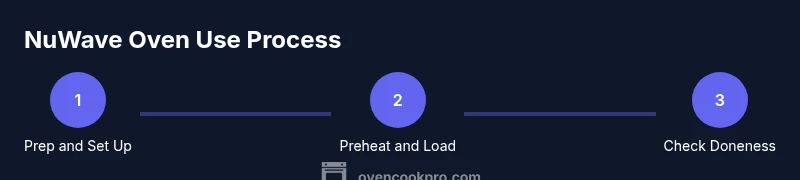
Preheat according to recipe
If preheating is recommended, set the temperature and allow 2–5 minutes for the oven to reach a stable heat. Do not rush this step, as it improves browning and cook uniformity.
Tip: If in doubt, start with a shorter preheat and monitor progress closely. - 4
Prepare food and season
Pat foods dry, season evenly, and portion into uniform sizes. Uneven pieces cook at different rates, so aim for consistent thickness where possible.
Tip: A light coating of oil helps achieve a crisp exterior without deep-frying. - 5
Load food and select mode
Place items on the rack with space between pieces. Choose Bake/Roast for most items, or Crisp for a crisper finish. Start with a mid-range temperature and adjust as needed.
Tip: Use the thermometer to verify doneness rather than relying solely on time. - 6
Monitor and turn as needed
Check progress mid‑cook and rotate or flip as appropriate to ensure even browning. Avoid opening the door frequently, which can drop heat.
Tip: Use tongs to flip delicate items carefully. - 7
Check doneness and rest
Insert a thermometer into the thickest part of the food to verify safe internal temperature. Allow resting time for juices to redistribute before serving.
Tip: Resting improves texture and juiciness after cooking. - 8
Clean and store
Unplug and let the unit cool completely. Clean removable parts with warm, soapy water and wipe the exterior with a damp cloth.
Tip: Regular cleaning prevents residue buildup that can affect heat distribution.
Questions & Answers
What foods can I cook in a NuWave oven?
A wide range of foods can be prepared in a NuWave oven, including proteins, vegetables, and some baked items. Start with simple recipes to understand how the appliance handles different textures and moisture levels.
You can cook many foods in a NuWave oven, beginning with simple recipes to learn its behavior with proteins, vegetables, and small baked items.
Do I need to preheat a NuWave oven?
Preheating is recommended for best browning and even cooking in many recipes. If a recipe doesn’t call for preheating, you can still start with a moderate temperature and monitor the progress.
Preheating is often recommended for better browning; if not specified, start at a moderate temperature and watch the progress.
Can I use metal pans in a NuWave oven?
Yes, you can use oven-safe metal pans or baskets as long as they fit and are stable. Avoid non-oven-safe materials that could warp or cause hot spots.
Metal pans that are oven-safe can be used if they fit properly and are stable.
How do I clean the NuWave oven safely?
Unplug the unit and let it cool before cleaning. Wipe the exterior and wash removable parts with warm, soapy water. Avoid submerging the main unit and don't use abrasive cleaners.
Unplug and let it cool, then wipe the outside and wash the removable parts with soap and water.
Is the NuWave oven energy efficient?
Compared with conventional ovens, the NuWave oven can save time and energy for many meals, thanks to faster cooking and targeted heat. Always consider recipe complexity and batch size when evaluating efficiency.
It often saves energy due to faster cooking, especially for small batches.
Where should I place the NuWave oven on the countertop?
Place the unit on a stable, heat-resistant surface with clear space around it for ventilation. Keep it away from edges and cabinets to prevent heat buildup and accidents.
Set it on a sturdy, heat-resistant spot with space around it for ventilation.
Watch Video
Main Points
- Preheat when advised for best browning.
- Space foods to ensure complete air flow.
- Check doneness with a thermometer.
- Clean promptly after cooking to maintain performance.