Anova Oven Step-by-Step Guide for Home Cooks
Learn to set up and use the Anova Oven with confidence. This Oven Cook Pro guide covers preheating, temperature control, safety, and maintenance for consistent results.


By the end, you’ll confidently set up and use the Anova Oven for precise roasting and baking, including preheating guidance, safe operation, and reliable temperature control. You’ll learn how to position items, select active modes, and monitor results with simple steps. According to Oven Cook Pro, mastering preheat, probe use, and bake times yields consistent, restaurant-worthy results.
What is the Anova Oven and why it matters for home cooks
The Anova Oven is a countertop appliance designed to deliver consistent heat and even browning for a range of dishes. By combining precise temperature control with multi-mode cooking, it helps home cooks move beyond guesswork. For vegetable roasts, lean proteins, and bakery-style finishes, the oven's steady heat yields reliable results. According to Oven Cook Pro, this degree of control reduces the guesswork that comes with traditional ovens and supports repeatable outcomes. In practice, users can set a target temp, choose the appropriate mode, and let the oven maintain the environment while you prepare your ingredients. This article explains how to maximize the Anova Oven’s potential, from initial setup to finishing touches.
Tools & Materials
- Anova Oven ( countertop model )(Power cable and user manual)
- Oven-safe rack(Perforated or flat rack depending on dish)
- Baking sheet or pan(Metal or glass, safe for hot temps)
- Digital thermometer or built-in probe(Ensure compatibility with the oven’s probe)
- Heat-resistant oven mitts(FDA-approved or equivalent for safe handling)
- Silicone mat or parchment paper(For easier cleanup and non-stick surfaces)
- Timer or smartphone with timer(Useful if the oven timer isn’t audible)
Steps
Estimated time: 30-45 minutes
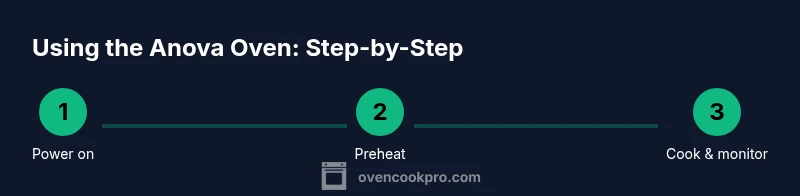
- 1
Power on and verify readiness
Plug in the oven and confirm the display lights up. If your model supports smart features, ensure it connects to power and, if desired, your Wi‑Fi network for remote monitoring. Check for any error codes and confirm that the interior cavity is clean before starting.
Tip: Use a dry, stable surface and verify you have a clear path to the outlet to avoid tripping a circuit. - 2
Preheat to the target temperature
Set the oven to the cooking temperature required for your dish and wait until the preheat indicator signals readiness. This step helps ensure even thermal distribution as the food starts cooking. If you’re testing a new recipe, allow a few extra minutes for the oven to reach temperature.
Tip: Avoid opening the door during preheating to prevent heat loss and uneven results. - 3
Position food and select mode
Place the rack and pan in the center of the cavity, leaving space around items for air flow. Choose the appropriate mode (e.g., bake, roast, or convection) based on your dish’s needs. For best browning, avoid crowding the tray.
Tip: For consistent results, arrange items in a single layer and rotate halfway through if cooking multiple pieces. - 4
Set time and monitor progress
Input the cooking time and observe the oven’s indicators. If your model supports a probe, insert it into the thickest part of the food and monitor internal temperature as it cooks. Make note of any alarms or alerts during the process.
Tip: If the oven offers a live temperature readout, use it to catch early signs of over- or undercooking. - 5
Check temperature and adjust if needed
Near the end of cooking, verify that the target internal temperature is reached. If the dish needs more browning, switch to a higher heat or finish with a brief broil in short bursts. Remove from the oven promptly once done.
Tip: Trust the internal thermometer over visual cues for safer, more precise results. - 6
Rest, plate, and assess results
Let the food rest briefly to redistribute juices and settle flavors. Plate it and take notes on texture, moisture, and color to inform future experiments. Clean up utensils and wipe the oven interior after it cools.
Tip: Record temperatures, times, and outcomes to build a personal reference for future recipes.
Questions & Answers
What can I cook in the Anova Oven?
The Anova Oven supports a wide range of dishes, including vegetables, poultry, seafood, and baked goods. With precise temperature control and modes for roasting and baking, you can achieve consistent textures from crispy edges to tender interiors. Start with simple proteins and gradually expand to more complex recipes.
You can use it for vegetables, chicken, fish, and baked items with precise control for consistent results.
Is the Anova Oven a convection oven?
Yes. The oven uses a built-in convection system to circulate hot air, promoting even cooking and browning without needing as much manual turning as some traditional ovens.
Yes, it uses convection to cook evenly and brown foods nicely.
Do I need a thermometer with the Anova Oven?
A built-in probe is often available on higher-end models, providing real-time temperature readings. An external thermometer can be used for additional verification when cooking new or delicate dishes.
The built-in probe is helpful, and you can add an external thermometer if you want extra precision.
How do I preheat correctly?
Turn on the oven, set the desired temperature, and wait for the preheat indicator to confirm readiness. Avoid opening the door during this phase to prevent heat loss and maintain even cooking.
Preheat until the oven shows it’s ready, and don’t open the door while it’s heating up.
How do I clean the Anova Oven safely?
Unplug the unit and let it cool before cleaning. Wipe the interior with a damp cloth, and remove and wash any racks or trays with mild soap. Avoid harsh abrasives that can damage coatings.
Let it cool, wipe with a damp cloth, and wash racks with mild soap.
What safety precautions should I follow?
Keep flammable items away from the oven, use heat-resistant gloves, and never leave the appliance unattended while in operation. Regularly inspect power cords and vents for signs of wear.
Keep flammables away, wear gloves, and never leave it unattended while in use.
Watch Video
Main Points
- Preheat accurately to avoid undercooked centers
- Use probes for precise doneness
- Avoid overcrowding to ensure even browning
- Document results to refine your technique
- Regularly clean and inspect the oven for safety